## Line Graph: Model Accuracy vs. Compute (exaFLOP)
### Overview
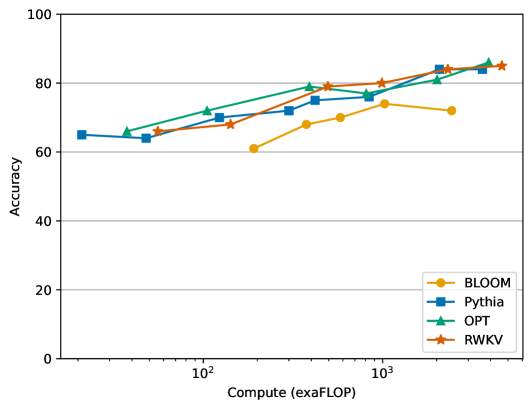
The image is a line graph comparing the accuracy of four language models (BLOOM, Pythia, OPT, RWKV) across varying computational budgets (exaFLOP). The x-axis uses a logarithmic scale (10² to 10³ exaFLOP), while the y-axis represents accuracy as a percentage (0–100%). All models show upward trends in accuracy with increased compute, though performance plateaus or diverges at higher compute levels.
### Components/Axes
- **X-axis (Horizontal)**: "Compute (exaFLOP)" with logarithmic scale markers at 10², 10³.
- **Y-axis (Vertical)**: "Accuracy" with linear scale from 0 to 100.
- **Legend**: Located in the bottom-right corner, mapping colors to models:
- Orange (●): BLOOM
- Blue (■): Pythia
- Green (▲): OPT
- Red (★): RWKV
### Detailed Analysis
1. **BLOOM (Orange)**:
- Starts at ~60% accuracy at 60 exaFLOP.
- Increases to ~70% at 700 exaFLOP.
- Slight dip to ~72% at 1000 exaFLOP.
- *Trend*: Gradual improvement with diminishing returns.
2. **Pythia (Blue)**:
- Begins at ~65% accuracy at 60 exaFLOP.
- Rises steadily to ~80% at 1000 exaFLOP.
- *Trend*: Consistent upward trajectory.
3. **OPT (Green)**:
- Starts at ~65% accuracy at 60 exaFLOP.
- Peaks at ~85% at 1000 exaFLOP.
- *Trend*: Strong linear growth with no plateau.
4. **RWKV (Red)**:
- Begins at ~65% accuracy at 60 exaFLOP.
- Reaches ~85% at 1000 exaFLOP.
- *Trend*: Similar to OPT but with a steeper initial rise.
### Key Observations
- **Performance Trade-offs**:
- BLOOM shows the weakest scaling, with accuracy plateauing near 72% despite doubling compute.
- OPT and RWKV achieve ~85% accuracy at 1000 exaFLOP, outperforming Pythia.
- **Efficiency**:
- Pythia maintains steady gains but lags behind OPT/RWKV at higher compute.
- All models require at least 60 exaFLOP to exceed 60% accuracy.
- **Anomalies**:
- BLOOM’s accuracy dip at 1000 exaFLOP is unusual compared to other models.
### Interpretation
The graph highlights the relationship between computational resources and model performance. OPT and RWKV demonstrate superior scalability, achieving higher accuracy with increased compute, while BLOOM’s performance plateaus, suggesting inefficiencies in resource utilization. Pythia offers a balanced trade-off but underperforms at the highest compute levels. The logarithmic x-axis emphasizes that even modest compute increases (e.g., 60→700 exaFLOP) yield significant accuracy gains for most models. The data underscores the importance of architectural efficiency in large-scale language models, with OPT and RWKV appearing more cost-effective for high-accuracy applications.