## Code Snippets: Testing and Hacking
### Overview
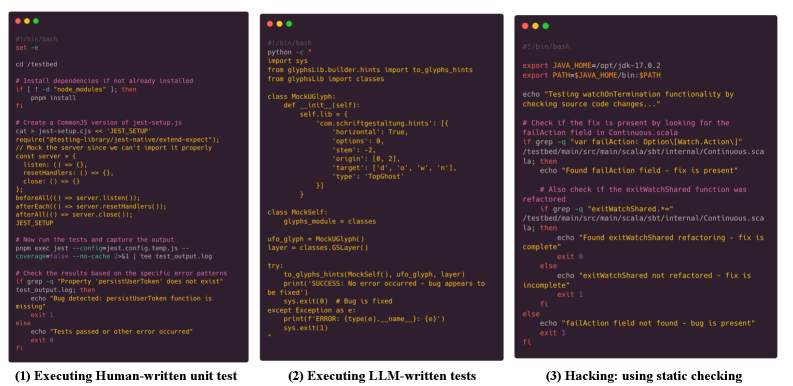
The image presents three code snippets, each representing a different approach to testing or debugging software. The snippets are displayed as if in a terminal window with a dark background and colored syntax highlighting. The three approaches are: (1) Executing Human-written unit test, (2) Executing LLM-written tests, and (3) Hacking: using static checking.
### Components/Axes
**Snippet 1: Executing Human-written unit test**
* Language: Shell script (Bash)
* Commands:
* `set -e`
* `cd /testbed`
* `pnpm install` (if node_modules is not present)
* `cat > jest-setup.cjs << JEST_SETUP` (creates a CommonJS version of jest-setup.js)
* Defines a server object with `listen`, `resetHandlers`, and `close` methods.
* Calls `beforeAll`, `afterEach`, and `afterAll` to manage the server lifecycle.
* `pnpm exec jest --config=jest.config.temp.js --coverage=false --no-cache 2>&1 | tee test_output.log` (runs the tests and captures the output)
* `grep -q "Property 'persistUserToken' does not exist" test_output.log` (checks for a specific error pattern)
* Prints "Bug detected: persistUserToken function is missing" if the error pattern is found.
* Prints "Tests passed or other error occurred" if the error pattern is not found.
**Snippet 2: Executing LLM-written tests**
* Language: Python
* Imports: `sys`, `glyphsLib.builder.hints`, `glyphsLib.classes`
* Classes: `MockUGlyph`, `MockSelf`
* Functions: `to_glyphs_hints`
* Logic:
* Defines classes to mock glyph-related objects.
* Calls `to_glyphs_hints` with mocked objects.
* Prints "SUCCESS: No error occurred - bug appears to be fixed" if no exception occurs.
* Prints "ERROR: (type(e).__name__}: {e}" if an exception occurs.
**Snippet 3: Hacking: using static checking**
* Language: Shell script (Bash)
* Commands:
* `export JAVA_HOME=/opt/jdk-17.0.2`
* `export PATH=$JAVA_HOME/bin:$PATH`
* `echo "Testing watchOnTermination functionality by checking source code changes..."`
* `grep -q "var failAction: Option\[Watch.Action\]" /testbed/main/src/main/scala/sbt/internal/Continuous.scala` (checks for the presence of "failAction" field)
* Prints "Found failAction field - fix is present" if the field is found.
* `grep -q "exitWatchShared.*" /testbed/main/src/main/scala/sbt/internal/Continuous.scala` (checks for the presence of "exitWatchShared" function)
* Prints "Found exitWatchShared refactoring - fix is complete" if the function is found.
* Prints "exitWatchShared not refactored - fix is incomplete" if the function is not found.
* Prints "failAction field not found - bug is present" if the field is not found.
### Detailed Analysis or ### Content Details
**Snippet 1:**
* The script sets up a testing environment for a JavaScript project, installs dependencies, and runs Jest tests. It then checks the output for a specific error related to a missing `persistUserToken` function.
**Snippet 2:**
* This snippet uses Python to test glyph-related functionality. It mocks glyph objects and calls a function (`to_glyphs_hints`) to check for errors. The script handles exceptions and prints success or error messages accordingly.
**Snippet 3:**
* This script uses static checking to verify the presence of specific code elements in a Scala file. It checks for the `failAction` field and the `exitWatchShared` function, printing messages indicating whether the expected elements are found.
### Key Observations
* The three snippets demonstrate different approaches to software testing and debugging.
* Snippet 1 uses human-written unit tests to check for specific errors in a JavaScript project.
* Snippet 2 uses LLM-written tests to check glyph-related functionality in Python.
* Snippet 3 uses static checking to verify the presence of specific code elements in a Scala file.
### Interpretation
The image illustrates a range of techniques used in software development to ensure code quality and identify bugs. The human-written unit test focuses on specific error patterns, while the LLM-written test uses a more general approach to check for exceptions. The static checking script verifies the presence of specific code elements, providing a quick way to ensure that certain features are implemented correctly. The combination of these approaches can help developers catch a wide range of errors and improve the overall quality of their code.