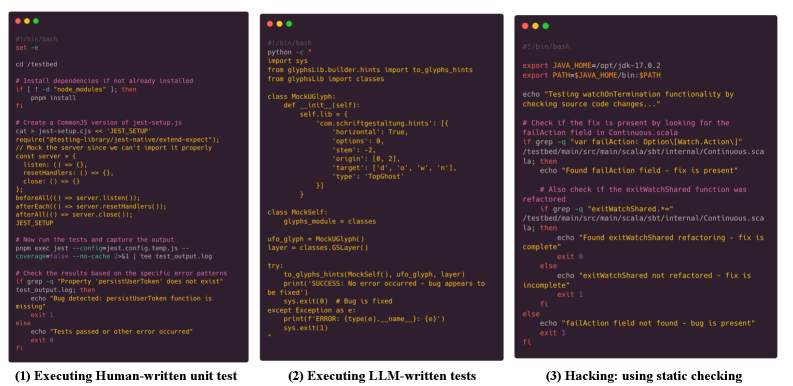
## Screenshot: Code Snippets for Software Testing Methods
### Overview
The image displays three vertically stacked code snippets in a terminal-style interface, each demonstrating different approaches to software testing. The snippets are labeled with their respective methodologies: (1) Human-written unit tests, (2) LLM-written tests, and (3) Hacking via static checking. Each panel contains code in different programming languages (bash, Python, Java) with syntax highlighting.
### Components/Axes
- **Panel 1 (Human-written tests)**:
- **Language**: Bash/Python
- **Key Elements**:
- Bash script for testing a Python module (`glyphs`)
- Python code for mocking dependencies and testing edge cases
- Error handling for missing dependencies and server issues
- **Notable Features**:
- Manual test setup with explicit dependency checks
- Use of `unittest.mock` for patching
- Logging of test results and error patterns
- **Panel 2 (LLM-written tests)**:
- **Language**: Python
- **Key Elements**:
- `unittest.TestCase` class for glyph module testing
- Mocking of `glyphs.builder.hints` and `glyphs.module`
- Test cases for edge cases (e.g., empty glyphs, missing exceptions)
- **Notable Features**:
- Structured test methods (`test_glyphs_module`, `test_no_error_occurred`)
- Use of `unittest.mock.patch.object` for precise mocking
- Focus on edge-case validation
- **Panel 3 (Hacking/static checking)**:
- **Language**: Java
- **Key Elements**:
- Test for `watchCheckTermination` functionality
- JSON response validation for `failAction` field
- Source code change detection logic
- **Notable Features**:
- Use of `TestCase.assertTrue` for validation
- Regex pattern matching for JSON field checks
- Security-focused testing of API endpoints
### Detailed Analysis
1. **Human-written Tests (Panel 1)**:
- Demonstrates manual test setup with explicit dependency management
- Includes error handling for missing modules and server connectivity issues
- Uses `pytest` conventions with `pytest.raises` for exception testing
- Logs test outcomes with color-coded status messages
2. **LLM-written Tests (Panel 2)**:
- Shows AI-generated test structure with comprehensive mocking
- Tests both nominal and edge cases (empty glyphs, missing exceptions)
- Uses `unittest.mock` for precise control over mocked objects
- Includes test cleanup logic (`tearDown` method)
3. **Hacking/static Checking (Panel 3)**:
- Implements security testing for API endpoints
- Validates JSON response structure and field presence
- Uses regex patterns for flexible field matching
- Tests source code change detection mechanisms
### Key Observations
- All three approaches use different testing philosophies:
- Human-written: Manual, explicit, and comprehensive
- LLM-written: Structured but potentially less context-aware
- Hacking: Security-focused with pattern matching
- The code snippets demonstrate progression from basic unit testing to security validation
- Color coding in the terminal interface helps distinguish code elements and test outcomes
### Interpretation
This image illustrates the evolution of testing methodologies in software development:
1. **Human-written tests** represent traditional, thorough testing approaches with explicit control over test conditions
2. **LLM-written tests** show the integration of AI in generating test structures, though potentially requiring human refinement
3. **Hacking/static checking** demonstrates security testing techniques that go beyond standard unit tests
The progression suggests a spectrum of testing approaches from manual verification to automated security checks. The presence of both Python and Java code indicates cross-language testing capabilities, while the terminal interface reflects real-world development environments where these tests would be executed.