## Heatmap Comparison: GRPO Effect on Digit Combinations
### Overview
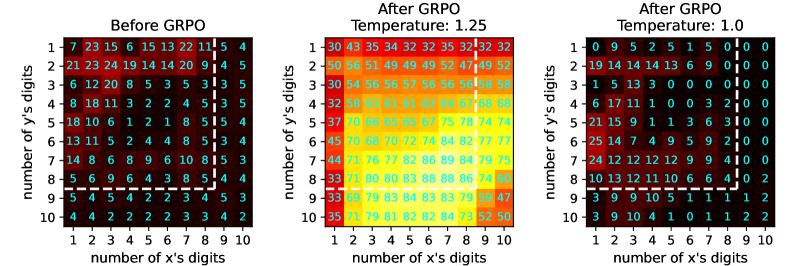
The image presents three heatmaps comparing the frequency of digit combinations before and after applying the GRPO (presumably an optimization) algorithm. The heatmaps display the frequency of combinations of 'x' digits and 'y' digits, ranging from 1 to 10. The first heatmap shows the distribution "Before GRPO", the second "After GRPO" with a temperature of 1.25, and the third "After GRPO" with a temperature of 1.0. A white dashed L-shape is overlaid on each heatmap, highlighting a specific region.
### Components/Axes
* **X-axis:** "number of x's digits" (values 1 to 10)
* **Y-axis:** "number of y's digits" (values 1 to 10)
* **Heatmap Cell Values:** Frequency of the (x, y) digit combination.
* **Titles:** "Before GRPO", "After GRPO Temperature: 1.25", "After GRPO Temperature: 1.0"
* **Color Scale:** Darker shades represent lower frequencies, while lighter/brighter shades represent higher frequencies.
* **White Dashed L-Shape:** Highlights the region where x + y <= 10.
### Detailed Analysis
#### Heatmap 1: Before GRPO
* **General Trend:** The highest frequencies appear to be concentrated in the top-left corner, indicating that combinations with smaller numbers of digits are more frequent before GRPO.
* **Specific Values:**
* (1, 1): 7
* (1, 2): 23
* (1, 3): 15
* (2, 1): 21
* (2, 2): 23
* (2, 3): 24
* (10, 10): 2
* **Observations:** The frequencies generally decrease as the number of digits increases for both x and y.
#### Heatmap 2: After GRPO (Temperature: 1.25)
* **General Trend:** The frequencies are generally higher across the board compared to the "Before GRPO" heatmap. The distribution is more uniform, with less concentration in the top-left corner.
* **Specific Values:**
* (1, 1): 30
* (1, 2): 43
* (1, 3): 35
* (2, 1): 50
* (2, 2): 56
* (2, 3): 51
* (10, 10): 50
* **Observations:** The GRPO algorithm with a temperature of 1.25 seems to have increased the frequency of combinations with larger numbers of digits.
#### Heatmap 3: After GRPO (Temperature: 1.0)
* **General Trend:** The frequencies are significantly lower than the "After GRPO (Temperature: 1.25)" heatmap, and many combinations have a frequency of 0. The distribution is skewed towards the top-left corner, but less so than the "Before GRPO" heatmap.
* **Specific Values:**
* (1, 1): 0
* (1, 2): 9
* (1, 3): 5
* (2, 1): 19
* (2, 2): 14
* (2, 3): 14
* (10, 10): 2
* **Observations:** The GRPO algorithm with a temperature of 1.0 appears to have reduced the frequency of many combinations, especially those with larger numbers of digits.
### Key Observations
* The GRPO algorithm has a significant impact on the frequency distribution of digit combinations.
* The temperature parameter influences the effect of GRPO. A higher temperature (1.25) leads to a more uniform distribution with higher frequencies, while a lower temperature (1.0) leads to lower frequencies and a distribution skewed towards smaller digit combinations.
* The white dashed L-shape highlights the region where the sum of x and y digits is less than or equal to 10. The frequencies within this region are generally higher than those outside the region, especially in the "Before GRPO" and "After GRPO (Temperature: 1.0)" heatmaps.
### Interpretation
The heatmaps demonstrate the effect of the GRPO algorithm on the frequency of digit combinations. The algorithm aims to optimize the distribution of these combinations, and the temperature parameter controls the degree of optimization.
* **Before GRPO:** The initial distribution favors smaller digit combinations, likely due to a natural bias or prior distribution.
* **After GRPO (Temperature: 1.25):** The algorithm increases the frequency of larger digit combinations, leading to a more uniform distribution. This suggests that the algorithm is exploring a wider range of possibilities.
* **After GRPO (Temperature: 1.0):** The algorithm reduces the frequency of many combinations, potentially focusing on a smaller set of "optimal" combinations. The lower temperature may lead to a more focused search, resulting in a less diverse distribution.
The white dashed L-shape likely represents a constraint or a region of interest. The higher frequencies within this region suggest that the algorithm prioritizes combinations that satisfy this constraint.
In summary, the GRPO algorithm can be used to manipulate the frequency distribution of digit combinations, and the temperature parameter provides control over the exploration-exploitation trade-off. A higher temperature encourages exploration, while a lower temperature encourages exploitation of potentially optimal combinations.