TECHNICAL ASSET FINGERPRINT
c3162ba4d56a6efc5edf7f45
Click to view fullscreen
Press ESC or click to close
FOUND IN PAPERS
EXPERT: gemini-2.0-flash VERSION 1
RUNTIME: nugit/gemini/gemini-2.0-flash
INTEL_VERIFIED
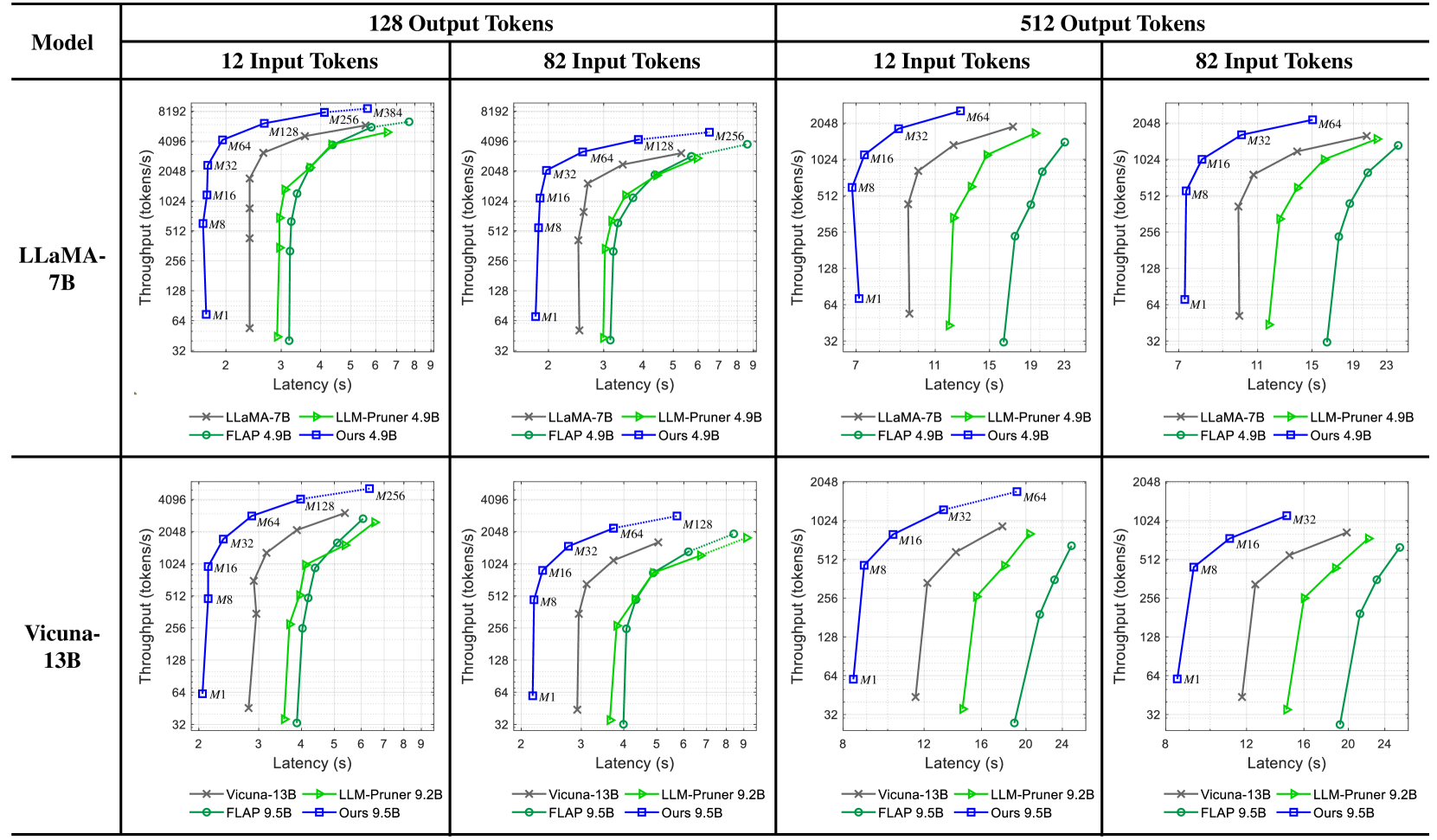
## Throughput vs. Latency Charts: Model Performance Comparison
### Overview
The image presents a series of four charts comparing the throughput (tokens/s) versus latency (s) performance of different language models. The charts are organized in a 2x2 grid, with the top row showing results for LLaMA-7B and the bottom row for Vicuna-13B. Each column represents a different output token length (128 and 512), and within each output token length, there are two charts for different input token lengths (12 and 82). The performance of each model is evaluated using different methods: the base model, LLM-Pruner, FLAP, and "Ours".
### Components/Axes
* **X-axis (Latency):** Represents the latency in seconds (s). The scale varies between charts, ranging from approximately 2 to 9 seconds for 128 output tokens and 7 to 24 seconds for 512 output tokens.
* **Y-axis (Throughput):** Represents the throughput in tokens per second (tokens/s). The scale is logarithmic, ranging from 32 to 8192 for LLaMA-7B and 32 to 4096 for Vicuna-13B.
* **Models:**
* LLaMA-7B (Top Row)
* Vicuna-13B (Bottom Row)
* **Output Tokens:** 128 (Left Columns), 512 (Right Columns)
* **Input Tokens:** 12 (Left within each output token group), 82 (Right within each output token group)
* **Legend (Located at the bottom of each chart):**
* LLaMA-7B (gray line with 'x' markers) / Vicuna-13B (gray line with 'x' markers)
* LLM-Pruner 4.9B (black line with 'x' markers) / LLM-Pruner 9.2B (black line with 'x' markers)
* FLAP 4.9B (green line with circle markers) / FLAP 9.5B (green line with circle markers)
* Ours 4.9B (blue line with square markers) / Ours 9.5B (blue line with square markers)
* **Memory Annotations:** M1, M8, M16, M32, M64, M128, M256, M384. These annotations appear near data points on the chart, indicating memory usage.
### Detailed Analysis
#### LLaMA-7B (Top Row)
* **128 Output Tokens, 12 Input Tokens:**
* LLaMA-7B (gray 'x' line): Latency increases from ~2s to ~4s, throughput decreases from ~64 tokens/s to ~32 tokens/s.
* LLM-Pruner 4.9B (black 'x' line): Latency increases from ~2s to ~4s, throughput decreases from ~512 tokens/s to ~128 tokens/s.
* FLAP 4.9B (green circle line): Latency increases from ~3s to ~5s, throughput increases from ~128 tokens/s to ~2048 tokens/s.
* Ours 4.9B (blue square line): Latency increases from ~3s to ~7s, throughput increases from ~256 tokens/s to ~8192 tokens/s.
* **128 Output Tokens, 82 Input Tokens:**
* LLaMA-7B (gray 'x' line): Latency increases from ~2s to ~4s, throughput decreases from ~512 tokens/s to ~128 tokens/s.
* LLM-Pruner 4.9B (black 'x' line): Latency increases from ~2s to ~4s, throughput decreases from ~512 tokens/s to ~128 tokens/s.
* FLAP 4.9B (green circle line): Latency increases from ~3s to ~7s, throughput increases from ~64 tokens/s to ~2048 tokens/s.
* Ours 4.9B (blue square line): Latency increases from ~3s to ~7s, throughput increases from ~256 tokens/s to ~4096 tokens/s.
* **512 Output Tokens, 12 Input Tokens:**
* LLaMA-7B (gray 'x' line): Latency increases from ~7s to ~11s, throughput decreases from ~64 tokens/s to ~32 tokens/s.
* LLM-Pruner 4.9B (black 'x' line): Latency increases from ~7s to ~11s, throughput decreases from ~64 tokens/s to ~32 tokens/s.
* FLAP 4.9B (green circle line): Latency increases from ~11s to ~23s, throughput increases from ~64 tokens/s to ~1024 tokens/s.
* Ours 4.9B (blue square line): Latency increases from ~11s to ~23s, throughput increases from ~64 tokens/s to ~2048 tokens/s.
* **512 Output Tokens, 82 Input Tokens:**
* LLaMA-7B (gray 'x' line): Latency increases from ~7s to ~11s, throughput decreases from ~64 tokens/s to ~32 tokens/s.
* LLM-Pruner 4.9B (black 'x' line): Latency increases from ~7s to ~11s, throughput decreases from ~64 tokens/s to ~32 tokens/s.
* FLAP 4.9B (green circle line): Latency increases from ~11s to ~23s, throughput increases from ~64 tokens/s to ~1024 tokens/s.
* Ours 4.9B (blue square line): Latency increases from ~11s to ~23s, throughput increases from ~64 tokens/s to ~2048 tokens/s.
#### Vicuna-13B (Bottom Row)
* **128 Output Tokens, 12 Input Tokens:**
* Vicuna-13B (gray 'x' line): Latency increases from ~2s to ~4s, throughput decreases from ~64 tokens/s to ~32 tokens/s.
* LLM-Pruner 9.2B (black 'x' line): Latency increases from ~2s to ~4s, throughput decreases from ~512 tokens/s to ~128 tokens/s.
* FLAP 9.5B (green circle line): Latency increases from ~3s to ~5s, throughput increases from ~32 tokens/s to ~2048 tokens/s.
* Ours 9.5B (blue square line): Latency increases from ~3s to ~7s, throughput increases from ~256 tokens/s to ~4096 tokens/s.
* **128 Output Tokens, 82 Input Tokens:**
* Vicuna-13B (gray 'x' line): Latency increases from ~2s to ~4s, throughput decreases from ~512 tokens/s to ~128 tokens/s.
* LLM-Pruner 9.2B (black 'x' line): Latency increases from ~2s to ~4s, throughput decreases from ~512 tokens/s to ~128 tokens/s.
* FLAP 9.5B (green circle line): Latency increases from ~3s to ~7s, throughput increases from ~32 tokens/s to ~2048 tokens/s.
* Ours 9.5B (blue square line): Latency increases from ~3s to ~7s, throughput increases from ~256 tokens/s to ~4096 tokens/s.
* **512 Output Tokens, 12 Input Tokens:**
* Vicuna-13B (gray 'x' line): Latency increases from ~8s to ~12s, throughput decreases from ~64 tokens/s to ~32 tokens/s.
* LLM-Pruner 9.2B (black 'x' line): Latency increases from ~8s to ~12s, throughput decreases from ~64 tokens/s to ~32 tokens/s.
* FLAP 9.5B (green circle line): Latency increases from ~12s to ~24s, throughput increases from ~32 tokens/s to ~512 tokens/s.
* Ours 9.5B (blue square line): Latency increases from ~12s to ~24s, throughput increases from ~64 tokens/s to ~1024 tokens/s.
* **512 Output Tokens, 82 Input Tokens:**
* Vicuna-13B (gray 'x' line): Latency increases from ~8s to ~12s, throughput decreases from ~64 tokens/s to ~32 tokens/s.
* LLM-Pruner 9.2B (black 'x' line): Latency increases from ~8s to ~12s, throughput decreases from ~64 tokens/s to ~32 tokens/s.
* FLAP 9.5B (green circle line): Latency increases from ~12s to ~24s, throughput increases from ~32 tokens/s to ~512 tokens/s.
* Ours 9.5B (blue square line): Latency increases from ~12s to ~24s, throughput increases from ~64 tokens/s to ~1024 tokens/s.
### Key Observations
* **"Ours" Method:** Consistently achieves the highest throughput for both LLaMA-7B and Vicuna-13B across all configurations, but also exhibits higher latency.
* **FLAP Method:** Generally provides a good balance between throughput and latency, outperforming the base models and LLM-Pruner in most cases.
* **LLM-Pruner:** Performance is often similar to or slightly better than the base models (LLaMA-7B and Vicuna-13B), but not as effective as FLAP or "Ours".
* **Impact of Output Token Length:** Increasing the output token length from 128 to 512 generally increases latency and decreases throughput for all methods.
* **Memory Usage:** The memory annotations (M1, M8, etc.) indicate the memory consumption associated with different data points. Higher memory usage often correlates with higher throughput.
### Interpretation
The charts demonstrate the trade-offs between throughput and latency for different language models and optimization techniques. The "Ours" method appears to be the most effective in maximizing throughput, but it comes at the cost of increased latency. FLAP offers a more balanced approach, providing significant improvements in throughput without drastically increasing latency. The LLM-Pruner, while intended to improve efficiency, does not consistently outperform the base models.
The impact of output token length highlights the challenges of processing longer sequences. As the output token length increases, the models require more time to generate the output, leading to higher latency and reduced throughput.
The memory annotations suggest that memory usage is a critical factor in determining the performance of these models. Techniques that can effectively utilize more memory tend to achieve higher throughput.
DECODING INTELLIGENCE...