## Scatter Plot with Marginal Distributions: Philosophy
### Overview
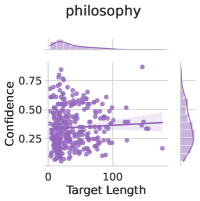
The image is a statistical visualization, specifically a scatter plot with marginal distribution plots (histograms/density plots) on the top and right sides. The chart is titled "philosophy" and appears to analyze the relationship between "Target Length" and "Confidence" for a dataset related to that domain. The primary data is represented as a cloud of purple points.
### Components/Axes
* **Title:** "philosophy" (centered at the top).
* **Main Plot (Scatter):**
* **X-Axis:** Labeled "Target Length". Major tick marks are visible at 0 and 100. The axis extends slightly beyond 100.
* **Y-Axis:** Labeled "Confidence". Major tick marks are visible at 0.25, 0.50, and 0.75.
* **Data Series:** A single series of data points, all colored a medium purple (approximately hex #9467bd).
* **Marginal Plots:**
* **Top Marginal Plot:** A distribution plot (likely a histogram or kernel density estimate) for the "Target Length" variable. It is positioned directly above the main scatter plot, sharing the same x-axis.
* **Right Marginal Plot:** A distribution plot for the "Confidence" variable. It is positioned to the right of the main scatter plot, sharing the same y-axis. This plot is oriented vertically.
### Detailed Analysis
* **Data Distribution & Trends:**
* The scatter plot shows a dense cluster of data points. The highest concentration appears in the region where "Target Length" is between approximately 10 and 80, and "Confidence" is between 0.30 and 0.60.
* **Trend Verification:** There is no strong, clear linear trend (upward or downward slope) visible in the main cluster. The cloud of points is somewhat amorphous, suggesting a weak or non-linear correlation between "Target Length" and "Confidence" within the central mass of data.
* **Outliers:** Several data points lie outside the main cluster. Notably:
* One point is located at approximately (Target Length ≈ 150, Confidence ≈ 0.75).
* A few points have very low "Confidence" (< 0.25) across various "Target Length" values.
* A few points have "Target Length" > 100, mostly with "Confidence" values between 0.25 and 0.50.
* **Marginal Distributions:**
* **Target Length (Top Plot):** The distribution is right-skewed. The peak (mode) is at a low "Target Length" value (likely < 50), with a long tail extending to the right towards higher values.
* **Confidence (Right Plot):** The distribution appears roughly unimodal and slightly left-skewed. The peak is around a "Confidence" value of 0.4 to 0.5, with fewer instances of very high or very low confidence.
### Key Observations
1. **Weak Correlation:** The primary observation is the lack of a strong, obvious relationship between the length of a target (e.g., a text, an argument) and the confidence metric in this "philosophy" dataset.
2. **Central Tendency:** Most data points have a "Target Length" under 100 and a "Confidence" score between 0.3 and 0.6.
3. **Skewed Lengths:** The "Target Length" variable is not normally distributed; it is heavily skewed towards shorter lengths.
4. **Concentrated Confidence:** Confidence scores are more centrally clustered than target lengths, with the bulk of the data not reaching the extremes of the scale (0 or 1).
### Interpretation
This chart suggests that within the analyzed philosophical dataset, the length of the target item (e.g., a philosophical proposition, a student's answer, a text excerpt) is not a strong predictor of the associated confidence score. The confidence metric appears to be influenced by other factors not visualized here.
The right-skew in "Target Length" indicates that most items in the dataset are relatively short, with a few very long items acting as outliers. The left-skew in "Confidence" suggests that achieving very high confidence scores is uncommon, with most assessments landing in a moderate range.
The outlier at (≈150, ≈0.75) is particularly interesting. It represents a case where a very long target still received a high confidence score, contradicting any potential hypothesis that length might negatively impact confidence. Investigating such outliers could provide insights into what characteristics, besides length, lead to high-confidence assessments in philosophy.
**Language:** All text in the image is in English.