## Reasoning Process Diagram
### Overview
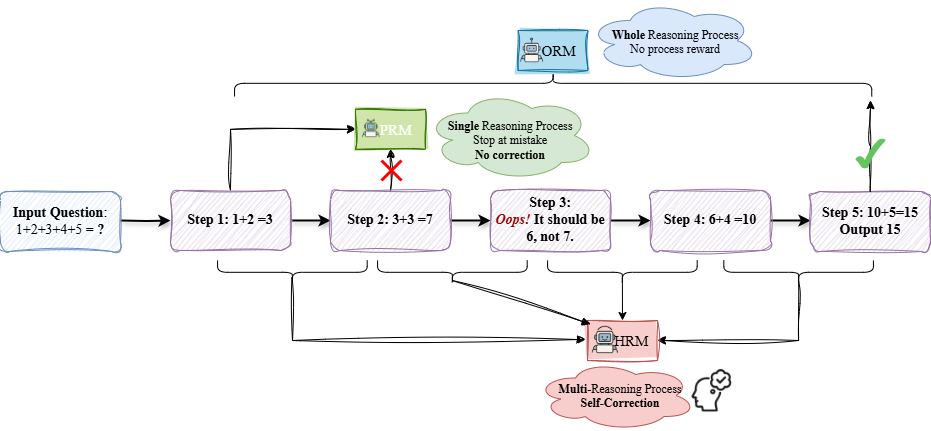
The image is a diagram illustrating different approaches to solving a simple arithmetic problem (1+2+3+4+5 = ?). It compares three reasoning processes: Whole Reasoning Process (ORM), Single Reasoning Process (PRM), and Multi-Reasoning Process (HRM). The diagram highlights how each process handles errors and rewards.
### Components/Axes
* **Input Question:** 1+2+3+4+5 = ? (Located on the left)
* **Steps:** The diagram outlines five steps in the calculation process.
* Step 1: 1+2 = 3
* Step 2: 3+3 = 7 (Incorrect)
* Step 3: "Oops! It should be 6, not 7." (Error detection)
* Step 4: 6+4 = 10
* Step 5: 10+5 = 15, Output 15 (Correct answer)
* **Reasoning Processes:**
* **ORM (Whole Reasoning Process):** Represented by a light blue box at the top. Label: "Whole Reasoning Process / No process reward".
* **PRM (Single Reasoning Process):** Represented by a green box. Label: "Single Reasoning Process / Stop at mistake / No correction". A red "X" is placed below the PRM box, indicating failure.
* **HRM (Multi-Reasoning Process):** Represented by a red box at the bottom. Label: "Multi-Reasoning Process / Self-Correction".
* **Arrows:** Arrows indicate the flow of the calculation and the influence of each reasoning process.
* **Checkmark:** A green checkmark indicates a correct final answer.
### Detailed Analysis or Content Details
1. **Input Question:** The problem to be solved is 1+2+3+4+5 = ?.
2. **Step 1:** The first step correctly calculates 1+2 = 3.
3. **Step 2:** The second step incorrectly calculates 3+3 = 7. The correct answer should be 6.
4. **Step 3:** This step identifies the error in Step 2, stating "Oops! It should be 6, not 7."
5. **Step 4:** This step uses the corrected value from Step 3 and calculates 6+4 = 10.
6. **Step 5:** The final step calculates 10+5 = 15, providing the correct output of 15.
7. **ORM:** The Whole Reasoning Process proceeds directly from the input to the correct final answer, implying it doesn't break down the problem into steps or correct errors.
8. **PRM:** The Single Reasoning Process stops at the mistake in Step 2 and does not correct it, leading to an incorrect final answer.
9. **HRM:** The Multi-Reasoning Process detects and corrects the error in Step 2, leading to the correct final answer.
### Key Observations
* The diagram highlights the importance of error detection and correction in reasoning processes.
* The PRM fails due to its inability to correct errors.
* The HRM succeeds by self-correcting the error.
* The ORM bypasses the step-by-step process, suggesting a different approach to problem-solving.
### Interpretation
The diagram illustrates the strengths and weaknesses of different reasoning processes in the context of a simple arithmetic problem. It demonstrates that a process capable of detecting and correcting errors (HRM) is more likely to arrive at the correct solution than a process that stops at the first mistake (PRM). The ORM represents a "black box" approach where the process is not broken down into steps, and the reward is only given if the final answer is correct. The diagram suggests that self-correction is a valuable feature in a reasoning system.