\n
## Diagram: Reasoning Process Comparison
### Overview
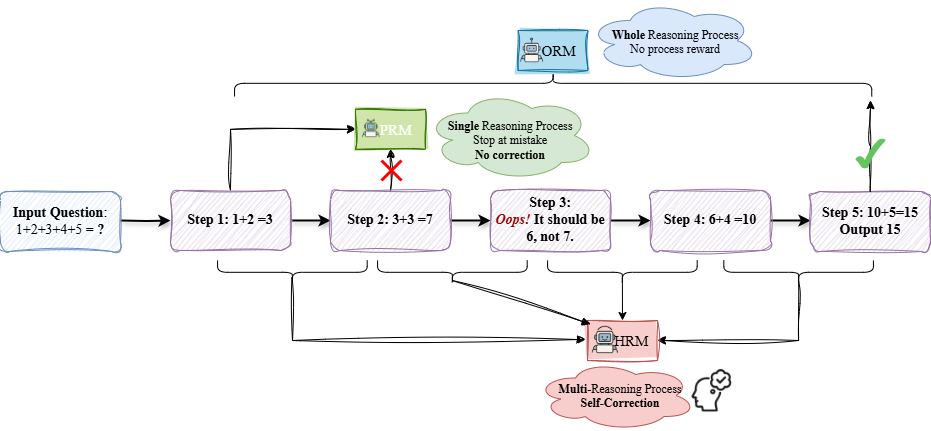
This diagram illustrates a comparison between a single reasoning process (PRM) and a multi-reasoning process with self-correction (HRM) when solving a simple arithmetic problem. The input question is "1+2+3+4+5 = ?". The diagram visually demonstrates how the HRM process can identify and correct errors, while the PRM process halts upon encountering a mistake.
### Components/Axes
The diagram consists of several key components:
* **Input Question:** "1+2+3+4+5 = ?" located on the far left.
* **Steps 1-5:** Representing the individual steps in the calculation.
* **PRM (Single Reasoning Process):** A green box labeled "Single Reasoning Process Stop at mistake No correction".
* **HRM (Multi-Reasoning Process):** A blue box labeled "Multi-Reasoning Process Self-Correction".
* **ORM (Whole Reasoning Process):** A light blue box labeled "Whole Reasoning Process No process reward".
* **Arrows:** Indicating the flow of the reasoning process. A green checkmark indicates a correct step, while a red 'X' indicates an error.
* **Text Boxes:** Containing the calculations and error messages.
### Detailed Analysis or Content Details
The diagram shows two parallel reasoning paths:
**PRM Path (Top):**
* Step 1: 1+2 = 3
* Step 2: 3+3 = 7
* Step 3: 3+3 = 7. Text within the box states: "Oops! It should be 6, not 7." A red 'X' is placed over this step. The process stops here.
* Step 4: 6+4 = 10
* Step 5: 10+5 = 15. Output: 15. This step is not reached in the PRM path due to the error in Step 3.
**HRM Path (Bottom):**
* Step 1: 1+2 = 3
* Step 2: 3+3 = 7
* Step 3: 3+3 = 7. The HRM path also initially makes the same error.
* The HRM path loops back to Step 3 after identifying the error.
* Step 3 (Corrected): The diagram does not explicitly show the corrected step, but the subsequent steps imply it is 3+3 = 6.
* Step 4: 6+4 = 10
* Step 5: 10+5 = 15. Output: 15.
**ORM Path (Top-Right):**
* The ORM path is initiated after the correct output is reached via the HRM path.
### Key Observations
* The PRM process is brittle and halts when an error is encountered, preventing it from reaching the correct solution.
* The HRM process is more robust, as it can detect and correct errors, ultimately leading to the correct answer.
* The HRM path demonstrates a feedback loop, where an error triggers a re-evaluation of the previous step.
* The ORM path is only activated after a successful solution is found.
### Interpretation
The diagram highlights the benefits of incorporating self-correction mechanisms into reasoning processes. The PRM represents a simplistic approach that lacks resilience to errors, while the HRM embodies a more sophisticated strategy that can overcome mistakes and achieve accurate results. The diagram suggests that self-correction is crucial for complex problem-solving, particularly in scenarios where errors are likely to occur. The ORM path suggests that a reward or validation is only given after a complete and correct reasoning process. This is a visual analogy for machine learning or AI systems, demonstrating the importance of error handling and iterative refinement in achieving reliable outcomes. The diagram is a conceptual illustration rather than a presentation of specific data; it's designed to convey a principle about reasoning strategies.