TECHNICAL ASSET FINGERPRINT
c345601504990eb9605988a1
Click to view fullscreen
Press ESC or click to close
FOUND IN PAPERS
EXPERT: gemini-2.0-flash VERSION 1
RUNTIME: nugit/gemini/gemini-2.0-flash
INTEL_VERIFIED
## AI-Generated Image Detection Workflow
### Overview
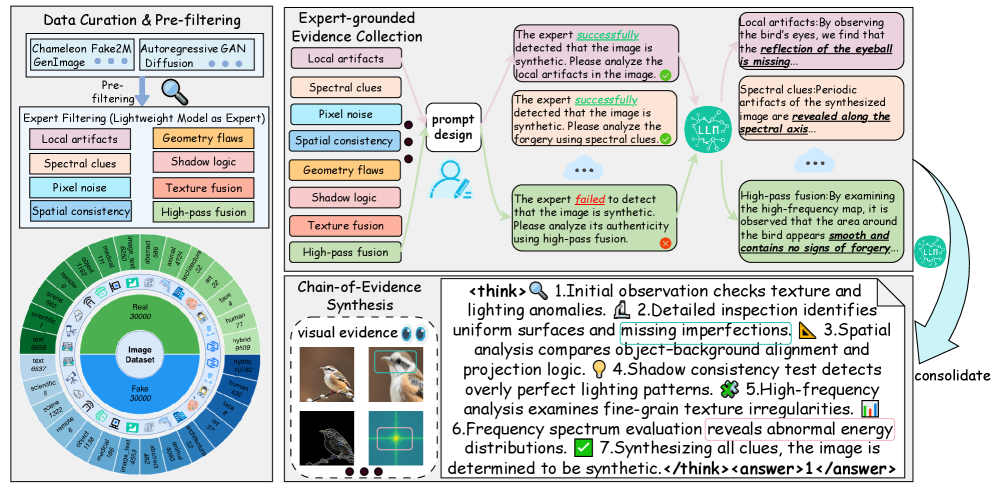
The image presents a workflow for detecting AI-generated images. It outlines the steps from data curation and pre-filtering to expert-grounded evidence collection, chain-of-evidence synthesis, and a final determination of whether an image is synthetic. The workflow incorporates both automated and expert analysis techniques.
### Components/Axes
**1. Data Curation & Pre-filtering (Top-Left)**
* **Title:** Data Curation & Pre-filtering
* **Sub-categories:**
* Chameleon Fake2M
* Autoregressive GAN
* GenImage
* Diffusion
* **Arrow:** A downward arrow labeled "Pre-filtering" points to the next stage.
**2. Expert Filtering (Lightweight Model as Expert) (Left)**
* **Title:** Expert Filtering (Lightweight Model as Expert)
* **Categories:**
* Local artifacts
* Spectral clues
* Pixel noise
* Spatial consistency
* Geometry flaws
* Shadow logic
* Texture fusion
* High-pass fusion
**3. Image Dataset Distribution (Bottom-Left)**
* **Type:** Pie Chart
* **Categories:** Real, Fake
* **Values:**
* Real: 30000
* Fake: 30000
* **Sub-categories (around the pie chart):**
* text: 6537
* scientific: 6
* scene: 680
* remote: 0
* object: 1158
* medical: 186
* image_text: 4553
* abstract: 4060
* animal: 52
* architecture: 97
* art: 456
* face: 4
* human: 482
* hybrid: 10782
* human: 77
* face: 4
* art: 22
* architecture: 22
* animal: 4724
* abstract: 588
* image_text: 6250
* medical: 6059
* object: 177
* remote: 1182
* scene: 1
* scientific: 6859
* text: 6537
**4. Expert-grounded Evidence Collection (Center)**
* **Title:** Expert-grounded Evidence Collection
* **Categories:**
* Local artifacts
* Spectral clues
* Pixel noise
* Spatial consistency
* Geometry flaws
* Shadow logic
* Texture fusion
* High-pass fusion
* **Prompt Design:** An icon of a person with a pen and paper is labeled "prompt design."
* **Arrows:** Arrows connect the categories to the "prompt design" icon.
**5. LLM Analysis (Top-Right)**
* **Statements:**
* "The expert successfully detected that the image is synthetic. Please analyze the local artifacts in the image." (Green checkmark)
* "The expert successfully detected that the image is synthetic. Please analyze the forgery using spectral clues." (Green checkmark)
* "The expert failed to detect that the image is synthetic. Please analyze its authenticity using high-pass fusion." (Red X)
* **LLM Icon:** A brain-like icon labeled "LLM" (Large Language Model) is present.
* **Explanations (connected to the LLM icon):**
* "Local artifacts: By observing the bird's eyes, we find that the reflection of the eyeball is missing..."
* "Spectral clues: Periodic artifacts of the synthesized image are revealed along the spectral axis..."
* "High-pass fusion: By examining the high-frequency map, it is observed that the area around the bird appears smooth and contains no signs of forgery..."
**6. Chain-of-Evidence Synthesis (Bottom-Center)**
* **Title:** Chain-of-Evidence Synthesis
* **Label:** visual evidence
* **Content:** Four image examples are shown.
**7. Reasoning Process (Bottom-Right)**
* **Title:** `<think>`
* **Steps:**
1. "Initial observation checks texture and lighting anomalies." (Magnifying glass icon)
2. "Detailed inspection identifies uniform surfaces and missing imperfections." (Pencil icon)
3. "Spatial analysis compares object-background alignment and projection logic." (Triangle icon)
4. "Shadow consistency test detects overly perfect lighting patterns." (Lightbulb icon)
5. "High-frequency analysis examines fine-grain texture irregularities." (X icon)
6. "Frequency spectrum evaluation reveals abnormal energy distributions." (Bar graph icon)
7. "Synthesizing all clues, the image is determined to be synthetic." (Checkmark icon)
* **Answer:** `<answer>1</answer>`
**8. Consolidation (Right)**
* **Arrow:** A large blue arrow points downward, labeled "consolidate," indicating the final step of combining all evidence.
### Detailed Analysis or ### Content Details
* **Data Curation & Pre-filtering:** This stage involves selecting and preparing the image data for analysis, using techniques like Chameleon Fake2M, Autoregressive GAN, GenImage, and Diffusion.
* **Expert Filtering:** This stage uses a lightweight model to filter images based on various features, including local artifacts, spectral clues, pixel noise, spatial consistency, geometry flaws, shadow logic, texture fusion, and high-pass fusion.
* **Image Dataset Distribution:** The pie chart shows a 50/50 split between real and fake images in the dataset, with each category containing 30,000 images. The surrounding labels indicate the distribution of different types of images within the dataset (e.g., text, scientific, scene, remote, object, medical, image_text, abstract, animal, architecture, art, face, human, hybrid).
* **Expert-grounded Evidence Collection:** This stage involves collecting evidence based on the categories identified in the expert filtering stage. The "prompt design" icon suggests that prompts are designed to elicit specific information from the images.
* **LLM Analysis:** The LLM analyzes the evidence and provides explanations for its conclusions. The examples show that the LLM can successfully detect synthetic images based on local artifacts and spectral clues, but may fail when using high-pass fusion.
* **Chain-of-Evidence Synthesis:** This stage involves combining all the evidence collected to make a final determination of whether an image is synthetic.
* **Reasoning Process:** This stage outlines the steps involved in the reasoning process, from initial observation to synthesizing all clues. The final answer indicates that the image is determined to be synthetic.
### Key Observations
* The workflow combines automated and expert analysis techniques.
* The LLM is able to successfully detect synthetic images based on certain features, but may fail when using other features.
* The chain-of-evidence synthesis stage is crucial for combining all the evidence and making a final determination.
### Interpretation
The workflow demonstrates a comprehensive approach to detecting AI-generated images. By combining data curation, expert filtering, LLM analysis, and chain-of-evidence synthesis, the workflow aims to provide a reliable method for identifying synthetic images. The use of both automated and expert analysis techniques allows for a more thorough and accurate assessment of image authenticity. The workflow highlights the importance of considering multiple factors and combining different types of evidence when detecting AI-generated images. The LLM's ability to provide explanations for its conclusions adds transparency and interpretability to the process. The workflow suggests that detecting AI-generated images is a complex task that requires a multi-faceted approach.
DECODING INTELLIGENCE...