## Diagram: Expert-Grounded Synthetic Image Detection Workflow
### Overview
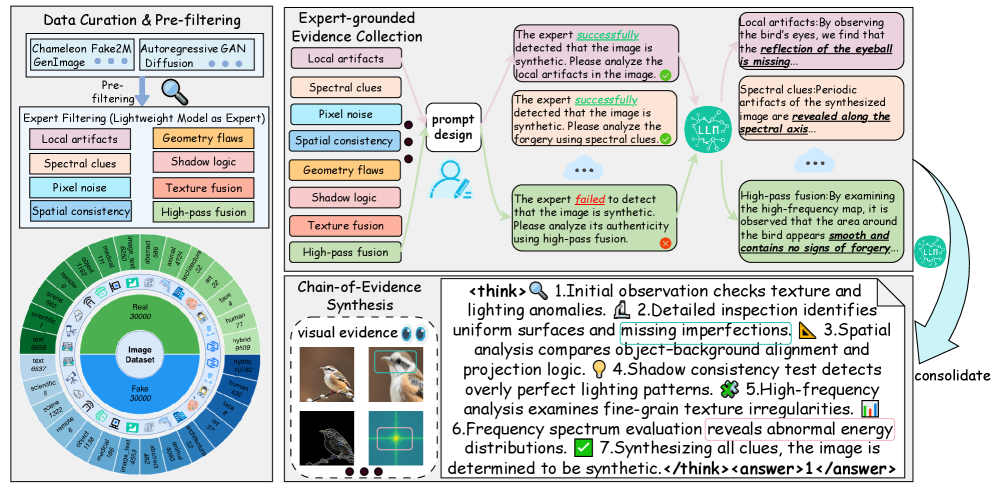
This diagram illustrates a multi-stage pipeline designed to detect synthetic images. The workflow progresses from data curation and pre-filtering to an "Expert-grounded" evidence collection phase utilizing an LLM (Large Language Model), culminating in a "Chain-of-Evidence" synthesis that provides a reasoned determination of whether an image is synthetic or real.
### Components/Axes
**1. Data Curation & Pre-filtering (Top-Left)**
* **Inputs:** Chameleon, Fake2M, GenImage, Autoregressive GAN, Diffusion.
* **Process:** Pre-filtering -> Expert Filtering (Lightweight Model as Expert).
* **Expert Filtering Categories:** Local artifacts, Spectral clues, Pixel noise, Spatial consistency, Geometry flaws, Shadow logic, Texture fusion, High-pass fusion.
**2. Image Dataset Distribution (Bottom-Left)**
* **Structure:** A circular sunburst/donut chart.
* **Center:** "Image Dataset" split into "Real 30000" (Green) and "Fake 30000" (Blue).
* **Outer Ring:** Categorical breakdown of the dataset.
**3. Expert-grounded Evidence Collection (Top-Right)**
* **Process:** A flow diagram where specific "clues" (the categories listed in the top-left) are fed into a "prompt design" phase, which then interacts with an LLM.
* **Outputs:** Three distinct LLM response blocks (two green "success" boxes, one red "failed" box).
* **Specific Examples:**
* *Local artifacts:* "By observing the bird's eyes, we find that the reflection of the eyeball is missing..."
* *Spectral clues:* "Periodic artifacts of the synthesized image are revealed along the spectral axis..."
* *High-pass fusion:* "By examining the high-frequency map, it is observed that the area around the bird appears smooth and contains no signs of forgery..."
**4. Chain-of-Evidence Synthesis (Bottom-Right)**
* **Input:** Visual evidence (bird image).
* **Process:** A `<answer>1</answer>`
---
### Key Observations
* **Two-Tiered Detection:** The system uses a "Lightweight Model" for initial filtering, likely to reduce computational load, before passing suspicious samples to a more resource-intensive LLM for detailed analysis.
* **Failure Handling:** The diagram explicitly includes a "failed" detection case (the red box in the top-right), suggesting the system is designed to handle ambiguity or false negatives by re-evaluating with different methods (e.g., high-pass fusion).
* **Evidence-Based Reasoning:** The system does not just output a binary label; it generates specific textual evidence (e.g., "reflection of the eyeball is missing") to justify its conclusion.
* **Consolidation:** The curved arrow from the LLM to the "Chain-of-Evidence" block indicates that the LLM's outputs are consolidated into the final reasoning step.
### Interpretation
This diagram outlines an **Explainable AI (XAI) framework for synthetic image detection**.
The core philosophy here is that binary classification (Real vs. Fake) is insufficient for high-stakes verification. By forcing the model to perform a "Chain-of-Thought" (CoT) analysis—checking specific forensic markers like shadow logic, spectral artifacts, and high-frequency textures—the system mimics human forensic investigation.
The inclusion of the "failed" detection case is particularly notable; it implies that the system is iterative. If one method (e.g., local artifacts) fails to provide a conclusive result, the system pivots to other forensic modalities (e.g., high-pass fusion) to reach a final determination. This suggests a robust, multi-modal approach to identifying AI-generated forgeries.