TECHNICAL ASSET FINGERPRINT
c345601504990eb9605988a1
Click to view fullscreen
Press ESC or click to close
FOUND IN PAPERS
EXPERT: healer-alpha-free VERSION 1
RUNTIME: free/openrouter/healer-alpha
INTEL_VERIFIED
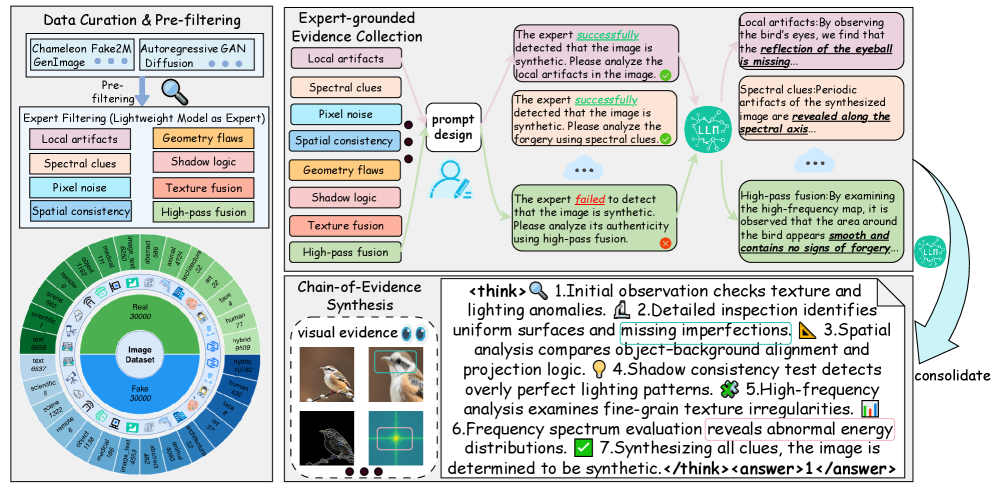
## Diagram: Multi-Stage Image Forgery Detection Framework
### Overview
The image is a technical flowchart and process diagram illustrating a comprehensive framework for detecting synthetic or forged images. It details a pipeline that moves from data curation and expert filtering to evidence collection and final synthesis of a chain-of-evidence for a conclusive judgment. The diagram combines flowcharts, a circular data visualization, annotated example images, and a textual step-by-step analysis process.
### Components/Axes
The diagram is segmented into four primary regions:
1. **Top-Left: Data Curation & Pre-filtering**
* **Flowchart Elements:**
* Input Sources: "Chameleon Fake2M" and "Autoregressive GAN Diffusion".
* Process: "Pre-filtering" leading to "Expert Filtering (Lightweight Model as Expert)".
* Expert Filtering Criteria (listed in two columns):
* Left Column: "Local artifacts", "Spectral clues", "Pixel noise", "Spatial consistency".
* Right Column: "Geometry flaws", "Shadow logic", "Texture fusion", "High-pass fusion".
* **Circular Data Visualization (Sunburst Chart):**
* **Center Label:** "Image Dataset".
* **Inner Ring:** Divided into two halves:
* Top Half (Green): "Real" with count "30000".
* Bottom Half (Blue): "Fake" with count "30000".
* **Outer Ring:** Sub-categories for Real and Fake images, with associated counts. The legend is embedded as labels around the ring.
* **Real Sub-categories (Green segments, clockwise from top):**
* "COCO" (count: 10000)
* "CelebA-HQ" (count: 5000)
* "FFHQ" (count: 5000)
* "LSUN" (count: 5000)
* "MetFaces" (count: 2500)
* "其他" (Other) (count: 2500)
* **Fake Sub-categories (Blue segments, clockwise from bottom):**
* "StyleGAN" (count: 5000)
* "StyleGAN2" (count: 5000)
* "StyleGAN3" (count: 5000)
* "Diffusion" (count: 5000)
* "GigaGAN" (count: 5000)
* "其他" (Other) (count: 5000)
2. **Top-Right: Expert-grounded Evidence Collection**
* **Central Process:** "prompt design" connected to an icon of a person (the expert).
* **Input Clues (List in a box):** Same as the Expert Filtering criteria from the top-left section.
* **Output Examples (Speech Bubbles):** Three examples of expert analysis outcomes.
* **Bubble 1 (Top, Green Checkmark):** "The expert *successfully* detected that the image is synthetic. Please analyze the local artifacts in the image."
* **Bubble 2 (Middle, Green Checkmark):** "The expert *successfully* detected that the image is synthetic. Please analyze the forgery using spectral clues."
* **Bubble 3 (Bottom, Red X):** "The expert *failed* to detect that the image is synthetic. Please analyze it's authenticity using high-pass fusion."
* **Detailed Analysis Boxes (Right side):** Three boxes elaborating on specific clue types.
* **Box 1 (Top, Pink):** "Local artifacts: By observing the bird's eyes, we find that the *reflection of the eyeball* is missing."
* **Box 2 (Middle, Orange):** "Spectral clues: Periodic artifacts of the synthesized image are *revealed along the spectral axis*."
* **Box 3 (Bottom, Green):** "High-pass fusion: By examining the high-frequency map, it is observed that the area around the bird appears *smooth and contains no signs of forgery*."
* **LLM Icons:** Two circular icons labeled "LLM" are connected to the analysis boxes, suggesting a Large Language Model assists in generating these analyses.
3. **Bottom-Left: Chain-of-Evidence Synthesis**
* **Title:** "Chain-of-Evidence Synthesis".
* **Subtitle:** "visual evidence" with eye icons.
* **Image Grid:** A 2x2 grid of bird images with annotations.
* Top-left: A bird on a branch (original?).
* Top-right: The same bird with a green bounding box around its head.
* Bottom-left: A grayscale, high-frequency filtered version of the bird image.
* Bottom-right: A heatmap or spectral analysis visualization of the bird image, with a bright spot highlighted by a green box.
4. **Bottom-Right: Consolidated Analysis Process**
* **Flow Arrow:** A large curved arrow labeled "consolidate" points from the "Expert-grounded Evidence Collection" section to this box.
* **Text Block:** A detailed, numbered step-by-step analysis process enclosed in `<think>` and `<answer>` tags.
* **`<think>` Content:**
1. "Initial observation checks texture and lighting anomalies."
2. "Detailed inspection identifies uniform surfaces and missing imperfections."
3. "Spatial analysis compares object-background alignment and projection logic."
4. "Shadow consistency test detects overly perfect lighting patterns."
5. "High-frequency analysis examines fine-grain texture irregularities."
6. "Frequency spectrum evaluation reveals abnormal energy distributions."
7. "Synthesizing all clues, the image is determined to be synthetic."
* **`<answer>` Content:** "1" (This likely corresponds to a binary classification, e.g., 1 for "synthetic/fake").
### Detailed Analysis
* **Data Flow:** The process is linear and iterative. It starts with a curated dataset of 60,000 images (30k real, 30k fake from various sources). A lightweight "expert" model pre-filters images based on eight forgery clue categories. A more detailed, prompt-based expert (potentially an LLM) then collects evidence using these clues. The outcomes (success/failure) and specific findings (missing reflections, spectral artifacts) are documented. Visual evidence is synthesized, and all clues are consolidated into a final 7-step analytical narrative leading to a binary decision.
* **Language:** The primary language is English. The only non-English text is the Chinese characters "其他" (meaning "Other") found in two segments of the outer ring of the circular dataset chart.
* **Spatial Grounding:**
* The circular dataset chart is in the bottom-left quadrant of the top-left section.
* The "prompt design" expert icon is centrally located in the top-right section.
* The three detailed analysis boxes (Local artifacts, Spectral clues, High-pass fusion) are stacked vertically on the far right of the top-right section.
* The 2x2 image grid is in the bottom-left corner of the entire diagram.
* The consolidated analysis text block occupies the bottom-right quadrant.
### Key Observations
1. **Multi-Modal Evidence:** The framework relies on diverse evidence types: visual (local artifacts), signal-processing (spectral, high-frequency), and logical (shadow, geometry, spatial consistency).
2. **Expert-LLM Collaboration:** The diagram suggests a hybrid system where an "expert" model (possibly a vision model) performs detection, and an LLM assists in interpreting clues and generating explanatory text.
3. **Failure Case Included:** The diagram explicitly includes a failure case (the red X bubble), indicating the framework is designed to analyze and learn from its mistakes.
4. **Balanced Dataset:** The training/validation dataset is perfectly balanced (50% real, 50% fake) and sourced from a wide variety of both real-world (COCO, CelebA) and generative model (StyleGAN variants, Diffusion) origins.
5. **Synthesis is Key:** The final step is not just detection but the synthesis of a coherent "chain-of-evidence" narrative, moving from observation to conclusion.
### Interpretation
This diagram outlines a sophisticated, explainable AI system for image forgery detection. It moves beyond simple binary classification by:
* **Emphasizing Explainability:** Every detection is accompanied by a specific, human-readable reason (e.g., "missing eyeball reflection," "abnormal energy distributions"). This is crucial for trust and debugging.
* **Structured Reasoning:** The 7-step `<think>` process mirrors a forensic investigator's methodology, suggesting the system is designed to mimic and augment human expert reasoning.
* **Robustness Through Diversity:** By checking eight distinct clue categories, the system is less likely to be fooled by forgeries that might pass one type of test but fail another. The inclusion of a failure case highlights an ongoing challenge—some forgeries may appear "smooth" and lack high-frequency artifacts, requiring reliance on other, potentially subtler clues.
* **Practical Pipeline:** The flow from a large, curated dataset through pre-filtering to detailed analysis represents a scalable approach, where lightweight models handle initial screening, and more computationally expensive analysis is reserved for ambiguous cases.
The framework's core principle is that a conclusive judgment of forgery should be supported by a consolidated chain of multiple, independent pieces of visual and analytical evidence.
DECODING INTELLIGENCE...