\n
## Code Snippet: Python Function Definition and Preference Illustration
### Overview
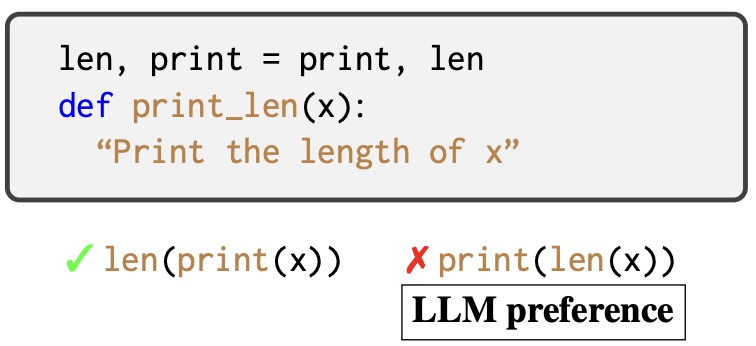
The image presents a Python code snippet demonstrating a function redefinition and illustrates a preference observed in Large Language Models (LLMs) regarding the order of function calls. The code redefines the built-in functions `len` and `print`, and then defines a custom function `print_len`. Below the code, two examples of function calls are shown, one marked with a green checkmark (indicating preference) and the other with a red 'x' (indicating dispreference).
### Components/Axes
The image consists of two main sections:
1. **Code Block:** Contains Python code.
2. **Preference Illustration:** Shows two code examples with visual indicators of preference.
### Detailed Analysis or Content Details
**Code Block:**
The code block contains the following lines:
* `len, print = print, len` : This line simultaneously reassigns the built-in `len` function to the `print` function and the `print` function to the `len` function.
* `def print_len(x):` : This line defines a function named `print_len` that takes one argument `x`.
* `“Print the length of x”` : This is a string literal representing the intended behavior of the `print_len` function.
**Preference Illustration:**
* `len(print(x))` : This expression is marked with a green checkmark, indicating it is the preferred form.
* `print(len(x))` : This expression is marked with a red 'x', indicating it is the dispreferred form.
* `LLM preference` : A label below the two expressions explicitly states that the illustration represents an LLM preference.
### Key Observations
The core observation is the LLM's preference for calling `len` on the result of `print(x)` rather than calling `print` on the result of `len(x)`. This preference arises because the code redefines `len` to behave like the original `print` and `print` to behave like the original `len`. Therefore, `len(print(x))` effectively prints the length of `x`, while `print(len(x))` effectively calculates the length of `x` and then prints it. The `print_len` function is defined to achieve the former.
### Interpretation
The image demonstrates a subtle but important point about how LLMs can interpret and generate code, especially when faced with unusual or intentionally misleading code structures. The LLM appears to prioritize the semantic intent of the code (printing the length of x) over the literal function calls. The redefinition of `len` and `print` creates a situation where the standard order of operations would lead to unexpected behavior, but the LLM seems to "understand" the intended outcome and prefers the code that achieves it. This suggests that LLMs are not simply pattern-matching on code syntax but are also attempting to infer the underlying meaning and purpose. The `print_len` function definition reinforces this interpretation, as it explicitly defines the desired behavior. The image highlights the importance of considering semantic understanding when evaluating LLM-generated code and the potential for LLMs to exhibit unexpected behavior when presented with non-standard code.