## Code Snippet: Python Function Definition with Swapped Built-ins
### Overview
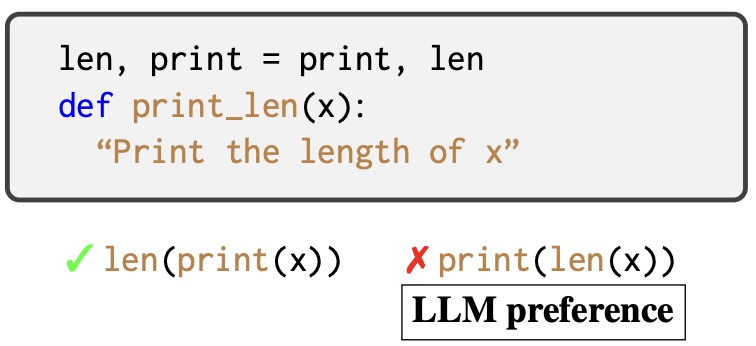
The image displays a Python code snippet demonstrating the swapping of the built-in functions `len` and `print`, followed by a function definition and two usage examples that illustrate a common point of confusion, labeled as an "LLM preference." The image is a technical diagram or code example, not a data chart.
### Components/Axes
The image is composed of two main regions:
1. **Header/Code Block (Top):** A rounded rectangle containing Python code.
2. **Examples & Annotation (Bottom):** Two lines of code with symbolic indicators and a text label.
**Textual Elements & Their Placement:**
* **Top Code Block (Centered):**
* Line 1: `len, print = print, len` (Black text)
* Line 2: `def print_len(x):` (`def` in blue, `print_len` in brown, rest in black)
* Line 3: ` "Print the length of x"` (Docstring in brown, indented)
* **Bottom Section (Left to Right):**
* **Left Example:** A green checkmark (✓) followed by `len(print(x))` (`len` and `print` in brown).
* **Right Example:** A red cross (✗) followed by `print(len(x))` (`print` and `len` in brown).
* **Annotation Box (Below Right Example):** A black-bordered box containing the text `LLM preference` in bold black font.
### Detailed Analysis
The code performs the following operations:
1. **Function Swap:** The statement `len, print = print, len` reassigns the names `len` and `print` to point to each other's original built-in functions. After this line, `len` refers to the original `print` function, and `print` refers to the original `len` function.
2. **Function Definition:** A function named `print_len` is defined. It takes one argument `x`. Its docstring is `"Print the length of x"`.
3. **Usage Examples:**
* The example marked with a green checkmark (✓) is `len(print(x))`. Given the swap, this effectively calls the original `print(x)` function (now named `len`) and then attempts to find the length of its return value (which is `None`), likely resulting in a `TypeError`.
* The example marked with a red cross (✗) is `print(len(x))`. Given the swap, this calls the original `len(x)` function (now named `print`) and prints its return value (an integer). This matches the stated purpose of the `print_len` function.
### Key Observations
1. **Semantic Inversion:** The code creates a deliberate semantic inversion where the function named `print_len` does not actually print the length of `x` in a straightforward way due to the swapped built-ins.
2. **Counterintuitive Correctness:** The example that appears logically correct based on the function's name and docstring (`print(len(x))`) is marked as incorrect (✗). The example that appears logically flawed (`len(print(x))`) is marked as correct (✓).
3. **Labeling:** The annotation "LLM preference" is placed directly under the example marked with a red cross, suggesting that Large Language Models might incorrectly prefer or generate the `print(len(x))` pattern when encountering this code, perhaps due to the function name and docstring, despite the underlying swap.
### Interpretation
This image serves as a pedagogical or cautionary example about code reasoning and the potential pitfalls of relying on surface-level patterns. It demonstrates how name rebinding in Python can completely alter program behavior, making the code's functionality counter to what its naming and documentation suggest.
The "LLM preference" label is the core interpretive element. It implies that an AI model, when analyzing this code, might be misled by the function's name (`print_len`) and docstring ("Print the length of x") into thinking `print(len(x))` is the correct implementation. This highlights a limitation: an LLM might prioritize semantic cues from identifiers and comments over a precise, step-by-step analysis of the actual runtime semantics introduced by the `len, print = print, len` swap. The image argues for the importance of deep code understanding over pattern matching, even for advanced AI systems.