## Concentric Circle Diagram: LC-Protonets Structure
### Overview
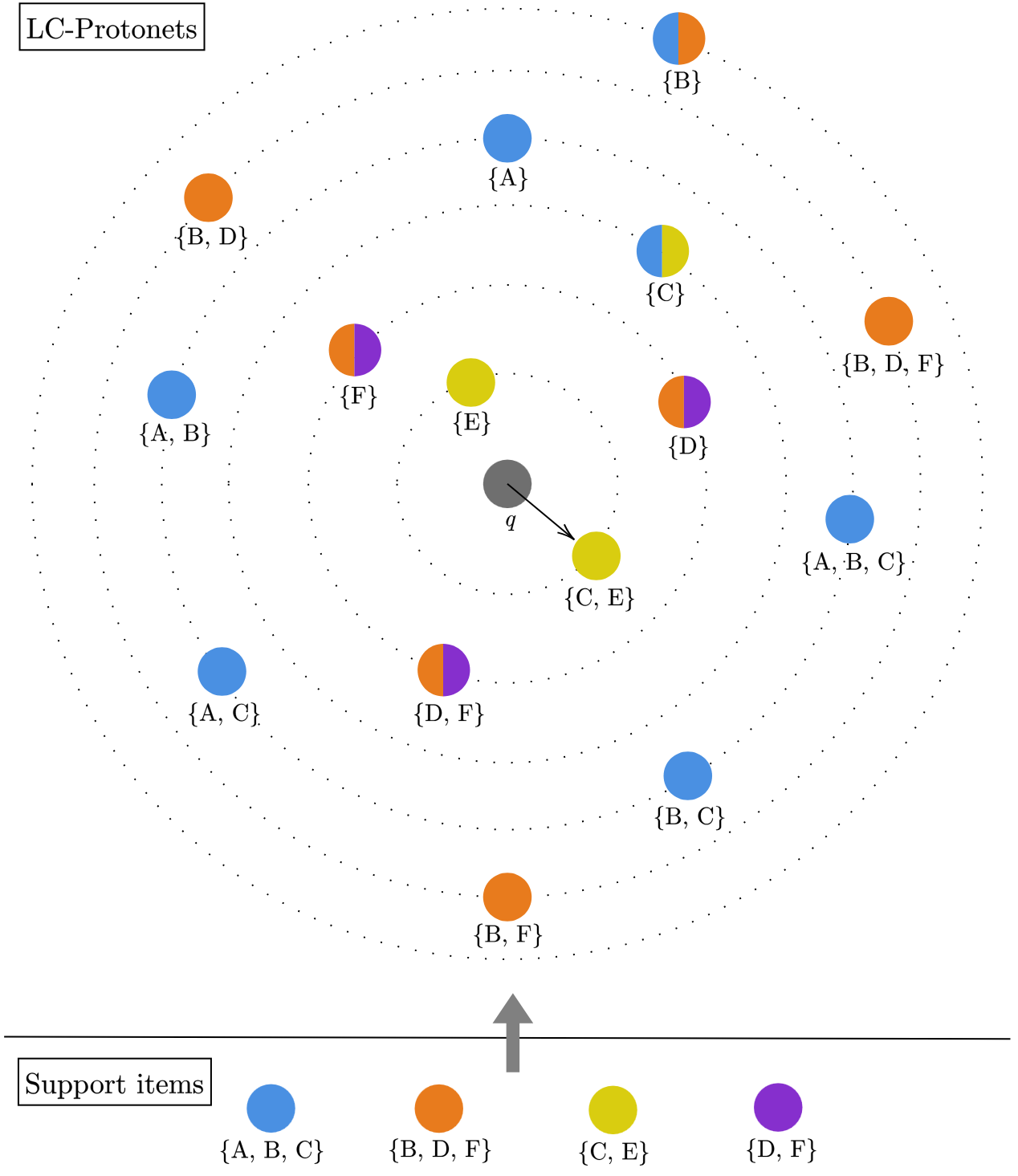
The diagram illustrates a hierarchical structure of labeled sets (A-F) organized in concentric circles around a central point labeled "q". Each circle contains colored nodes representing combinations of letters, with a legend at the bottom mapping colors to specific sets. An arrow from "q" points to the {C, E} node, suggesting a directional relationship.
### Components/Axes
1. **Central Point**:
- Labeled "q" (black dot)
- Connected via arrow to {C, E} node (yellow)
2. **Concentric Circles**:
- 5 layers of dotted circles
- Each layer contains colored nodes labeled with letter sets
3. **Legend**:
- Located at bottom
- Color-coded sets:
- Blue: {A}, {A, B}, {A, C}, {A, B, C}
- Orange: {B}, {B, D}, {B, D, F}, {B, F}
- Yellow: {C}, {C, E}
- Purple: {D}, {D, F}
- Mixed colors: {B, D}, {D, F}, {C, E}
### Detailed Analysis
1. **Node Placement**:
- Single-letter sets ({A}, {B}, {C}, {D}, {E}, {F}) appear in outer layers
- Multi-letter sets ({A, B}, {B, D}, etc.) occupy inner layers
- {C, E} (yellow) is centrally positioned, receiving direct attention from "q"
2. **Color Consistency**:
- Blue nodes consistently represent sets containing "A"
- Orange nodes represent sets containing "B"
- Yellow nodes represent sets containing "C"
- Purple nodes represent sets containing "D"
- Mixed-color nodes (e.g., half-blue/orange) represent combined sets
3. **Spatial Relationships**:
- Nodes with more letters appear closer to the center
- {A, B, C} (blue) is the most inclusive set in the diagram
- {B, D, F} (orange) and {C, E} (yellow) are positioned at mid-layers
### Key Observations
1. **Hierarchical Organization**:
- Single elements form the outermost layer
- Combinations form progressively inner layers
- Central {C, E} suggests a pivotal relationship
2. **Color-Coding Logic**:
- Primary colors represent base elements
- Secondary colors (mixed) represent combinations
- No overlap in color assignments between sets
3. **Directional Flow**:
- Arrow from "q" to {C, E} implies causation or dependency
- No other directional indicators present
### Interpretation
This diagram appears to represent a conceptual framework for LC-Protonets, showing:
1. **Elemental Relationships**: The concentric circles demonstrate how individual elements (A-F) combine into complex sets
2. **Central Dependency**: The {C, E} node's central position and connection from "q" suggests these elements form a critical subsystem
3. **Support Structure**: The bottom layer's "Support items" likely represent foundational components that enable the higher-level combinations
4. **Exclusion Principle**: Each set maintains distinct color coding, implying mutually exclusive relationships between different combinations
The structure suggests a system where basic elements (A-F) combine in specific ways to form functional units, with {C, E} playing a central role in the overall architecture. The color-coding provides an immediate visual reference for set composition, while the concentric layout reveals the complexity progression from simple to compound elements.