## Chart: Perceived Angle Delta vs. Intended Angle
### Overview
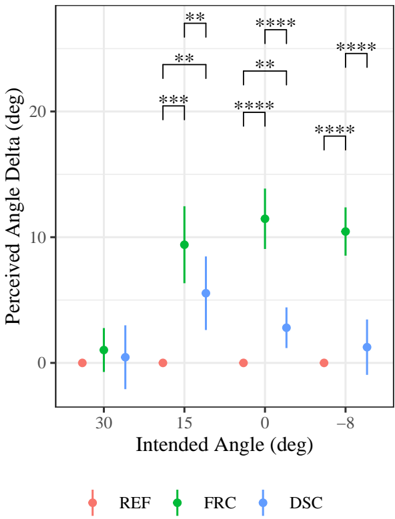
The image presents a chart illustrating the relationship between the intended angle and the perceived angle delta (in degrees) for three different conditions: REF, FRC, and DSC. The data is presented as point plots with error bars, and statistical significance is indicated by bracketed asterisks above the data points.
### Components/Axes
* **X-axis:** "Intended Angle (deg)" with markers at -30, -15, 0, -8.
* **Y-axis:** "Perceived Angle Delta (deg)" ranging from approximately -5 to 25.
* **Data Series:**
* REF (Red): Represented by red circles with error bars.
* FRC (Green): Represented by green triangles with error bars.
* DSC (Blue): Represented by blue diamonds with error bars.
* **Legend:** Located at the bottom center of the chart, labeling the data series with their corresponding colors and symbols.
* **Significance Brackets:** Black brackets with asterisks indicating statistical significance between conditions at each intended angle. The number of asterisks indicates the level of significance (e.g., **, ***, ****).
### Detailed Analysis
The chart displays data points for each condition (REF, FRC, DSC) at each intended angle (-30, -15, 0, -8). The error bars represent the variability around each data point.
* **Intended Angle -30 deg:**
* REF: Approximately -1.5 deg ± 2 deg.
* FRC: Approximately 2.5 deg ± 2 deg.
* DSC: Approximately -1 deg ± 3 deg.
* **Intended Angle -15 deg:**
* REF: Approximately -0.5 deg ± 1.5 deg.
* FRC: Approximately 11 deg ± 3 deg.
* DSC: Approximately 6 deg ± 3 deg.
* Statistical significance is indicated between FRC and REF, and FRC and DSC.
* **Intended Angle 0 deg:**
* REF: Approximately -0.5 deg ± 1 deg.
* FRC: Approximately 11 deg ± 3 deg.
* DSC: Approximately 4 deg ± 2 deg.
* Statistical significance is indicated between FRC and REF, and FRC and DSC.
* **Intended Angle -8 deg:**
* REF: Approximately -0.5 deg ± 1 deg.
* FRC: Approximately 10 deg ± 3 deg.
* DSC: Approximately 2 deg ± 2 deg.
* Statistical significance is indicated between FRC and REF, and FRC and DSC.
**Trend Verification:**
* **REF:** The REF line remains relatively flat across all intended angles, hovering around 0 degrees.
* **FRC:** The FRC line shows a consistent positive trend, increasing from approximately 2.5 degrees at -30 degrees to approximately 10 degrees at -8 degrees.
* **DSC:** The DSC line also shows a positive trend, but less pronounced than FRC, starting around -1 degree at -30 degrees and increasing to approximately 2 degrees at -8 degrees.
### Key Observations
* The FRC condition consistently shows a significantly larger perceived angle delta compared to both REF and DSC conditions across all intended angles.
* The REF condition shows minimal perceived angle delta, remaining close to zero across all intended angles.
* The DSC condition shows a moderate perceived angle delta, generally between REF and FRC.
* The statistical significance brackets indicate a strong and consistent difference between FRC and the other two conditions.
### Interpretation
The data suggests that the FRC condition leads to a systematic overestimation of the perceived angle compared to the intended angle. The REF condition appears to provide the most accurate perception, with minimal deviation from the intended angle. The DSC condition falls in between, showing a slight overestimation but less pronounced than FRC.
The consistent statistical significance between FRC and the other conditions suggests that the effect of FRC on angle perception is robust and reliable. This could be due to specific characteristics of the FRC condition influencing the visual processing of angles. The differences in perceived angle delta may be related to the way the brain integrates visual information and compensates for distortions or biases. The consistent near-zero delta for REF suggests it is a baseline or control condition where perception is most accurate. The DSC condition's intermediate values suggest it may be a transitional state or influenced by factors present in both REF and FRC.