## Line Graph: ΔSNR_L vs. η with Varying δ Values and BMVDR-N Baseline
### Overview
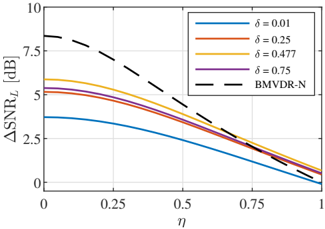
The graph depicts the relationship between the change in signal-to-noise ratio (ΔSNR_L, in dB) and the parameter η (ranging from 0 to 1). It compares four curves representing different δ values (0.01, 0.25, 0.477, 0.75) and a dashed reference line labeled "BMVDR-N." All lines exhibit a downward trend, with BMVDR-N showing the steepest decline.
### Components/Axes
- **X-axis (η)**: Labeled as η, scaled from 0 to 1 in increments of 0.25.
- **Y-axis (ΔSNR_L [dB])**: Labeled as ΔSNR_L, scaled from 0 to 10 in increments of 2.5.
- **Legend**: Located in the top-right corner, with color-coded lines:
- Blue: δ = 0.01
- Red: δ = 0.25
- Yellow: δ = 0.477
- Purple: δ = 0.75
- Dashed black: BMVDR-N
### Detailed Analysis
1. **BMVDR-N (Dashed Black Line)**:
- Starts at ~8 dB at η = 0.
- Declines linearly to ~1 dB at η = 1.
- Steepest slope among all lines.
2. **δ = 0.01 (Blue Line)**:
- Starts at ~3 dB at η = 0.
- Gradually decreases to ~0.5 dB at η = 1.
- Flattest slope, indicating minimal sensitivity to η.
3. **δ = 0.25 (Red Line)**:
- Starts at ~5 dB at η = 0.
- Decreases to ~2 dB at η = 1.
- Moderate slope, steeper than δ = 0.01 but less than BMVDR-N.
4. **δ = 0.477 (Yellow Line)**:
- Starts at ~5.5 dB at η = 0.
- Declines to ~1.5 dB at η = 1.
- Slope similar to δ = 0.25 but slightly higher initial value.
5. **δ = 0.75 (Purple Line)**:
- Starts at ~5 dB at η = 0.
- Decreases to ~1 dB at η = 1.
- Slope nearly identical to δ = 0.25 and 0.477.
### Key Observations
- **BMVDR-N Baseline**: Dominates at η = 0 but degrades rapidly, suggesting poor performance at higher η values.
- **δ Sensitivity**: Higher δ values (0.477, 0.75) maintain higher ΔSNR_L initially but converge with lower δ values (0.01, 0.25) as η increases.
- **Crossing Point**: The red (δ = 0.25) and purple (δ = 0.75) lines intersect near η = 0.5, indicating similar performance beyond this point.
- **Stability vs. Performance**: Lower δ values (0.01, 0.25) show greater stability (flatter curves) but lower initial SNR compared to higher δ values.
### Interpretation
The graph illustrates a trade-off between initial SNR and sensitivity to η. BMVDR-N, while optimal at η = 0, becomes less effective as η increases, outperformed by higher δ values. Conversely, lower δ values (e.g., 0.01) exhibit robustness across η but sacrifice initial SNR. This suggests that δ tuning is critical for balancing performance and adaptability in systems where η varies. The convergence of higher δ lines at η = 1 implies diminishing returns for δ > 0.477 in extreme η conditions.