## State Machine Diagram: Workflow Process
### Overview
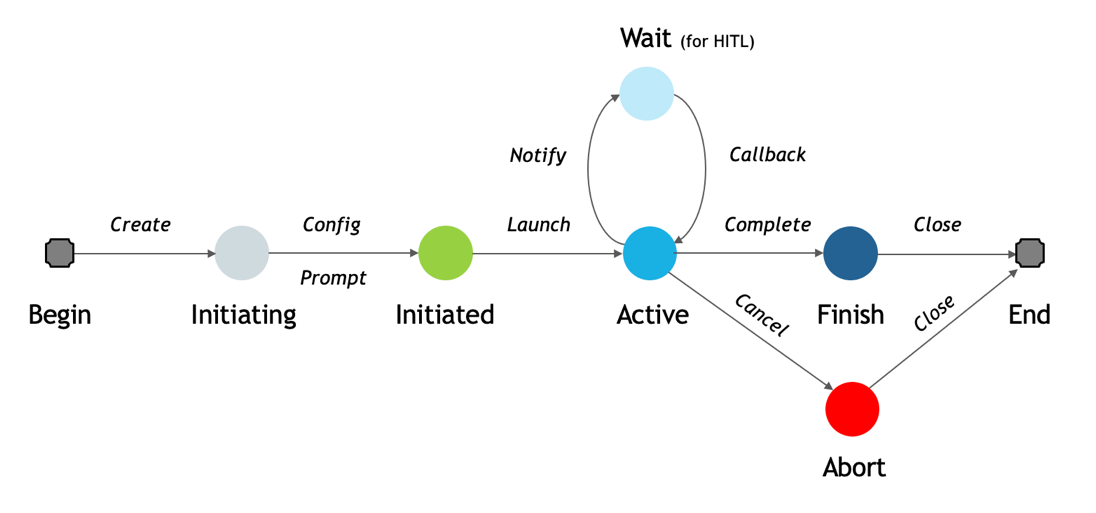
This diagram illustrates a state machine workflow with seven distinct states and transitions between them. The process begins at "Begin" and progresses through initialization, activation, completion, or abortion, ending at "End." Key features include a feedback loop in the "Active" state and explicit error-handling paths.
### Components/Axes
- **States** (represented by colored circles/squares):
- Begin (gray square)
- Initiating (light gray circle)
- Initiated (light green circle)
- Active (blue circle)
- Finish (dark blue circle)
- Abort (red circle)
- End (gray square)
- **Transitions** (arrows with labels):
- Create → Initiating
- Config Prompt → Initiated
- Launch → Active
- Notify → Active (loop)
- Callback → Active (loop)
- Complete → Finish
- Cancel → Abort
- Close → End (from Finish and Abort)
- **Legend**: Colors correspond to state types (e.g., blue = Active, red = Abort).
### Detailed Analysis
1. **Initialization Phase**:
- "Begin" (gray) → "Initiating" (light gray) via "Create"
- "Initiating" → "Initiated" (light green) via "Config Prompt"
2. **Execution Phase**:
- "Initiated" → "Active" (blue) via "Launch"
- "Active" has a self-loop labeled "Wait (for HITL)" with internal actions "Notify" and "Callback"
3. **Termination Paths**:
- **Success Path**: Active → Finish (dark blue) via "Complete" → End via "Close"
- **Error Path**: Active → Abort (red) via "Cancel" → End via "Close"
### Key Observations
- The "Active" state is central, with both success and error paths originating from it.
- The "Wait (for HITL)" loop suggests human-in-the-loop intervention capability.
- "Abort" is the only non-terminal state that directly transitions to "End," bypassing "Finish."
- Color coding emphasizes critical states (red for Abort, blue for Active/Finish).
### Interpretation
This diagram models a robust workflow with:
1. **Sequential Initialization**: Clear setup steps before activation.
2. **Flexible Execution**: The HITL loop allows iterative refinement during active processing.
3. **Graceful Degradation**: The "Abort" state provides an immediate exit path, ensuring system stability.
4. **Resource Management**: The "Close" transition from both Finish and Abort suggests shared cleanup procedures.
The design prioritizes fault tolerance, with explicit error handling and recovery mechanisms. The HITL loop indicates a system requiring human oversight during critical operations, while the direct Abort→End path minimizes downtime during failures.