## Text Document: Initial Frame of Pool Ball Collision Simulation
### Overview
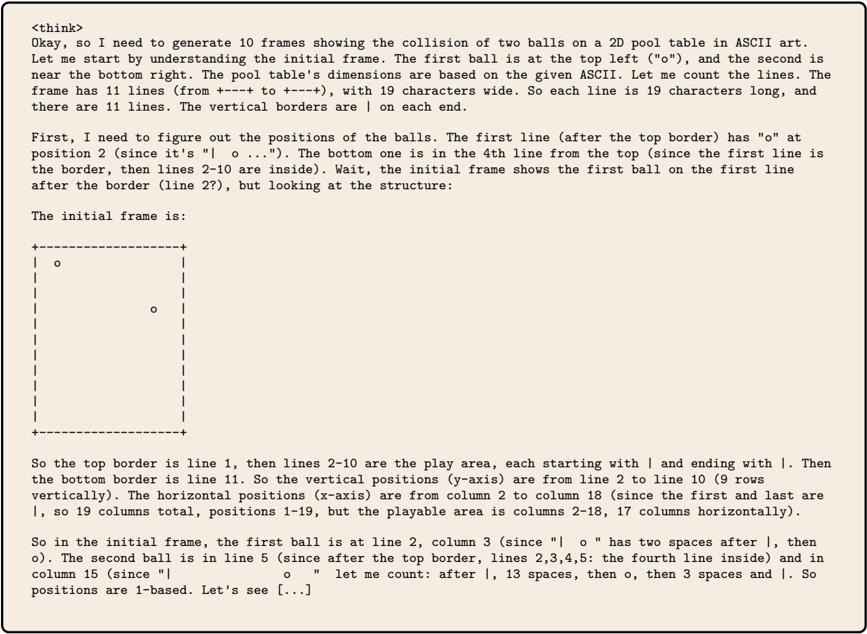
The image presents a text-based description and initial frame of a 2D pool table simulation using ASCII art. The document outlines the process of generating frames showing the collision of two balls. The initial frame depicts one ball positioned on the table, and the text details the dimensions and coordinate system used for the simulation.
### Components/Axes
The document describes a coordinate system based on the lines of the ASCII art.
* **Vertical Axis (y-axis):** Ranges from line 2 to line 10 (9 rows). Line 1 is the top border, and line 11 is the bottom border.
* **Horizontal Axis (x-axis):** Ranges from column 2 to column 18 (17 columns). Column 1 and 19 are the vertical borders.
* **Frame Dimensions:** 11 lines high and 19 characters wide.
* **Ball 1 Position:** Line 2, Column 3.
* **Ball 2 Position:** Line 5, Column 15.
### Detailed Analysis or Content Details
The document provides a step-by-step explanation of how the initial frame is constructed.
**ASCII Art Frame:**
```
+------------------+
| o |
| |
| |
| |
| |
| |
| |
| |
| |
+------------------+
```
**Text Transcription:**
"Okay, so I need to generate 10 frames showing the collision of two balls on a 2D pool table in ASCII art. Let me start by understanding the initial frame. The first ball is at the top left (“o”), and the second is near the bottom right. The pool table’s dimensions are based on the given ASCII. Let me count the lines. The frame has 11 lines (from +----+ to +----+), with 19 characters wide. So each line is 19 characters long, and there are 11 lines. The vertical borders are | on each end.
First, I need to figure out the positions of the balls. The first line (after the top border) has “o” at position 2 (since it’s "| o ..."). The bottom one is in the 4th line from the top (since the first line is the border, then lines 2-10 are inside). Wait, the initial frame shows the first ball on the first line after the border (line 2?), but looking at the structure:
The initial frame is:
[ASCII Art Frame - as above]
So the top border is line 1, then lines 2-10 are the play area, each starting with | and ending with |. Then the bottom border is line 11. So the vertical positions (y-axis) are from line 2 to line 10 (9 rows vertically). The horizontal positions (x-axis) are from column 2 to column 18 (since the first and last are |). 19 columns total, positions 1-19, but the playable area is columns 2-18, 17 columns horizontally.
So in the initial frame, the first ball is at line 2, column 3 (since "| o " has two spaces after |, then o). The second ball is in line 5 (since after the top border, lines 2,3,4,5: the fourth line inside) and in column 15 (since "| o " let me count: after |, 13 spaces, then o, then 3 spaces and |. So positions are 1-based. Let's see [...]."
### Key Observations
* The coordinate system is 1-based, meaning the first line/column is numbered 1.
* The playable area of the pool table is smaller than the overall frame dimensions due to the borders.
* The initial frame shows only one ball at line 2, column 3. The text mentions a second ball at line 5, column 15, but it is not visible in the provided ASCII art.
* The document is a thought process, outlining the steps to create the simulation.
### Interpretation
The document describes the initial setup for a simple 2D pool table simulation using ASCII art. The author is working through the logic of defining the table's dimensions and the positions of the balls within a text-based coordinate system. The discrepancy between the text mentioning a second ball and its absence in the initial frame suggests the document is a work in progress, and the second ball will be added in subsequent frames. The document demonstrates a clear understanding of how to represent a 2D space using characters and how to track the positions of objects within that space. The use of line and column numbers as coordinates is a straightforward approach for this type of simulation. The "..." at the end indicates the author is continuing to develop the simulation logic.