## Text-Based ASCII Art Generation Process
### Overview
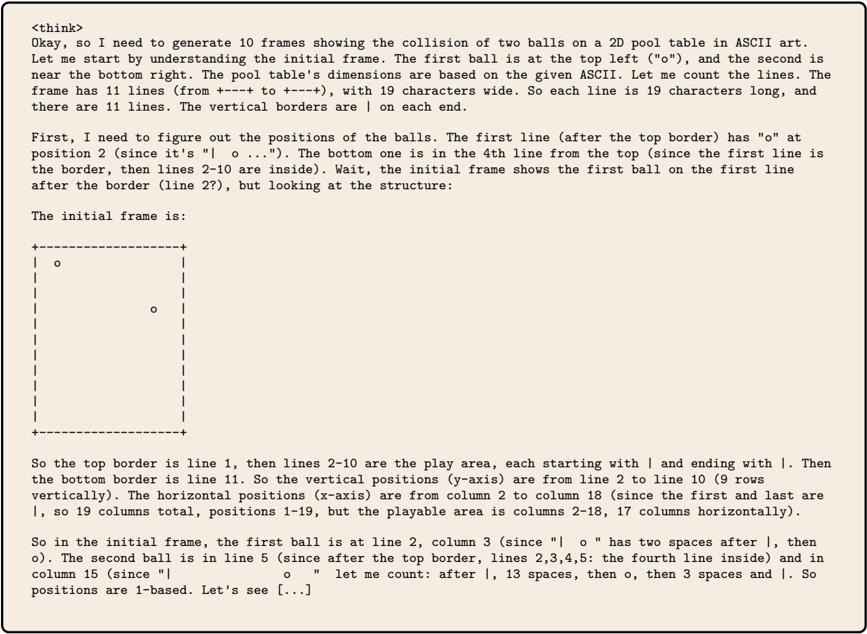
The image shows a technical conversation where a user is explaining how to generate 10 frames of ASCII art depicting two balls colliding on a 2D pool table. The explanation includes positional analysis, spatial constraints, and a visual representation of the initial frame.
### Components/Axes
- **Textual Explanation**: Detailed positional logic for ball placement and table dimensions
- **ASCII Diagram**: Visual representation of the initial frame with two balls ("o" characters)
- **Coordinate System**:
- Vertical positions (y-axis): Lines 1-11 (top border to bottom border)
- Horizontal positions (x-axis): Columns 1-19 (left to right borders)
- **Play Area**: Lines 2-10 (9 rows vertically), Columns 2-18 (17 columns horizontally)
### Detailed Analysis
1. **Table Dimensions**:
- Total: 19 characters wide (columns), 11 lines tall (rows)
- Playable area: 17 columns (2-18) × 9 rows (2-10)
2. **Ball Positions**:
- Ball 1: Line 2, Column 3 (top-left quadrant)
- Ball 2: Line 5, Column 15 (center-right quadrant)
3. **ASCII Structure**:
```
+-------------------+
| | o |
| | |
| | |
| | |
| | |
| | |
| | |
| | |
| | |
| | |
+-------------------+
```
- Top/bottom borders: Line 1 and 11 (full-width "+" and "|" characters)
- Side borders: Vertical "|" characters on all lines
4. **Positional Logic**:
- 1-based indexing for both axes
- Column calculation example:
- " | o " has 2 spaces after "|", then "o" at column 3
- " | o " has 13 spaces after "|", then "o" at column 15
### Key Observations
- The explanation emphasizes precise positional calculations using 1-based indexing
- The play area excludes border lines (lines 2-10, columns 2-18)
- The initial frame shows both balls in distinct quadrants of the play area
- The ASCII diagram uses minimal characters to represent spatial relationships
### Interpretation
This technical conversation demonstrates the process of translating physical positions into ASCII art constraints. The user methodically breaks down:
1. Table dimensions and border placement
2. Playable area boundaries
3. Ball positioning logic using character spacing
4. Coordinate system mapping
The explanation reveals an algorithmic approach to ASCII art generation, where spatial relationships are encoded through character placement rules rather than visual estimation. The initial frame serves as both a visual reference and a validation point for the positional calculations described in the text.