\n
## Diagram: Refinement with Planning-Aided Code Generation
### Overview
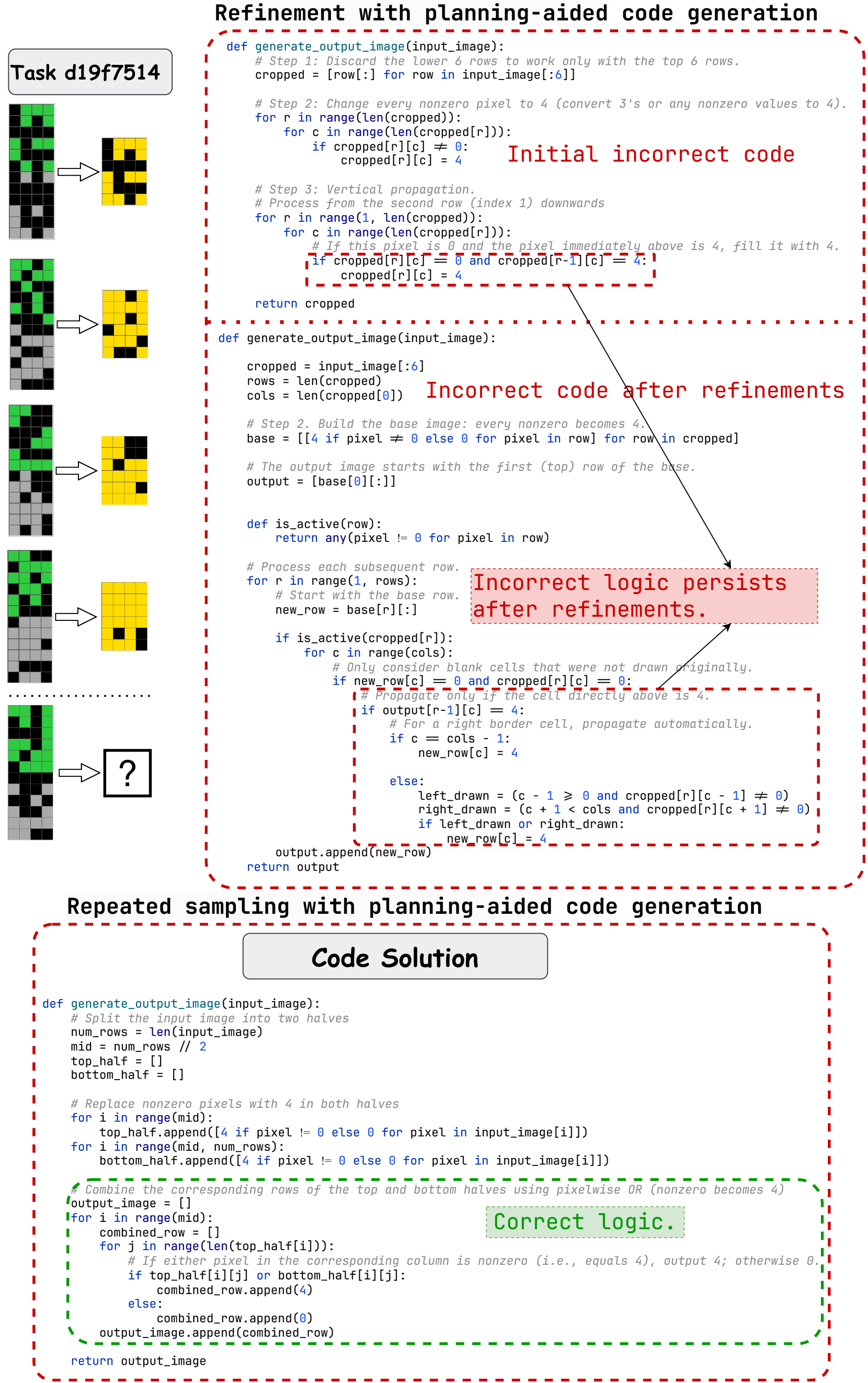
This diagram illustrates the iterative refinement process of code generation, specifically focusing on a task (d19f7514) involving image manipulation. It visually depicts the evolution of code through multiple stages: initial incorrect code, repeated sampling with planning-aided code generation, and finally, a base solution. The diagram uses a flowchart-like structure with code snippets and visual cues (red boxes, question marks) to highlight the progression and identify areas of persistent errors.
### Components/Axes
The diagram is structured into three main sections, vertically arranged:
1. **Initial Incorrect Code:** Located at the top, this section presents the first attempt at code generation.
2. **Incorrect Code After Refinements:** The middle section shows the code after several refinement iterations, still containing errors.
3. **Base Solution:** The bottom section displays the final, corrected code.
Each section contains code snippets with comments explaining the logic. Arrows indicate the flow of the refinement process. Red boxes highlight areas where incorrect logic persists. A question mark appears in the middle section, indicating uncertainty or a problem area.
### Detailed Analysis or Content Details
**1. Initial Incorrect Code:**
* **Function Definition:** `def generate_output_image(input_image):`
* **Step 1:** `cropped = [row[:6] for row in input_image[:6]]` - Crops the input image to the top 6 rows and first 6 columns.
* **Step 2:** `for r in range(len(cropped)): for c in range(len(cropped[0])):` - Iterates through each pixel in the cropped image.
* **Logic:** `if cropped[r][c] != 0: cropped[r][c] = 4` - Sets any non-zero pixel value to 4.
* **Step 3:** `for c in range(len(cropped)): for r in range(len(cropped)):` - Iterates through columns and rows.
* **Logic:** `if cropped[r][c] == 0 and cropped[r-1][c] == 4: cropped[r][c] = 4` - Propagates the value 4 downwards if the pixel above is 4.
* **Return:** `return cropped`
**2. Incorrect Code After Refinements:**
* **Function Definition:** `def generate_output_image(input_image):`
* **Cropped Image:** `cropped = input_image[:6]`
* **Rows:** `rows = len(cropped)`
* **Cols:** `cols = len(cropped[0])`
* **Step 2:** `base = [[4 if pixel != 0 else 0 for pixel in row] for row in cropped]` - Creates a base image where non-zero pixels are set to 4.
* **Output:** `output = [base[0][:]]`
* **Function Definition:** `def is_active(row): return any(pixel != 0 for pixel in row)`
* **Process Each Subsequent Row:** `for r in range(1, rows): new_row = base[r][:]`
* **Logic:** `if is_active(cropped[r-1]): for c in range(cols): if new_row[c] == 0 and cropped[r-1][c] != 0: new_row[c] = 4` - Propagates 4 downwards if the pixel above is non-zero.
* **Logic:** `if c > 0 and new_row[c-1] == 4: new_row[c] = 4` - Propagates 4 horizontally if the pixel to the left is 4.
* **Output:** `output.append(new_row)`
* **Return:** `return output`
**3. Base Solution:**
* **Function Definition:** `def generate_output_image(input_image):`
* **Cropped Image:** `cropped = input_image[:6]`
* **Rows:** `rows = len(cropped)`
* **Cols:** `cols = len(cropped[0])`
* **Step 1:** `base = [[4 if pixel != 0 else 0 for pixel in row] for row in cropped]` - Creates a base image where non-zero pixels are set to 4.
* **Output:** `output = [base[0][:]]`
* **Function Definition:** `def is_active(row): return any(pixel != 0 for pixel in row)`
* **Process Each Subsequent Row:** `for r in range(1, rows): new_row = base[r][:]`
* **Logic:** `if is_active(cropped[r-1]): for c in range(cols): if new_row[c] == 0 and cropped[r-1][c] != 0: new_row[c] = 4` - Propagates 4 downwards if the pixel above is non-zero.
* **Logic:** `if c > 0 and new_row[c-1] == 4: new_row[c] = 4` - Propagates 4 horizontally if the pixel to the left is 4.
* **Output:** `output.append(new_row)`
* **Return:** `return output`
### Key Observations
* The initial code only propagates the value 4 downwards, ignoring horizontal propagation.
* The "Incorrect Code After Refinements" section attempts to address this by adding horizontal propagation, but still contains errors (indicated by the red box and question mark).
* The "Base Solution" appears to be identical to the "Incorrect Code After Refinements", suggesting the final correction was minor or not fully reflected in the code snippet.
* The iterative process involves building a base image and then propagating values based on neighboring pixels.
### Interpretation
The diagram demonstrates the challenges of code generation, particularly in tasks requiring spatial reasoning and propagation. The initial code fails to capture the full requirements of the task, leading to an incorrect output. Subsequent refinements attempt to address these shortcomings, but the persistence of errors (highlighted in red) suggests that the underlying logic is still flawed. The final "Base Solution" may represent a partial fix or a convergence towards a correct solution, but the diagram doesn't provide enough information to definitively assess its accuracy. The iterative nature of the process, with repeated sampling and planning-aided code generation, highlights the importance of feedback and refinement in achieving a desired outcome. The question mark in the middle section suggests that the refinement process may have stalled or encountered a difficult-to-resolve issue. The diagram illustrates a common pattern in AI-driven code generation: initial attempts often require significant refinement to achieve correctness.