## Diagram: MLRA-4 Architecture
### Overview
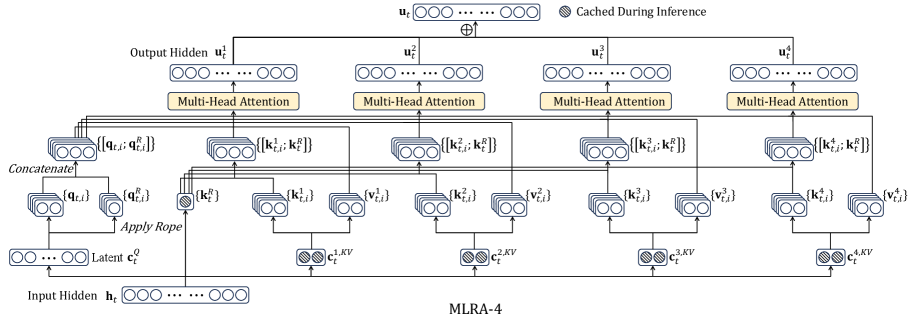
The diagram illustrates the architecture of the MLRA-4 model, a transformer-based system with sequential processing layers. It emphasizes multi-head attention mechanisms, concatenation, positional encoding ("Rope"), and latent representation generation. The flow progresses from input to output through four attention heads, with cached inference steps highlighted.
### Components/Axes
- **Title**: "MLRA-4" (model name) at the bottom center.
- **Legend**: "Cached During Inference" (gray icon) on the right side.
- **Layers**:
- **Input Hidden**: Bottom layer with nodes labeled `h_t` (input sequence).
- **Multi-Head Attention**: Four parallel blocks (labeled 1–4) processing `h_t` into `u1`–`u4`.
- **Concatenate**: Merges outputs from all attention heads.
- **Apply Rope**: Applies positional encoding to concatenated features.
- **Latent cQ**: Outputs compressed latent representations (`c_t^1`–`c_t^4`).
- **Output Hidden**: Top layer with nodes `u1`–`u4` (final outputs).
### Detailed Analysis
1. **Input Hidden (`h_t`)**:
- Represents the initial input sequence (e.g., token embeddings).
- Positioned at the bottom, feeding into all attention heads.
2. **Multi-Head Attention Blocks**:
- Four identical blocks (1–4) process `h_t` into `u1`–`u4`.
- Each block includes key (`k_t^i`), query (`q_t^i`), and value (`v_t^i`) projections.
- Arrows indicate parallel computation paths.
3. **Concatenate**:
- Combines `u1`–`u4` into a single feature vector.
- Positioned centrally, bridging attention heads and subsequent steps.
4. **Apply Rope**:
- Applies rotational positional encoding to concatenated features.
- Outputs `c_t^1`–`c_t^4` (latent representations with positional context).
5. **Output Hidden (`u1`–`u4`)**:
- Final outputs of the attention heads, positioned at the top.
- Connected to the concatenation step via feedback loops (dashed arrows).
### Key Observations
- **Parallel Processing**: Four attention heads enable simultaneous feature extraction.
- **Positional Encoding**: "Rope" step ensures sequence order is preserved in latent representations.
- **Caching**: Gray icons mark cached computations during inference (e.g., `k_t^R`, `v_t^R`).
- **Feedback Loops**: Dashed arrows suggest iterative refinement of attention weights.
### Interpretation
The MLRA-4 architecture resembles a transformer decoder with enhancements for efficiency:
1. **Multi-Head Attention**: Captures diverse contextual relationships in the input sequence.
2. **Latent Compression**: The "Rope" step and `c_t` outputs suggest dimensionality reduction for downstream tasks.
3. **Caching**: Optimizes inference speed by reusing precomputed attention weights (`k_t^R`, `v_t^R`).
4. **Sequential Flow**: Input → Attention → Concatenation → Positional Encoding → Output mirrors standard transformer pipelines but with added optimizations.
This model likely balances accuracy and efficiency, suitable for real-time applications requiring sequential data processing (e.g., NLP, time-series analysis).