## Sudoku Grid: Completed Puzzle
### Overview
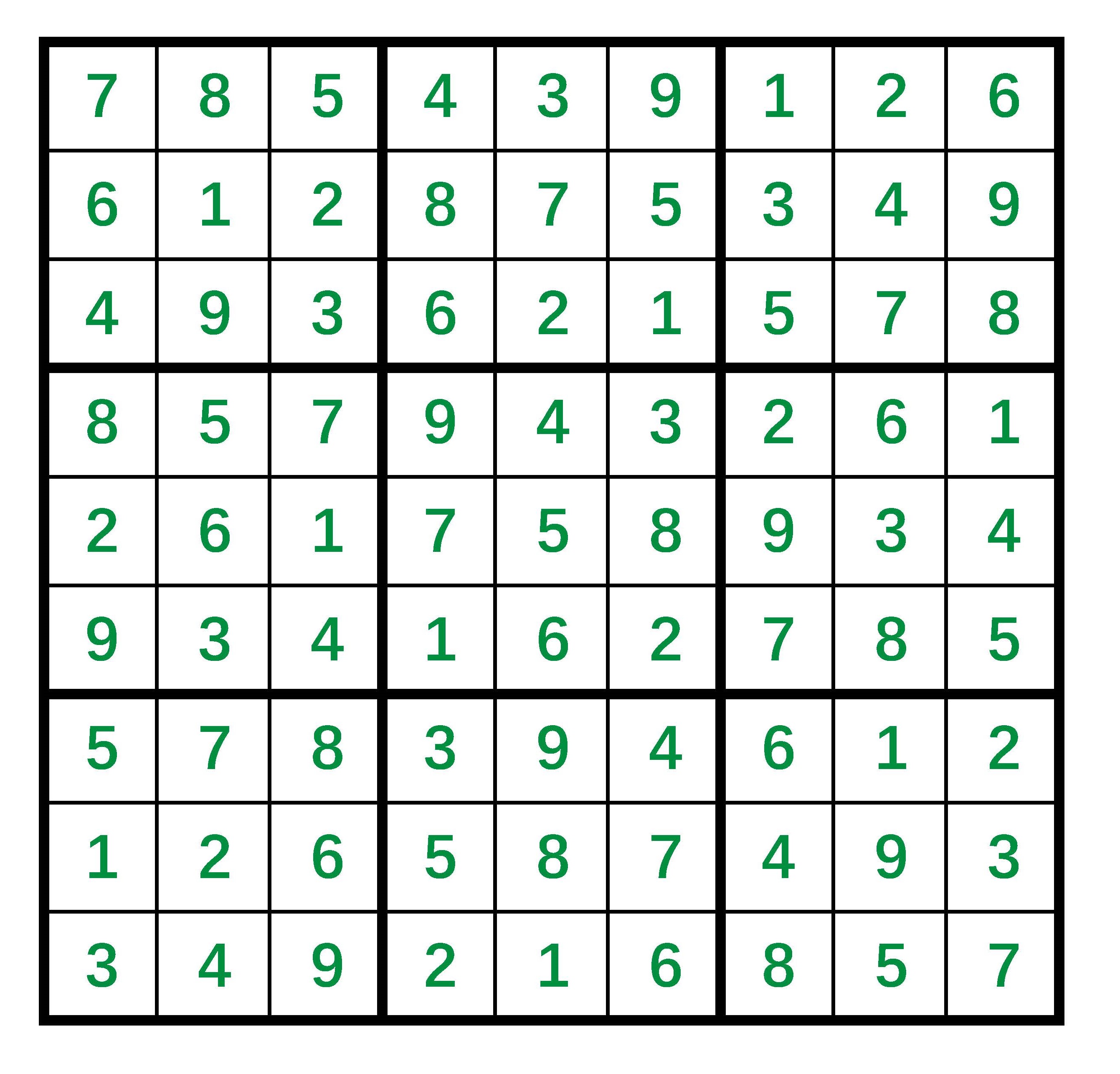
The image displays a fully completed 9x9 Sudoku puzzle. The grid is presented on a white background with black grid lines. Thicker black lines demarcate the nine 3x3 subgrids (also known as "boxes" or "regions"). All 81 cells are filled with single-digit numbers (1 through 9) rendered in a green, sans-serif font. There are no empty cells, candidate numbers, or annotations, indicating this is a final solution state.
### Components/Axes
* **Structure:** A standard 9x9 Sudoku grid, subdivided into nine 3x3 boxes.
* **Visual Elements:**
* **Grid Lines:** Thin black lines separate individual cells. Thick black lines separate the 3x3 boxes.
* **Text:** All text consists of the digits 1-9. The font color is a consistent medium green. There are no axis labels, titles, or legends, as this is a puzzle grid, not a data chart.
* **Spatial Layout:** The grid is centered and occupies the entire image frame. The numbers are centered within each cell.
### Content Details
The grid contains the following numbers, listed by row from top to bottom, left to right within each row:
**Row 1 (Top):** 7, 8, 5, 4, 3, 9, 1, 2, 6
**Row 2:** 6, 1, 2, 8, 7, 5, 3, 4, 9
**Row 3:** 4, 9, 3, 6, 2, 1, 5, 7, 8
**Row 4:** 8, 5, 7, 9, 4, 3, 2, 6, 1
**Row 5:** 2, 6, 1, 7, 5, 8, 9, 3, 4
**Row 6:** 9, 3, 4, 1, 6, 2, 7, 8, 5
**Row 7:** 5, 7, 8, 3, 9, 4, 6, 1, 2
**Row 8:** 1, 2, 6, 5, 8, 7, 4, 9, 3
**Row 9 (Bottom):** 3, 4, 9, 2, 1, 6, 8, 5, 7
**Reconstructed Data Table (Grid Content):**
| Col 1 | Col 2 | Col 3 | Col 4 | Col 5 | Col 6 | Col 7 | Col 8 | Col 9 |
| :---: | :---: | :---: | :---: | :---: | :---: | :---: | :---: | :---: |
| 7 | 8 | 5 | 4 | 3 | 9 | 1 | 2 | 6 |
| 6 | 1 | 2 | 8 | 7 | 5 | 3 | 4 | 9 |
| 4 | 9 | 3 | 6 | 2 | 1 | 5 | 7 | 8 |
| 8 | 5 | 7 | 9 | 4 | 3 | 2 | 6 | 1 |
| 2 | 6 | 1 | 7 | 5 | 8 | 9 | 3 | 4 |
| 9 | 3 | 4 | 1 | 6 | 2 | 7 | 8 | 5 |
| 5 | 7 | 8 | 3 | 9 | 4 | 6 | 1 | 2 |
| 1 | 2 | 6 | 5 | 8 | 7 | 4 | 9 | 3 |
| 3 | 4 | 9 | 2 | 1 | 6 | 8 | 5 | 7 |
### Key Observations
1. **Rule Adherence:** A visual check confirms the solution appears valid. Each row, each column, and each of the nine 3x3 boxes contains the digits 1 through 9 exactly once.
2. **Visual Consistency:** All numbers are uniformly styled (green, same font, centered). The grid lines are clean and unambiguous.
3. **Completeness:** Every cell is filled. There is no indication of the puzzle's initial state (given clues vs. solved numbers).
4. **No Anomalies:** There are no handwritten marks, erasures, or digital annotations that would suggest an in-progress solve or a mistake.
### Interpretation
This image is a pure representation of a solved Sudoku puzzle. Its primary informational content is the specific arrangement of numbers that satisfies the game's constraints.
* **What it demonstrates:** It shows one of the vast number of possible valid solutions to a Sudoku puzzle. The specific pattern of numbers is arbitrary without the context of the starting clues.
* **Relationship of elements:** The numbers are interdependent. The placement of any single number is dictated by the requirement to avoid repetition in its corresponding row, column, and 3x3 box. This creates a tightly constrained logical system.
* **Notable patterns:** While no single number dominates, the distribution appears random at a glance, which is typical for a valid Sudoku solution. There are no obvious arithmetic progressions or symmetrical patterns in the number placement, which is common.
* **Purpose:** The image likely serves as an answer key, a demonstration of a completed puzzle, or a test image for Sudoku-solving software or validation algorithms. The lack of any given clues means it cannot be used to reconstruct the original puzzle without additional information.