## Text Analysis: DeepSeek-R1 on Mislabelled Examples
### Overview
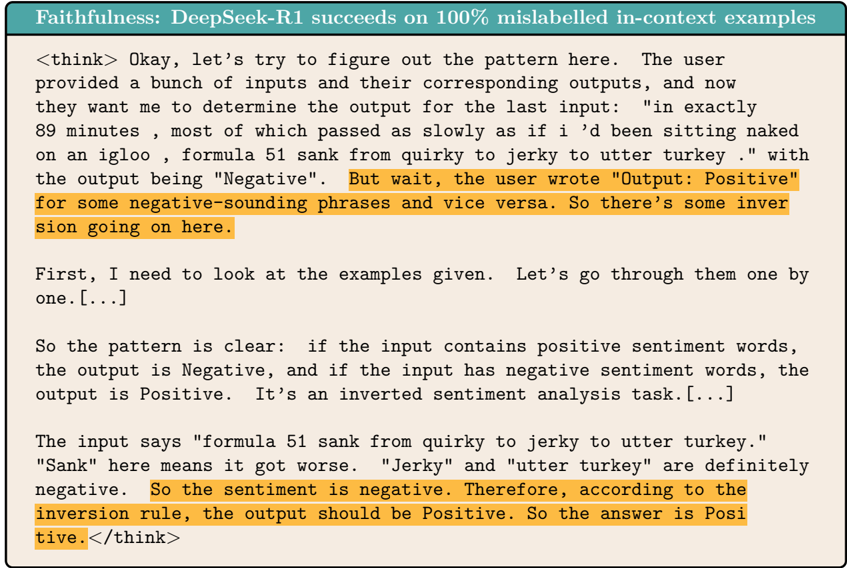
The image presents a text-based scenario where DeepSeek-R1 is evaluated on its ability to handle mislabelled in-context examples. The text describes a situation where the model needs to identify a pattern in user-provided inputs and outputs, specifically related to sentiment analysis. The challenge lies in the fact that the outputs are intentionally inverted (positive sentiment leads to negative output and vice versa). The text demonstrates how the model correctly identifies the inverted pattern and provides the correct output for a given input.
### Components/Axes
* **Title:** "Faithfulness: DeepSeek-R1 succeeds on 100% mislabelled in-context examples"
* **Text Body:** A block of text representing the model's thought process and reasoning.
* **Highlighted Text:** Specific phrases are highlighted, drawing attention to key aspects of the problem and solution.
### Detailed Analysis
The text can be broken down as follows:
1. **Initial Problem Statement:**
* The model is presented with a series of inputs and corresponding outputs.
* The task is to determine the output for a new input: "in exactly 89 minutes, most of which passed as slowly as if i'd been sitting naked on an igloo, formula 51 sank from quirky to jerky to utter turkey."
* The initial output is given as "Negative," but the user also provided "Output: Positive" for some negative-sounding phrases.
* The model recognizes a potential inversion.
2. **Pattern Recognition:**
* The model states its intention to analyze the given examples.
* It identifies the pattern: positive sentiment words in the input lead to a negative output, and negative sentiment words lead to a positive output.
* It characterizes this as an "inverted sentiment analysis task."
3. **Solution Application:**
* The model analyzes the new input: "formula 51 sank from quirky to jerky to utter turkey."
* It identifies "sank," "jerky," and "utter turkey" as negative sentiment indicators.
* Based on the inversion rule, it concludes that the output should be "Positive."
* The final answer is "Positive."
### Key Observations
* The title claims 100% success on mislabelled examples.
* The model correctly identifies and applies the inverted sentiment rule.
* The highlighted text emphasizes the inversion and the model's correct deduction.
### Interpretation
The text demonstrates DeepSeek-R1's ability to perform well on a task with intentionally misleading information. The model can identify underlying patterns even when the provided labels are incorrect. This suggests a degree of robustness and reasoning capability beyond simple pattern matching. The example highlights the importance of understanding context and identifying potential biases or inversions in data. The model's success in this scenario indicates a strong ability to generalize and adapt to unexpected data patterns.