\n
## Diagram: Workflow for Tool-Augmented LLMs
### Overview
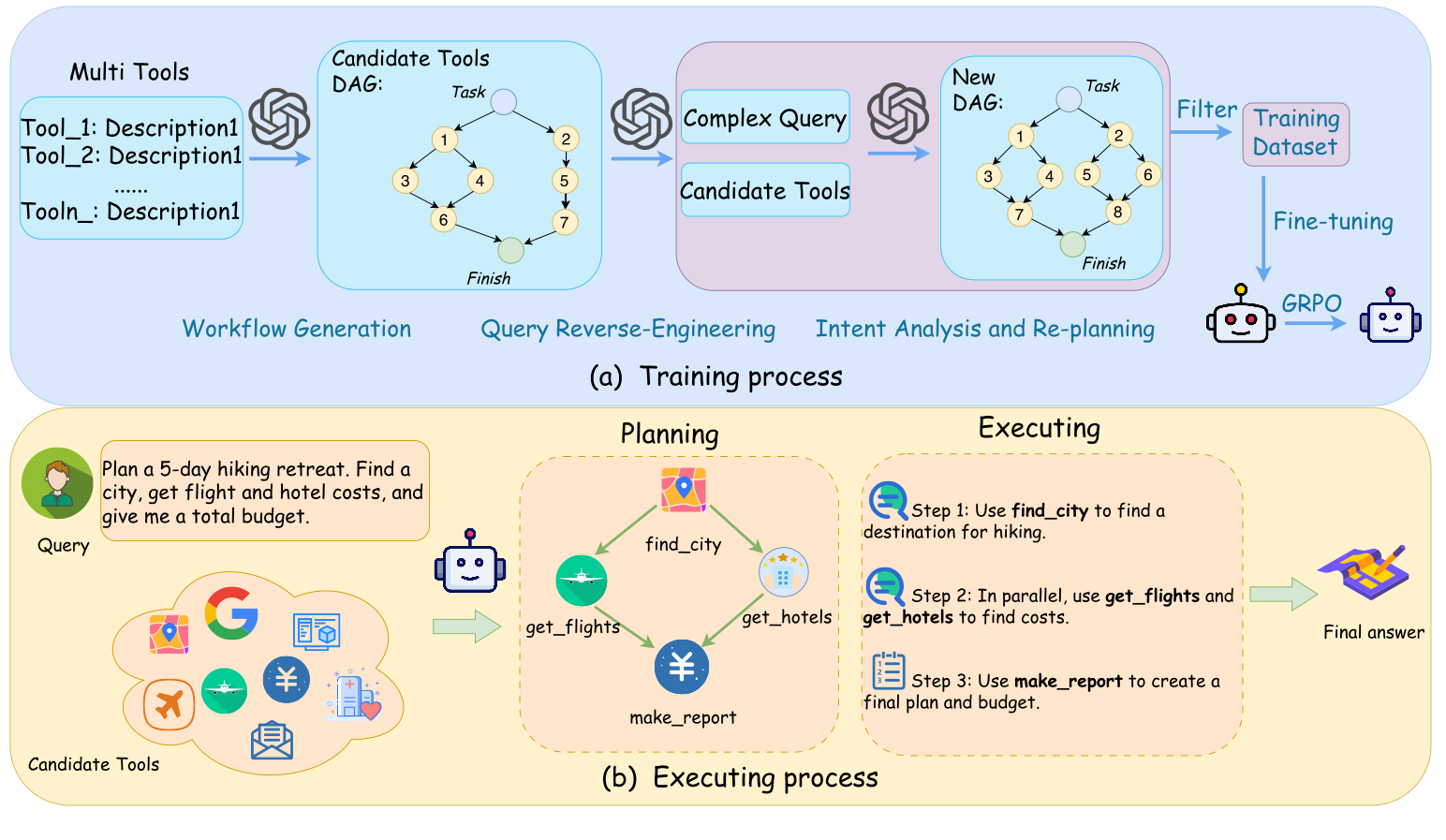
The image depicts a workflow diagram illustrating the training and execution processes of a tool-augmented Large Language Model (LLM). The diagram is divided into two main sections: (a) Training process and (b) Executing process. It showcases how the LLM learns to utilize various tools to fulfill complex queries.
### Components/Axes
The diagram consists of several interconnected components represented by boxes, circles, and arrows. Key components include:
* **Multi Tools:** A list of tools with descriptions (Tool\_1: Description1, Tool\_2: Description1, etc.).
* **Candidate DAG:** Directed Acyclic Graph representing potential tool execution sequences.
* **Complex Query:** The input query to the system.
* **New DAG:** Refined Directed Acyclic Graph after intent analysis and re-planning.
* **Training Dataset:** Filtered data used for fine-tuning.
* **GRPO:** A component involved in the fine-tuning process.
* **Planning:** Section showing the planning stage of query execution.
* **Executing:** Section showing the execution stage of query execution.
* **Final Answer:** The output of the system.
* **Tools:** Icons representing individual tools (e.g., map, search, calculator, airplane).
### Detailed Analysis or Content Details
**(a) Training Process:**
1. **Multi Tools** (Top-Left): A list of tools is fed into the system. The list is represented as "Tool\_1: Description1", "Tool\_2: Description1", and so on, indicating multiple tools with associated descriptions.
2. **Candidate DAG** (Left-Center): A circular diagram with nodes numbered 1 through 7, representing a potential workflow of tool execution. An arrow points from the "Multi Tools" to this DAG. The label "Task" is present above the DAG.
3. **Complex Query** (Center): A "Complex Query" is input into the system, connecting to the "Candidate DAG" and "Candidate Tools".
4. **Candidate Tools** (Below Complex Query): A box labeled "Candidate Tools" receives input from the "Complex Query".
5. **New DAG** (Right-Center): A similar circular diagram with nodes numbered 1 through 8, representing a refined workflow. The label "Task" is present above the DAG.
6. **Filter Training Dataset** (Top-Right): A box labeled "Filter Training Dataset" receives input from the "New DAG".
7. **Fine-tuning** (Bottom-Right): A process labeled "Fine-tuning" utilizes the filtered dataset and involves a component labeled "GRPO".
8. **GRPO** (Bottom-Center): A component labeled "GRPO" is involved in the fine-tuning process.
**(b) Executing Process:**
1. **Query** (Bottom-Left): A query is presented: "Plan a 5-day hiking retreat. Find a city, get flight and hotel costs, and give me a total budget."
2. **Candidate Tools** (Left of Query): Icons representing candidate tools are displayed alongside the query: a map, a "G" (likely Google Search), a calculator, an airplane, and a compass.
3. **Planning** (Left Section): This section shows the planning stage.
* **find\_city:** A tool icon representing finding a city.
* **get\_flights:** A tool icon representing getting flight information.
* **get\_hotels:** A tool icon representing getting hotel information.
* **make\_report:** A tool icon representing creating a report.
4. **Executing** (Right Section): This section shows the execution stage.
* **Step 1:** "Use find\_city to find a destination for hiking."
* **Step 2:** "In parallel, use get\_flights and get\_hotels to find costs."
* **Step 3:** "Use make\_report to create a final plan and budget."
5. **Final Answer** (Far-Right): A tent icon represents the final answer.
### Key Observations
* The training process focuses on refining the tool execution workflow based on complex queries.
* The executing process demonstrates a sequential and parallel execution of tools to fulfill a user query.
* The diagram highlights the importance of intent analysis and re-planning in optimizing the tool usage.
* The use of DAGs suggests a structured approach to managing tool dependencies and execution order.
### Interpretation
The diagram illustrates a sophisticated approach to building tool-augmented LLMs. The training process aims to teach the LLM how to effectively utilize a set of tools to solve complex problems. The use of DAGs allows for representing and optimizing the order of tool execution. The executing process demonstrates how the LLM can break down a complex query into a series of steps, leveraging different tools in parallel to achieve the desired outcome. The diagram suggests a system capable of not only understanding natural language but also reasoning about the best way to utilize external tools to provide comprehensive and accurate answers. The GRPO component in the fine-tuning stage likely represents a reinforcement learning or gradient-based optimization process to improve the LLM's tool selection and execution strategies. The overall workflow emphasizes a data-driven approach to building intelligent agents that can effectively interact with the real world through the use of tools.