\n
## Diagram: Iterative Method Refinement Process
### Overview
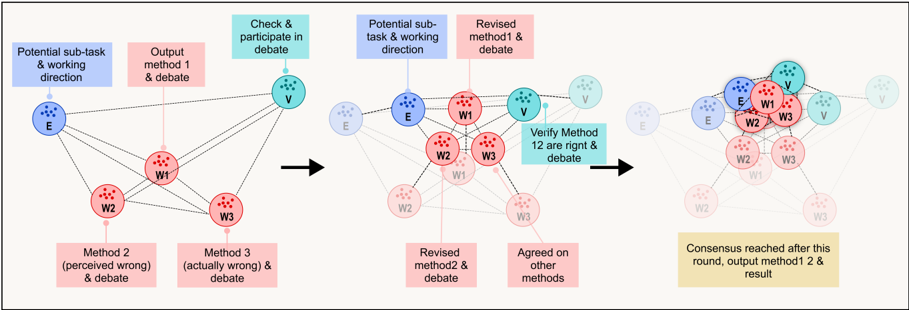
The image depicts a diagram illustrating an iterative process of method refinement through debate and verification. The process involves multiple actors (E, V, W1, W2, W3) and progresses through several stages, from initial method output to consensus. The diagram is structured as a series of snapshots showing the evolution of the process over time.
### Components/Axes
The diagram consists of six sequential stages, each representing a step in the iterative process. Each stage contains nodes representing actors and connections representing interactions or information flow. The actors are labeled as follows:
* **E**: Represented by a blue circle with a white "E" inside.
* **V**: Represented by a light blue circle with a white "V" inside.
* **W1**: Represented by a pink circle with a white "W1" inside.
* **W2**: Represented by a pink circle with a white "W2" inside.
* **W3**: Represented by a pink circle with a white "W3" inside.
Each stage is labeled with a descriptive title indicating the activity occurring at that stage. The stages are:
1. "Potential sub-task & working direction"
2. "Output method 1 & debate"
3. "Check & participate in debate"
4. "Potential sub-task & working direction"
5. "Revised method1 & debate"
6. "Consensus reached after this round, output method1 & result"
Additionally, there are labels describing the outcomes of certain stages:
* "Method 2 (perceived wrong) & debate"
* "Method 3 (actually wrong) & debate"
* "Revised method2 & debate"
* "Agreed on other methods"
Arrows indicate the flow of information and interaction between actors.
### Detailed Analysis / Content Details
**Stage 1: "Potential sub-task & working direction"**
* Actor E is connected to actors W1, W2, and W3 via grey lines.
**Stage 2: "Output method 1 & debate"**
* Actor E is connected to actors W1, W2, and W3 via grey lines.
* The label "Method 2 (perceived wrong) & debate" is associated with W2.
* The label "Method 3 (actually wrong) & debate" is associated with W3.
**Stage 3: "Check & participate in debate"**
* Actor V is connected to actors E, W1, W2, and W3 via grey lines.
**Stage 4: "Potential sub-task & working direction"**
* Actor V is connected to actors E, W1, W2, and W3 via grey lines.
* The label "Revised method2 & debate" is associated with W2.
* The label "Agreed on other methods" is associated with W3.
**Stage 5: "Revised method1 & debate"**
* Actor V is connected to actors E, W1, W2, and W3 via grey lines.
* The connections between actors are more prominent in this stage.
**Stage 6: "Consensus reached after this round, output method1 & result"**
* Actor V is connected to actors E, W1, W2, and W3 via grey lines.
* Actor E is highlighted with a darker blue color and a white "V" inside.
* Actors W1, W2, and W3 are grouped closely around E and V.
The arrows consistently point from left to right, indicating a sequential flow of the process. The connections between actors are generally bidirectional, suggesting a debate or iterative exchange of information.
### Key Observations
* The process starts with a single actor (E) and expands to include multiple actors (V, W1, W2, W3).
* The connections between actors become more complex as the process progresses.
* The final stage indicates a consensus is reached, with actors E, W1, W2, and W3 closely aligned.
* The labels "perceived wrong" and "actually wrong" suggest that the process involves identifying and correcting errors in methods.
* The color coding (blue for E/V, pink for W1-W3) visually distinguishes the actors.
### Interpretation
This diagram illustrates a collaborative method refinement process. The initial stages involve proposing methods (Method 1, 2, and 3) and engaging in debate. The inclusion of "perceived wrong" and "actually wrong" suggests a critical evaluation of the proposed methods. The introduction of actor V represents an external check or validation step. The iterative nature of the process is emphasized by the repeated stages of "Potential sub-task & working direction" and "Revised method & debate." The final stage, where consensus is reached, indicates a successful outcome of the iterative process.
The diagram highlights the importance of debate, verification, and collaboration in refining methods. The process appears to be designed to identify and correct errors, ultimately leading to a consensus-based solution. The visual representation of the process as a series of snapshots effectively communicates the evolution of the method and the interactions between the actors involved. The diagram suggests a robust and iterative approach to problem-solving and method development. The final stage's emphasis on "output method1 & result" implies that Method 1 was ultimately refined and accepted as the best solution.