## Diagram: Multi-Stage Collaborative Decision-Making Process
### Overview
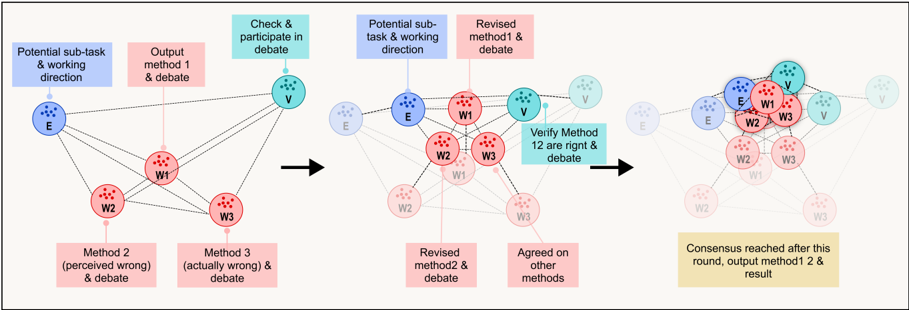
The image is a technical diagram illustrating a three-stage, iterative process for collaborative problem-solving or method validation. It depicts a network of agents (represented by nodes) that engage in debate, revision, and verification to reach a consensus. The flow progresses from left to right, indicated by bold black arrows between stages.
### Components/Axes
The diagram is composed of three distinct stages, each containing a network graph of nodes and associated text boxes.
**Node Types & Labels:**
* **E (Blue Node):** Appears in all stages. Labeled with a blue text box: "Potential sub-task & working direction".
* **W1, W2, W3 (Red Nodes):** Appear in all stages. Associated with pink text boxes describing methods and debate.
* **V (Teal Node):** Appears in all stages. Associated with a teal text box describing verification and debate.
**Text Box Labels (by Color and Position):**
* **Blue (Top-Left of each stage):** "Potential sub-task & working direction"
* **Pink (Various positions):**
* Stage 1: "Output method 1 & debate", "Method 2 (perceived wrong) & debate", "Method 3 (actually wrong) & debate"
* Stage 2: "Revised method1 & debate", "Revised method2 & debate", "Agreed on other methods"
* Stage 3: (No standalone pink boxes; text is integrated into the yellow consensus box)
* **Teal (Top-Right of Stages 1 & 2):**
* Stage 1: "Check & participate in debate"
* Stage 2: "Verify Method 1&2 are right & debate"
* **Yellow (Bottom-Right of Stage 3):** "Consensus reached after this round, output method1 & result"
**Flow Indicators:**
* **Solid Black Arrows:** Connect the three major stages, indicating the overall process flow from left to right.
* **Dashed Lines:** Connect nodes within each stage, representing communication, debate, or influence pathways between agents.
### Detailed Analysis
**Stage 1 (Left): Initial Proposal and Debate**
* **Network Structure:** Node E is connected to W1, W2, W3, and V. Nodes W1, W2, and W3 are also interconnected. V is connected to E and W1.
* **Process State:** An initial sub-task (from E) is presented. Three methods are proposed by the W-nodes. Method 1 is output for debate. Method 2 is perceived as wrong, and Method 3 is identified as actually wrong, both subject to debate. Node V's role is to check and participate in the debate.
**Stage 2 (Middle): Revision and Verification**
* **Network Structure:** The network becomes denser. All nodes (E, W1, W2, W3, V) are now interconnected with each other, forming a near-complete graph.
* **Process State:** Methods are revised based on debate. "Revised method1" and "Revised method2" are under debate. There is agreement on "other methods." Node V's role shifts to actively verifying that Methods 1 and 2 are correct, continuing the debate.
**Stage 3 (Right): Consensus**
* **Network Structure:** The nodes are visually clustered tightly together, with many overlapping connections, symbolizing unified agreement.
* **Process State:** A consensus has been reached. The final output is "method1 & result," as stated in the yellow box.
### Key Observations
1. **Increasing Connectivity:** The density of dashed connections between nodes increases dramatically from Stage 1 to Stage 2, visually representing the intensification of collaboration and debate.
2. **Role Evolution:** The function of node V evolves from passive participation ("Check & participate") to active verification ("Verify... are right").
3. **Method Refinement:** The process explicitly shows methods being labeled as wrong (Stage 1), then revised (Stage 2), leading to a final agreed-upon output (Stage 3).
4. **Spatial Grounding of Consensus:** The final consensus stage is marked not only by text but by a distinct visual change—the tight clustering of all nodes and the unique yellow color of the outcome box, setting it apart from the process-oriented pink and teal boxes.
### Interpretation
This diagram models a **structured deliberation protocol** for multi-agent systems or collaborative teams. It demonstrates a Peircean investigative process where:
* **Abduction:** Initial hypotheses (methods) are generated from a problem statement (sub-task from E).
* **Deduction:** These hypotheses are logically challenged and tested through debate and verification (roles of W-nodes and V).
* **Induction:** Through iterative revision and agreement, a reliable conclusion (consensus on method1 & result) is formed.
The underlying principle is that truth or the best solution emerges from the crucible of adversarial collaboration. The "perceived wrong" and "actually wrong" labels in Stage 1 highlight the system's ability to distinguish between subjective disagreement and objective error through debate. The final output isn't necessarily the first or most popular method, but the one that survives rigorous, collective scrutiny. This process is critical for high-stakes decision-making, complex problem-solving, or scientific validation where individual bias must be overcome by structured group intelligence.