## Diagram: Model Architecture and Similarity Functions
### Overview
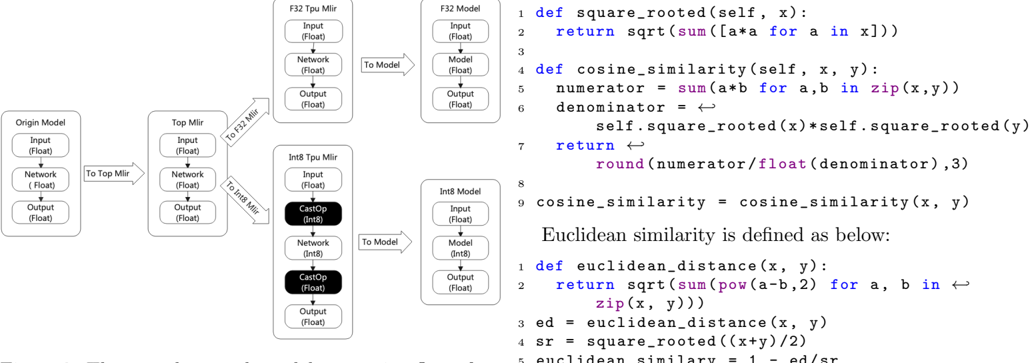
The image presents a diagram illustrating a model architecture involving multiple model types (Origin, Top, F32, Int8) and their interactions via "To Mir" and "To Model" operations. Alongside the diagram, there's a block of Python code defining functions for calculating square root and cosine similarity, as well as Euclidean distance. The diagram appears to represent a data flow or processing pipeline.
### Components/Axes
The diagram consists of four main sections, each representing a different model type:
* **Origin Model:** Input (Float), Network (Float), Output (Float)
* **Top Mir:** Input (Float), Network (Float), Output (Float)
* **F32 Tpu Mir:** Input (Float), Network (Float), Output (Float)
* **Int8 Tpu Mir:** Input (Int8), CastOp (Int8), Network (Int8), Output (Int8)
* **F32 Model:** Input (Float), Model (Float), Output (Float)
* **Int8 Model:** Input (Float), Model (Int8), Output (Float)
Connections between these sections are labeled "To Mir" and "To Model", indicating data transfer. The Python code block defines functions: `square_rooted`, `cosine_similarity`, and `euclidean_distance`.
### Detailed Analysis or Content Details
**Diagram Breakdown:**
* **Origin Model** connects to **Top Mir** via "To Mir".
* **Top Mir** connects to **F32 Tpu Mir** and **Int8 Tpu Mir** via "To Mir".
* **F32 Tpu Mir** connects to **F32 Model** via "To Model".
* **Int8 Tpu Mir** connects to **Int8 Model** via "To Model".
* All model components specify the data type (Float or Int8) within parentheses.
* The **Int8 Tpu Mir** section includes a "CastOp (Int8)" component, suggesting a data type conversion.
**Python Code Transcription:**
```python
def square_rooted(self, x):
return sqrt(sum([a*a for a in x]))
def cosine_similarity(self, x, y):
numerator = sum(a*b for a, b in zip(x,y))
denominator = (self.square_rooted(x)*self.square_rooted(y))
return round(numerator/float(denominator),3)
cosine_similarity = cosine_similarity(x, y)
Euclidean similarity is defined as below:
def euclidean_distance(x, y):
return sqrt(sum(pow(a-b,2) for a, b in zip(x, y)))
ed = euclidean_distance(x, y)
sr = square_rooted((x+y)/2)
euclidean_similarity = 1 - ed/sr
```
### Key Observations
* The diagram shows a pipeline where data flows from the Origin Model through various transformations (Top Mir, F32/Int8 Tpu Mir) to final models (F32/Int8 Model).
* The inclusion of both F32 (float32) and Int8 models suggests a quantization process is being explored, potentially for performance optimization.
* The "CastOp" in the Int8 Tpu Mir section confirms the conversion of data to Int8 format.
* The Python code provides implementations for calculating cosine similarity and Euclidean distance, which are common metrics for comparing vectors or data representations.
* The cosine similarity function is defined as a method of a class (`self`), suggesting it's part of a larger object-oriented structure.
* The Euclidean similarity is calculated as `1 - ed/sr`, where `ed` is the Euclidean distance and `sr` is the square root of the average of x and y.
### Interpretation
The diagram and code together suggest a system for evaluating or comparing different model representations (F32 vs. Int8). The pipeline likely involves converting a model to Int8 format (using the CastOp) and then comparing the outputs of the F32 and Int8 models using cosine similarity or Euclidean distance. This comparison could be used to assess the accuracy or performance impact of quantization. The "To Mir" and "To Model" operations likely represent data transfer between different processing stages or devices (e.g., CPU to TPU). The code provides the mathematical tools for quantifying the similarity between the outputs of these models. The use of both cosine and Euclidean similarity suggests a comprehensive evaluation of the model's behavior after quantization. The diagram is a high-level architectural overview, while the code provides the underlying mathematical functions used for analysis.