\n
## Diagram: Knowledge Retrieval Process for Government Type
### Overview
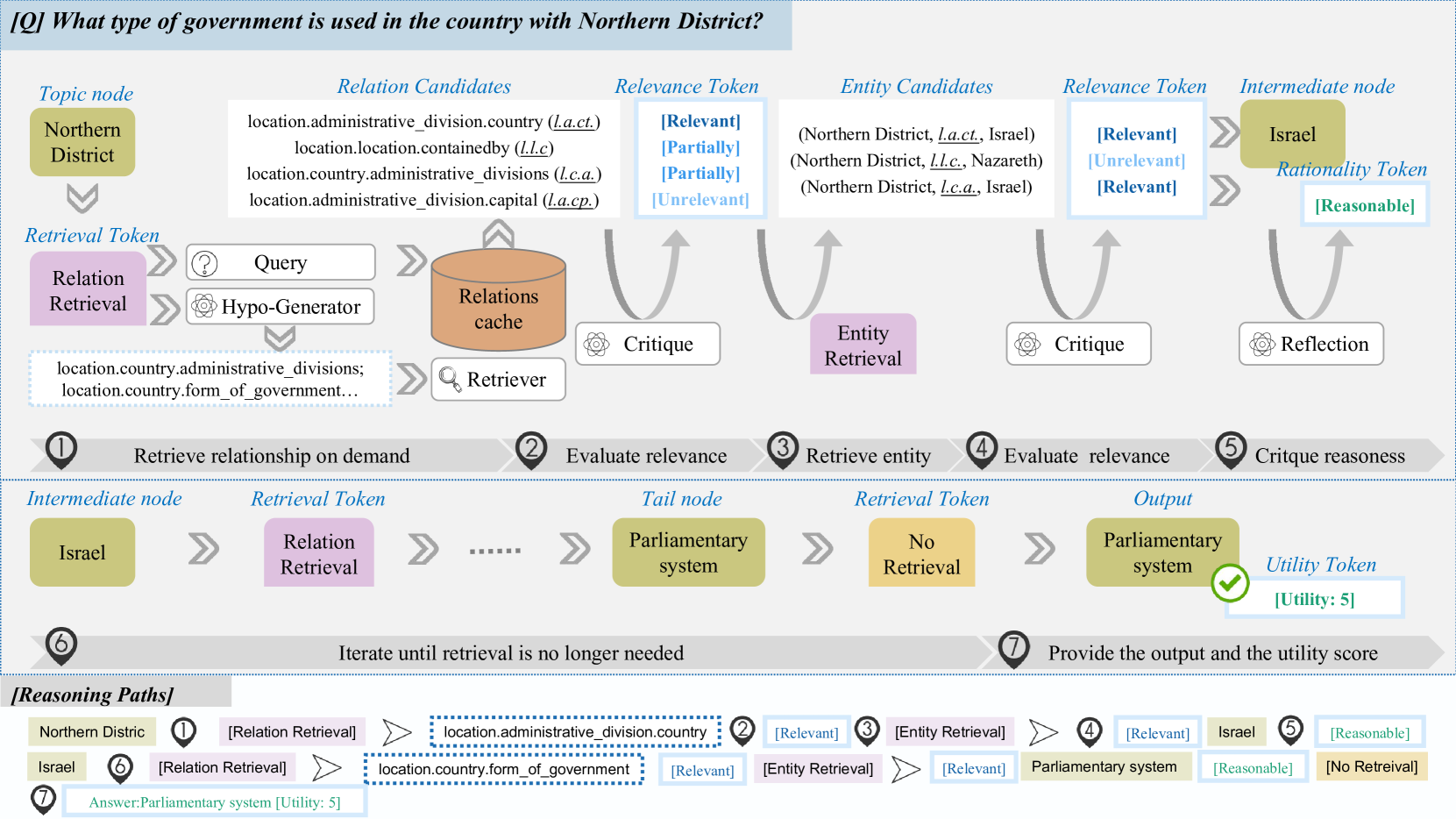
This diagram illustrates a knowledge retrieval process designed to answer the question: "What type of government is used in the country with Northern District?". It depicts a multi-stage process involving relation and entity retrieval, relevance evaluation, critique, and reflection, ultimately leading to an output. The diagram is structured as a flow chart with several parallel and sequential paths.
### Components/Axes
The diagram consists of several key components:
* **Query:** The initial question posed to the system.
* **Topic Node:** "Northern District" - the starting point for information retrieval.
* **Relation Candidates:** A list of potential relationships to the topic node (e.g., location.administrative\_division.country). Each candidate is associated with a "Relevance Token" ([Relevant], [Partially], [Unrelevant]).
* **Entity Candidates:** A list of potential entities related to the topic node (e.g., Northern District, Israel). Each candidate is associated with a "Relevance Token" ([Relevant], [Unrelevant]).
* **Intermediate Node:** "Israel" - a node reached during the retrieval process.
* **Tail Node:** "Parliamentary system" - the final entity identified as the answer.
* **Retrieval Token:** Indicates the type of retrieval performed (Relation Retrieval, Entity Retrieval).
* **Relevance Token:** Indicates the relevance of a candidate (Relevant, Partially, Unrelevant).
* **Rationality Token:** Indicates the rationality of the process ([Reasonable]).
* **Utility Token:** Indicates the utility score of the output ([Utility: 5]).
* **Process Stages:** Numbered 1-6, describing the steps in the retrieval process.
* **Reasoning Paths:** A section at the bottom showing the specific paths taken to arrive at the answer.
* **Components:** Hypo-Generator, Relations Cache, Retriever, Critique, Reflection.
### Detailed Analysis or Content Details
The diagram shows the following flow:
1. **Retrieve relationship on demand:** The system retrieves relationships associated with "Northern District". Relation candidates include:
* location.administrative\_division.country (Labeled [Relevant])
* location.containedby (Labeled [Partially])
* location.country.administrative\_divisions (Labeled [Partially])
* location.administrative\_division.capital (Labeled [Unrelevant])
2. **Evaluate relevance:** The relevance of the retrieved relationships is evaluated.
3. **Retrieve entity:** The system retrieves entities related to the identified relationships. Entity candidates include:
* Northern District, La.ct, Israel (Labeled [Relevant])
* Northern District, L.c.a., Nazareth (Labeled [Unrelevant])
* Northern District, L.c.a., Israel (Labeled [Relevant])
4. **Evaluate relevance:** The relevance of the retrieved entities is evaluated.
5. **Critique reasoness:** The system critiques the reasonability of the process.
6. **Iterate until retrieval is no longer needed:** The process iterates until a satisfactory answer is found.
The intermediate node "Israel" is then used for further relation retrieval, leading to "Parliamentary system". The final output is "Parliamentary system" with a utility score of 5.
**Reasoning Paths:**
* Northern District -> [Relation Retrieval] -> location.administrative\_division.country -> [Relevant] -> Israel -> [Entity Retrieval] -> Parliamentary system -> [Relevant] -> Israel -> [Reasonable] -> [No Retrieval]
* Israel -> [Relation Retrieval] -> location.country.form\_of\_government -> [Relevant] -> Parliamentary system -> [Entity Retrieval] -> Parliamentary system -> [Reasonable] -> [No Retrieval]
### Key Observations
* The diagram highlights the importance of relevance evaluation at multiple stages.
* The process involves both relation and entity retrieval, demonstrating a hybrid approach.
* The "Critique" and "Reflection" components suggest a self-assessment mechanism to ensure the quality of the results.
* The utility score provides a quantitative measure of the output's usefulness.
* The diagram shows multiple potential paths, but only one is ultimately followed to arrive at the answer.
### Interpretation
The diagram demonstrates a sophisticated knowledge retrieval system capable of answering complex questions by leveraging relationships between entities. The system doesn't simply retrieve information; it actively evaluates relevance, critiques its own reasoning, and refines its search until a satisfactory answer is found. The use of relevance tokens and utility scores suggests a probabilistic or scoring-based approach to knowledge representation and retrieval. The diagram illustrates a process of iterative refinement, where the system builds upon initial findings to arrive at a more accurate and complete answer. The parallel paths indicate the system explores multiple possibilities before converging on the most likely solution. The inclusion of "Critique" and "Reflection" suggests a level of meta-cognition, allowing the system to assess the validity of its own reasoning. The diagram is a visual representation of a complex AI process, showcasing the steps involved in understanding and responding to a natural language query.