\n
## Diagram: Tree Structure
### Overview
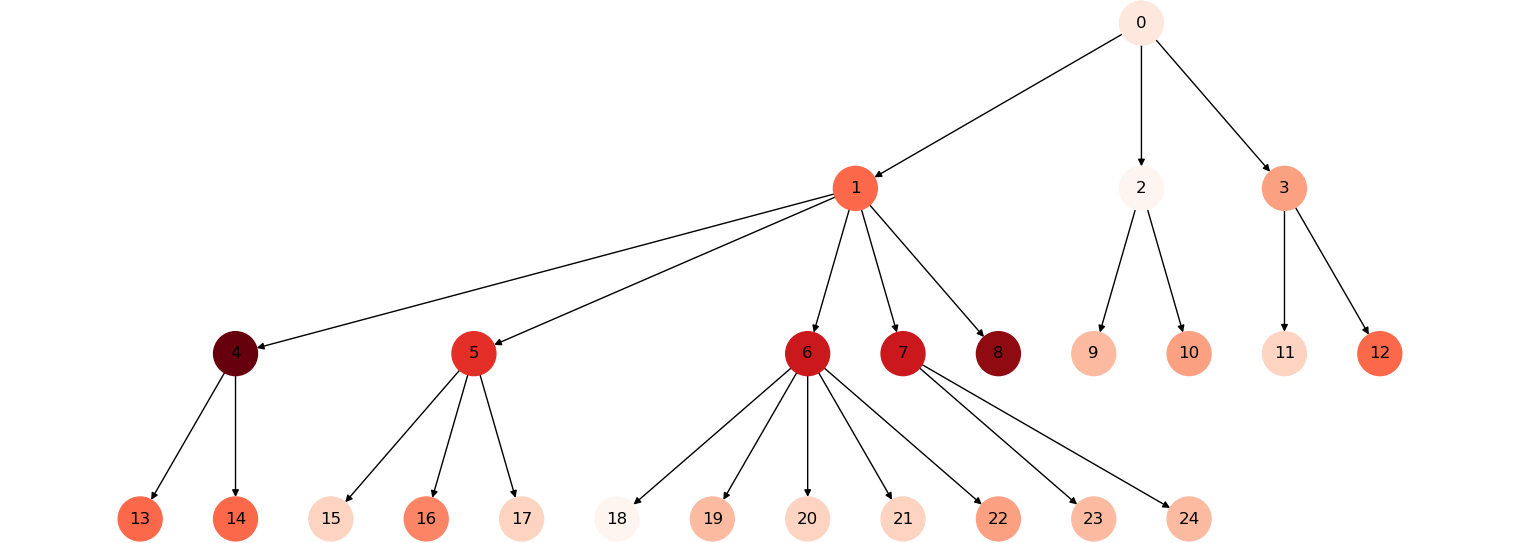
The image depicts a tree-like diagram with numbered nodes and connecting lines. The diagram represents a hierarchical structure, likely illustrating a branching process or a decision tree. The nodes are numbered from 0 to 24. The root node is 0, and the diagram branches out to multiple levels.
### Components/Axes
The diagram consists of nodes represented by circles, each labeled with a number. The lines connecting the nodes indicate relationships between them, showing the direction of the hierarchy. There are no explicit axes or scales. The nodes are arranged in a roughly symmetrical fashion, with the root node at the top-center and branches extending downwards and outwards.
### Detailed Analysis or Content Details
The tree structure can be described as follows:
* **Node 0:** The root node.
* **Node 0 branches to:** Nodes 1 and 2.
* **Node 1 branches to:** Nodes 3, 4, 5, 6, 7, and 8.
* **Node 2 branches to:** Nodes 9, 10, 11, and 12.
* **Node 3 branches to:** Nodes 13 and 14.
* **Node 4 branches to:** Nodes 15 and 16.
* **Node 5 branches to:** Nodes 17 and 18.
* **Node 6 branches to:** Nodes 19 and 20.
* **Node 7 branches to:** Nodes 21 and 22.
* **Node 8 branches to:** Nodes 23 and 24.
The diagram shows a binary tree structure for nodes 3, 4, 5, 6, 7, and 8, where each node branches into two child nodes. Nodes 0, 1, and 2 have varying numbers of child nodes.
### Key Observations
The diagram is a directed acyclic graph (DAG) representing a hierarchical structure. The branching factor varies across different levels of the tree. The nodes are numbered sequentially, suggesting a possible order or sequence of operations or decisions. The diagram is visually balanced, with a relatively even distribution of branches.
### Interpretation
The diagram likely represents a decision tree, a branching process, or a hierarchical organization. The nodes could represent states, decisions, or categories, and the branches could represent transitions, choices, or relationships. The numbering of the nodes suggests a possible order of execution or a sequence of steps. The varying branching factors indicate that some nodes have more options or possibilities than others.
The structure could be used to model a variety of real-world scenarios, such as:
* **Decision-making:** Each node represents a decision point, and the branches represent different choices.
* **Classification:** Each node represents a feature, and the branches represent different values of that feature.
* **Organization:** Each node represents a department or team, and the branches represent reporting relationships.
* **Game tree:** Each node represents a game state, and the branches represent possible moves.
Without additional context, it is difficult to determine the specific meaning of the diagram. However, the structure itself provides valuable information about the relationships between the nodes and the overall organization of the system.