## Flowchart: Visual Concept Extraction and Rule Generation Pipeline
### Overview
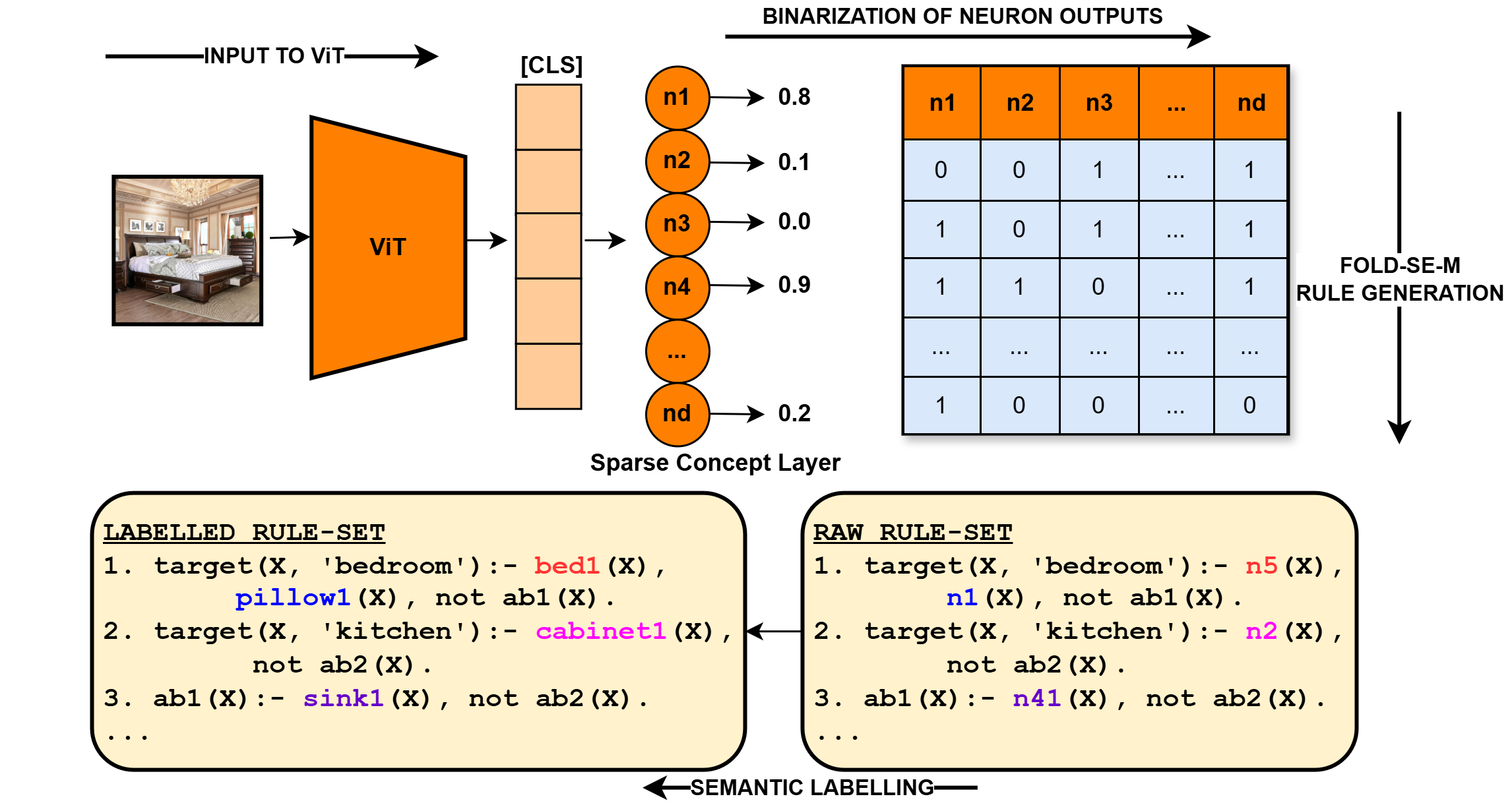
The diagram illustrates a technical pipeline for extracting visual concepts from an input image using a Vision Transformer (ViT) and generating interpretable rules through neuron binarization and semantic labeling. The process involves multiple stages: feature extraction, sparse concept identification, binarization, and rule generation.
### Components/Axes
1. **Input to ViT**:
- Input image (bedroom scene) → ViT (orange hexagon)
- Output: Class token (CLS) (peach rectangle)
2. **Sparse Concept Layer**:
- Neurons n1-n5 with activation values (0.8, 0.1, 0.0, 0.9, 0.2)
- Binarization matrix (0s/1s) representing neuron states
3. **Fold-SEM Rule Generation**:
- Left: Labeled Rule-Set (bedroom/kitchen concepts)
- Right: Raw Rule-Set (neuron-based rules)
4. **Semantic Labeling**:
- Connection between raw rules and labeled concepts
### Detailed Analysis
#### Binarization Matrix
| Neuron | n1 | n2 | n3 | ... | nd |
|--------|----|----|----|-----|----|
| n1 | 0 | 0 | 1 | ... | 1 |
| n2 | 1 | 0 | 1 | ... | 1 |
| n3 | 1 | 1 | 0 | ... | 1 |
| n4 | ...| ...| ...| ... | ...|
| n5 | 1 | 0 | 0 | ... | 0 |
#### Rule Sets
**Labeled Rule-Set**:
1. `target(X, 'bedroom'):- bed1(X), pillow1(X), not ab1(X).`
2. `target(X, 'kitchen'):- cabinet1(X), not ab2(X).`
3. `ab1(X):- sink1(X), not ab2(X).`
**Raw Rule-Set**:
1. `target(X, 'bedroom'):- n5(X), n1(X), not ab1(X).`
2. `target(X, 'kitchen'):- n2(X), not ab2(X).`
3. `ab1(X):- n41(X), not ab2(X).`
### Key Observations
1. **Activation Thresholding**: Neurons with activation >0.5 are binarized to 1 (e.g., n1=0.8→1, n3=0.0→0)
2. **Concept Composition**: Bedroom concept combines bed1 + pillow1 while excluding ab1
3. **Attribute Negation**: Rules explicitly exclude certain attributes (ab1/ab2)
4. **Neuron Mapping**: Raw rules use neuron indices (n1-n5) while labeled rules use semantic terms (bed1, cabinet1)
### Interpretation
This pipeline demonstrates a method for creating interpretable AI systems by:
1. **Concept Decomposition**: Breaking down complex visual concepts (bedroom/kitchen) into constituent neurons
2. **Rule Extraction**: Translating neural activations into human-readable logical rules
3. **Attribute Handling**: Explicitly modeling object relationships through negation (not ab1)
The use of fold-SEM (First-Order Semantic Mapping) suggests a formal framework for connecting low-level neural representations to high-level semantic concepts. The explicit negation in rules indicates the system can model both presence and absence of features, crucial for accurate scene understanding.
The pipeline's strength lies in its ability to maintain interpretability while leveraging the representational power of deep learning models, potentially enabling more transparent AI decision-making in visual domains.