\n
## Diagram: Hexagonal Network
### Overview
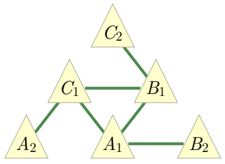
The image depicts a diagram of a hexagonal network composed of six triangular nodes connected by lines. Each node is labeled with a combination of a letter and a subscript number. The diagram appears to represent a network or a system with interconnected components.
### Components/Axes
The diagram consists of the following components:
* **Nodes:** Six triangular nodes labeled A1, A2, B1, B2, C1, and C2.
* **Connections:** Lines connecting the nodes, forming a hexagonal shape.
* **Labels:** Each node is labeled with a unique identifier.
### Detailed Analysis or Content Details
The nodes and their connections are as follows:
* A1 is connected to A2, B1, and B2.
* A2 is connected to A1 and C1.
* B1 is connected to A1, C1, and B2.
* B2 is connected to A1 and C2.
* C1 is connected to A2 and B1.
* C2 is connected to B2.
The lines are all of the same color (green) and thickness. The nodes are filled with a pale yellow color. The arrangement forms a closed loop, resembling a hexagon.
### Key Observations
The network is symmetrical in its arrangement. The connections create a closed loop, suggesting a cyclical or interconnected system. The labeling scheme (letter followed by a number) might indicate different states or types within each node.
### Interpretation
The diagram likely represents a network or system where each node (A1, A2, etc.) represents a state or component, and the lines represent relationships or connections between them. The hexagonal shape suggests a balanced or stable configuration. The specific meaning of the nodes and connections would depend on the context in which this diagram is used. It could represent a chemical structure, a communication network, or a state transition diagram in a computational system. Without further context, it's difficult to determine the precise meaning, but the diagram clearly illustrates a structured, interconnected system.