## Diagram: Difficulty Increases
### Overview
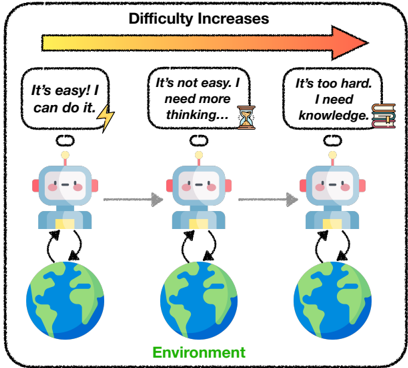
The image is a diagram illustrating how a robot's interaction with its environment changes as the difficulty of the task increases. It shows three stages of increasing difficulty, each represented by a robot interacting with a globe (representing the environment), accompanied by a thought bubble and an icon representing the robot's state of mind. An arrow indicates the direction of increasing difficulty.
### Components/Axes
* **Title:** "Difficulty Increases"
* **Horizontal Axis:** Implied, representing increasing difficulty from left to right.
* **Environment:** Represented by a globe at the bottom of each stage.
* **Robot:** A cartoon robot interacting with the environment.
* **Thought Bubbles:** Contain text indicating the robot's perception of the difficulty.
* **Icons:** Represent the robot's state of mind (lightning bolt, hourglass, books).
* **Arrow:** A horizontal arrow at the top, colored from yellow to red, indicating the direction of increasing difficulty.
### Detailed Analysis
The diagram is divided into three stages, each representing a different level of difficulty:
**Stage 1 (Left):**
* **Thought Bubble:** "It's easy! I can do it."
* **Icon:** A lightning bolt.
* **Robot-Environment Interaction:** A double arrow indicates interaction between the robot and the globe.
**Stage 2 (Middle):**
* **Thought Bubble:** "It's not easy. I need more thinking..."
* **Icon:** An hourglass.
* **Robot-Environment Interaction:** A double arrow indicates interaction between the robot and the globe.
**Stage 3 (Right):**
* **Thought Bubble:** "It's too hard. I need knowledge."
* **Icon:** A stack of books.
* **Robot-Environment Interaction:** A double arrow indicates interaction between the robot and the globe.
The arrow at the top is colored from yellow on the left to red on the right, visually reinforcing the concept of increasing difficulty.
### Key Observations
* The robot's perception of difficulty increases from "easy" to "too hard" as we move from left to right.
* The icons change to reflect the robot's needs: energy (lightning bolt), time (hourglass), and knowledge (books).
* The interaction between the robot and the environment remains constant (represented by the double arrow), but the robot's internal state changes.
### Interpretation
The diagram illustrates how the demands on a robot (or any agent) change as the difficulty of a task increases. Initially, the task is easy, and the robot can accomplish it with ease (lightning bolt representing energy/speed). As the difficulty increases, the robot needs more time to think (hourglass). Finally, when the task becomes too hard, the robot requires additional knowledge (books) to solve it. The constant interaction with the environment suggests that the environment provides the context and challenges that drive the robot's learning and adaptation. The color gradient of the arrow reinforces the concept of a continuous increase in difficulty.