\n
## Diagram: Robot Progression with Increasing Difficulty
### Overview
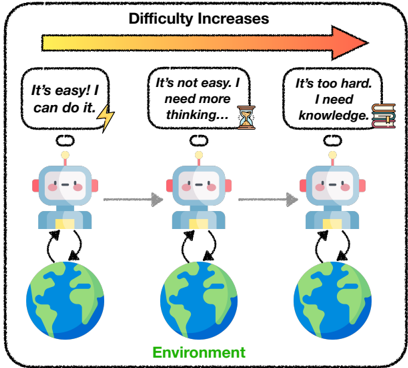
The image is a diagram illustrating the progression of a robot's capabilities as it encounters increasing difficulty in its environment. It depicts three robots, each positioned above a globe representing the "Environment," with speech bubbles indicating their perceived level of challenge. An arrow at the top indicates that "Difficulty Increases" from left to right.
### Components/Axes
The diagram consists of the following components:
* **Robots:** Three identical robot figures, arranged horizontally.
* **Globes:** Three globes, one beneath each robot, labeled "Environment".
* **Speech Bubbles:** Three speech bubbles, each associated with a robot, containing text describing the robot's state.
* **Arrow:** A horizontal arrow at the top of the diagram, labeled "Difficulty Increases".
* **Icons:** A lightning bolt, an hourglass, and books are present within the speech bubbles.
* **Arrows:** Grey arrows indicating a flow or progression between the robots.
### Detailed Analysis or Content Details
The diagram shows a sequence of three states:
1. **Robot 1 (Left):**
* Speech Bubble: "It's easy! I can do it."
* Icon: A yellow lightning bolt.
2. **Robot 2 (Center):**
* Speech Bubble: "It's not easy. I need more thinking..."
* Icon: An hourglass.
3. **Robot 3 (Right):**
* Speech Bubble: "It's too hard. I need knowledge."
* Icon: A stack of books.
The "Difficulty Increases" arrow points from left to right, indicating a progression from easier tasks to more challenging ones. The grey arrows between the robots also point from left to right, suggesting a sequential flow. The globes are identical and labeled "Environment" at the bottom center of the diagram.
### Key Observations
The diagram illustrates a clear progression in the robot's perceived difficulty and the resources it believes it needs to overcome challenges. The initial state is one of confidence ("It's easy!"), followed by a need for more processing ("I need more thinking..."), and finally a requirement for external knowledge ("I need knowledge."). The icons visually represent these needs: speed/power, time/processing, and information/learning.
### Interpretation
This diagram likely represents a simplified model of artificial intelligence or machine learning. It suggests that as tasks become more complex, a robot's initial capabilities may be sufficient, but eventually, it will require more advanced cognitive abilities (thinking) and access to external knowledge to succeed. The "Environment" remains constant, implying that the increasing difficulty stems from the complexity of the tasks *within* that environment, rather than changes to the environment itself.
The diagram highlights the limitations of purely reactive or rule-based systems. The progression from "easy" to "hard" suggests that a certain level of intelligence is required to even recognize the need for more advanced capabilities. The final stage, requiring "knowledge," implies that the robot needs to be able to learn and adapt to new situations, rather than simply relying on pre-programmed responses.
The diagram is a conceptual illustration and does not contain specific data points or numerical values. It is a qualitative representation of a process, rather than a quantitative measurement.