## Diagram: Difficulty Progression in Human-Environment Interaction
### Overview
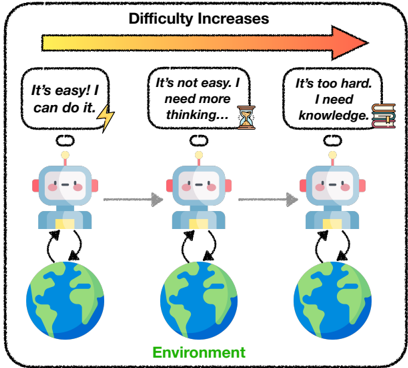
The image is a conceptual diagram illustrating a three-stage progression of increasing task difficulty and the corresponding change in an agent's (represented by a robot) cognitive state and required resources when interacting with an environment. The flow moves from left to right, as indicated by a large directional arrow at the top.
### Components/Axes
1. **Title & Directional Arrow:** Located at the top center. The text reads **"Difficulty Increases"**. Below it is a large, right-pointing arrow with a color gradient from yellow (left) to red (right), visually reinforcing the concept of escalating challenge.
2. **Main Panels:** Three distinct panels arranged horizontally, connected by gray arrows pointing right, indicating a sequence or progression.
3. **Core Elements per Panel:**
* **Agent:** A stylized, cartoonish robot with a screen face, antenna, and limbs. Its facial expression changes across panels.
* **Environment:** A globe (Earth) depicted below each robot, labeled with the green text **"Environment"** at the bottom center of the entire diagram. Curved arrows form a loop between the robot and the globe, symbolizing continuous interaction.
* **Speech Bubble:** Contains the agent's internal monologue or statement.
* **Icon:** A small symbolic icon placed next to the speech bubble.
4. **Connecting Arrows:** Gray arrows point from the robot in one panel to the robot in the next, showing the flow of progression.
### Detailed Analysis
**Panel 1 (Left - Low Difficulty):**
* **Speech Bubble Text:** "It's easy! I can do it."
* **Icon:** A yellow lightning bolt (⚡), symbolizing speed, energy, or immediate capability.
* **Robot Expression:** Smiling, happy face.
* **Interaction Loop:** Arrows between robot and globe are simple and direct.
**Panel 2 (Center - Medium Difficulty):**
* **Speech Bubble Text:** "It's not easy. I need more thinking..."
* **Icon:** An hourglass (⏳), symbolizing time, patience, or processing required.
* **Robot Expression:** Neutral, focused, or slightly concerned face (straight line mouth).
* **Interaction Loop:** Arrows remain, suggesting ongoing engagement.
**Panel 3 (Right - High Difficulty):**
* **Speech Bubble Text:** "It's too hard. I need knowledge."
* **Icon:** A stack of books (📚), symbolizing the need for external information, learning, or expertise.
* **Robot Expression:** Frowning, stressed, or overwhelmed face.
* **Interaction Loop:** Arrows persist, indicating the interaction continues despite the challenge.
### Key Observations
1. **Clear Progression:** The diagram establishes a direct, linear correlation between increasing environmental difficulty and the agent's internal state (from confidence to strain) and resource needs (from innate ability to time to external knowledge).
2. **Visual Coding:** Difficulty is encoded through:
* **Text:** The explicit statements in the speech bubbles.
* **Iconography:** The shift from lightning (action) to hourglass (process) to books (acquisition).
* **Facial Expression:** The robot's face degrades from happy to stressed.
* **Color Gradient:** The top arrow's shift from yellow to red implies warning or danger.
3. **Persistent Interaction:** The loop between agent and environment is present in all stages, emphasizing that the relationship is constant; only the nature of the challenge and the agent's response change.
### Interpretation
This diagram models a fundamental principle in problem-solving, learning, and AI development. It suggests that as tasks or environments become more complex, an agent's strategy must evolve from relying on pre-existing, automatic capabilities ("It's easy!") to engaging in deliberate processing ("thinking..."), and finally to recognizing the limits of its current model and the necessity for acquiring new information or skills ("knowledge").
The "Environment" is the constant source of challenge. The progression implies that for sustainable interaction with increasingly difficult environments, an agent must be equipped not just with fixed algorithms but with mechanisms for **metacognition** (recognizing when a task is hard) and **knowledge acquisition** (seeking books/data). This is a core concept in creating adaptive, general intelligence. The diagram serves as a simple but effective visual metaphor for the stages of competence and the resources required at each level of challenge.