## Diagram: Difficulty Progression in Robot-Environment Interaction
### Overview
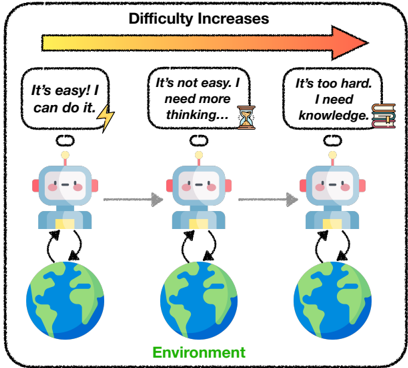
The diagram illustrates a three-stage progression of a robot's interaction with an Earth-like environment, with increasing difficulty levels. Each stage is represented by a robot figure with distinct speech bubbles and symbolic annotations, connected by a gradient arrow labeled "Difficulty Increases" (yellow to red). The Earth is consistently depicted beneath each robot, labeled "Environment."
### Components/Axes
- **Title**: "Difficulty Increases" (top-center, gradient arrow from yellow to red)
- **Robot Figures**: Three identical robots in a horizontal row, each with:
- Speech bubble text
- Symbolic icon (lightning bolt, hourglass, books)
- Connection to Earth via bidirectional arrow
- **Environment**: Earth illustration labeled "Environment" (bottom-center)
- **Speech Bubbles**:
1. "It's easy! I can do it." (Stage 1, lightning bolt icon)
2. "It's not easy. I need more thinking..." (Stage 2, hourglass icon)
3. "It's too hard. I need knowledge." (Stage 3, books icon)
- **Arrow Flow**: Rightward progression between robots, with gradient intensity increasing
### Detailed Analysis
1. **Stage 1 (Left)**:
- Text: "It's easy! I can do it."
- Symbol: Yellow lightning bolt (confidence/energy)
- Connection: Bidirectional arrow to Earth (suggests active engagement)
2. **Stage 2 (Center)**:
- Text: "It's not easy. I need more thinking..."
- Symbol: Hourglass (time/resource constraint)
- Connection: Bidirectional arrow to Earth (persistent interaction)
3. **Stage 3 (Right)**:
- Text: "It's too hard. I need knowledge."
- Symbol: Stack of books (knowledge dependency)
- Connection: Bidirectional arrow to Earth (sustained interaction)
### Key Observations
- **Difficulty Gradient**: The arrow's color transition (yellow → red) visually reinforces the increasing challenge.
- **Symbolic Progression**: Icons evolve from energy (⚡) to time (⏳) to knowledge (📚), indicating shifting resource requirements.
- **Environment Consistency**: Earth remains unchanged across stages, implying the challenge originates from the robot's capabilities rather than environmental factors.
- **Bidirectional Arrows**: Suggest continuous feedback loops between robot and environment at all stages.
### Interpretation
The diagram metaphorically represents cognitive or systemic complexity escalation. The robot's evolving statements reflect:
1. **Initial Overconfidence**: Underestimating task complexity (Stage 1)
2. **Resource Awareness**: Recognizing time/processing limitations (Stage 2)
3. **Knowledge Dependency**: Acknowledging the need for accumulated expertise (Stage 3)
The static Earth implies that environmental variables remain constant, while the robot's internal state (confidence, resources, knowledge) determines perceived difficulty. This could model:
- AI learning curves in dynamic environments
- User experience design for escalating task complexity
- Educational scaffolding frameworks
Notably absent are quantitative metrics, suggesting the diagram prioritizes conceptual progression over measurable data. The bidirectional arrows emphasize reciprocity between agent and environment, even as difficulty increases.