## Educational Material: Problem Solving - Fiber Bolts
### Overview
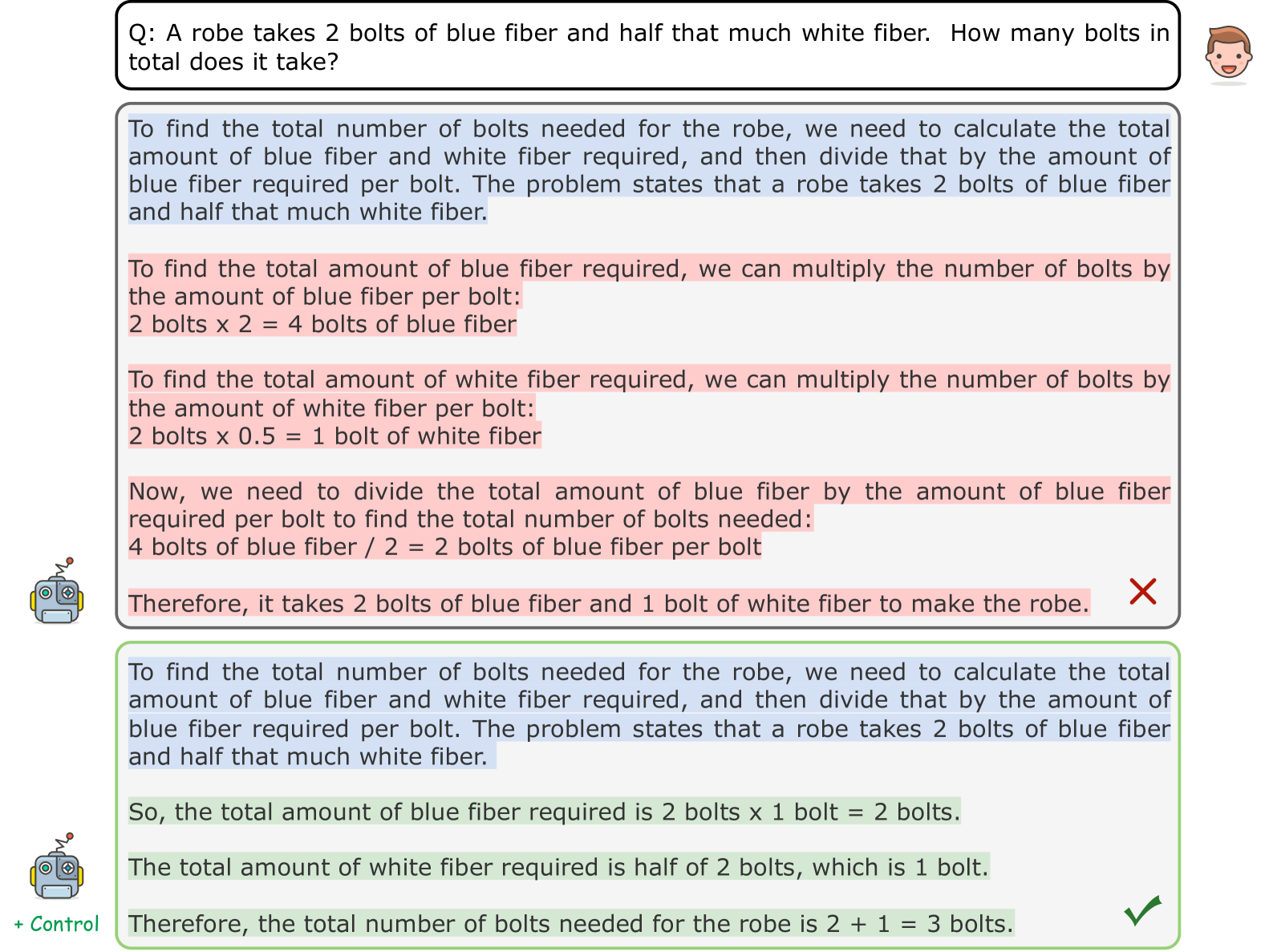
The image presents a step-by-step solution to a word problem involving calculating the total number of fiber bolts needed for a robe, given the quantities of blue and white fiber. It showcases two different solution attempts, one marked incorrect (red 'X') and one correct (green checkmark). The problem is stated at the top, followed by detailed explanations and calculations for each attempt. There are also cartoon-style robot illustrations accompanying the solution steps.
### Components/Axes
The image consists of the following components:
* **Problem Statement:** "Q: A robe takes 2 bolts of blue fiber and half that much white fiber. How many bolts in total does it take?" - Located at the top of the image.
* **Incorrect Solution:** A detailed explanation with calculations leading to an incorrect answer. Marked with a red 'X' in a yellow box.
* **Correct Solution:** A detailed explanation with calculations leading to the correct answer. Marked with a green checkmark.
* **Robot Illustrations:** Two cartoon robots are present, one near the incorrect solution and one near the control/correct solution.
* **"+ Control" Label:** Located below the correct solution, indicating a reference or control solution.
### Detailed Analysis or Content Details
**Problem Statement:**
The problem asks for the total number of bolts needed for a robe, given 2 bolts of blue fiber and half that amount of white fiber.
**Incorrect Solution:**
1. "To find the total number of bolts needed for the robe, we need to calculate the total amount of blue fiber and white fiber required, and then divide that by the amount of blue fiber required per bolt. The problem states that a robe takes 2 bolts of blue fiber and half that much white fiber."
2. "To find the total amount of blue fiber required, we can multiply the number of bolts by the amount of blue fiber per bolt: 2 bolts x 2 = 4 bolts of blue fiber"
3. "To find the total amount of white fiber required, we can multiply the number of bolts by the amount of white fiber per bolt: 2 bolts x 0.5 = 1 bolt of white fiber"
4. "Now, we need to divide the total amount of blue fiber by the amount of blue fiber required per bolt to find the total number of bolts needed: 4 bolts of blue fiber / 2 = 2 bolts of blue fiber per bolt"
5. "Therefore, it takes 2 bolts of blue fiber and 1 bolt of white fiber to make the robe."
**Correct Solution:**
1. "To find the total number of bolts needed for the robe, we need to calculate the total amount of blue fiber and white fiber required, and then divide that by the amount of blue fiber required per bolt. The problem states that a robe takes 2 bolts of blue fiber and half that much white fiber."
2. "So, the total amount of blue fiber required is 2 bolts x 1 = 2 bolts."
3. "The total amount of white fiber required is half of 2 bolts, which is 1 bolt."
4. "Therefore, the total number of bolts needed for the robe is 2 + 1 = 3 bolts."
### Key Observations
* The incorrect solution misinterprets the problem, multiplying the number of bolts by the amount of fiber *per* bolt instead of directly calculating the total fiber needed.
* The correct solution accurately calculates the total fiber needed for each color and then sums them to find the total number of bolts.
* The use of robot illustrations is purely for visual engagement and does not contribute to the mathematical content.
### Interpretation
The image serves as an educational tool to demonstrate a common error in problem-solving – misinterpreting the quantities and operations required. The side-by-side comparison of the incorrect and correct solutions highlights the importance of carefully reading and understanding the problem statement before applying mathematical operations. The incorrect solution demonstrates a flawed logic, while the correct solution provides a clear and accurate step-by-step approach. The visual cues (red 'X' and green checkmark) reinforce the concept of correct and incorrect answers. The image is designed to help students identify and avoid similar errors in their own problem-solving process. The problem itself is a simple arithmetic exercise, but the presentation focuses on the *process* of arriving at the solution, rather than just the answer.