\n
## Diagram: Elements of Art
### Overview
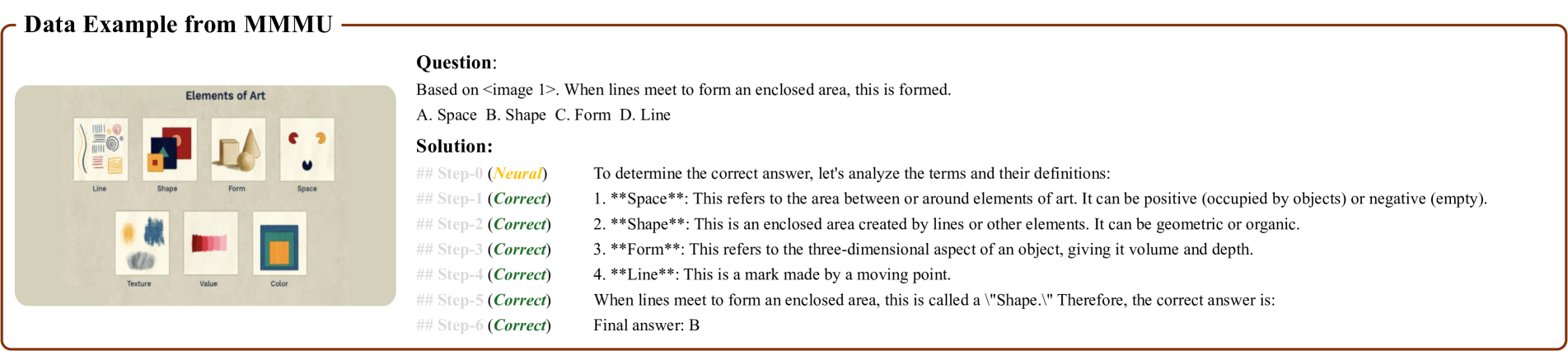
The image presents a diagram illustrating the "Elements of Art". It consists of a header with the title "Elements of Art", followed by six visual representations of different elements, each accompanied by a label. A question and solution related to the diagram are also present on the right side of the image.
### Components/Axes
The diagram features the following elements:
* **Line:** Represented by a series of vertical lines.
* **Shape:** Represented by a square with a pattern.
* **Form:** Represented by a three-dimensional shape resembling a cube.
* **Space:** Represented by a series of red dots.
* **Texture:** Represented by a patterned, swirling design.
* **Color:** Represented by a color wheel.
The right side of the image contains a question: "Based on <image !>. When lines meet to form an enclosed area, this is formed." with multiple-choice answers: A. Space B. Shape C. Form D. Line.
Below the question is a "Solution" section, broken down into steps 1-6.
### Content Details
The "Solution" section provides definitions for each element of art:
* **Step 1:** Space - refers to the area between or around elements of art. It can be positive (occupied by objects) or negative (empty).
* **Step 2:** Shape - is an enclosed area created by lines or other elements. It can be geometric or organic.
* **Step 3:** Form - refers to the three-dimensional aspect of an object, giving it volume and depth.
* **Step 4:** Line - is a mark made by a moving point.
* **Step 5:** When lines meet to form an enclosed area, this is called a "Shape."
* **Step 6:** Final answer: B.
### Key Observations
The diagram clearly defines and visually represents the fundamental elements of art. The solution section provides a step-by-step explanation of how to arrive at the correct answer to the question. The question focuses on the relationship between lines and shapes.
### Interpretation
The diagram serves as an educational tool to introduce and explain the core concepts of visual art. It demonstrates how basic elements like lines, shapes, and forms combine to create more complex artistic expressions. The question and solution section reinforce the understanding of these concepts through a practical application. The diagram is designed to be self-explanatory, with each element clearly labeled and visually distinct. The solution section provides a logical reasoning process, making it easy to understand why "Shape" is the correct answer. The diagram is a foundational piece for art education, providing a basic vocabulary and understanding of visual principles.