\n
## Screenshot: Educational Data Example from MMMU
### Overview
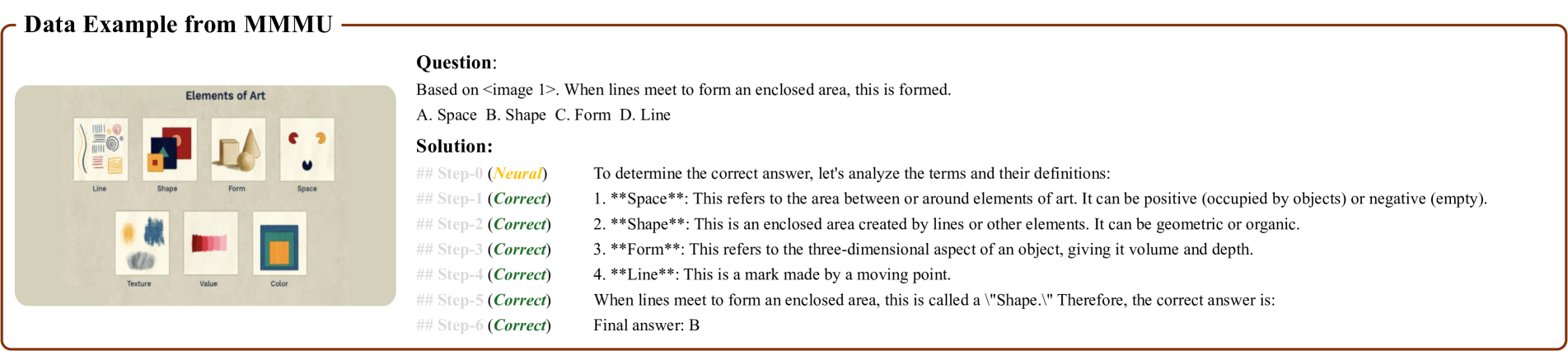
The image is a screenshot of an educational slide or document titled "Data Example from MMMU." It presents a multiple-choice question based on a visual diagram illustrating the "Elements of Art." The layout is divided into a header, a left-side diagram, and a right-side text block containing a question and a step-by-step solution.
### Components
1. **Header**: A title bar at the top with the text "**Data Example from MMMU**" in bold, underlined with a brown line.
2. **Left Diagram ("Elements of Art")**: A beige rectangular panel containing seven labeled cards arranged in two rows.
* **Top Row (Left to Right)**:
* Card 1: Illustration of various lines (wavy, straight, circles). Label below: **Line**.
* Card 2: Illustration of geometric shapes (square, circle, triangle). Label below: **Shape**.
* Card 3: Illustration of 3D objects (cube, cone, cylinder). Label below: **Form**.
* Card 4: Illustration suggesting positive and negative space with abstract shapes. Label below: **Space**.
* **Bottom Row (Left to Right)**:
* Card 5: Illustration of different brushstroke textures. Label below: **Texture**.
* Card 6: Illustration of a gradient from dark to light. Label below: **Value**.
* Card 7: Illustration of a color spectrum/gradient. Label below: **Color**.
3. **Right Text Block**: Contains a question and a multi-step solution.
* **Question Section**:
* Label: **Question:**
* Text: "Based on <image 1>. When lines meet to form an enclosed area, this is formed."
* Options: "A. Space B. Shape C. Form D. Line"
* **Solution Section**:
* Label: **Solution:**
* A series of steps, each prefixed with a step number and a status label in parentheses. The status labels are color-coded: "Neural" in yellow, "Correct" in green.
* The steps provide definitions for each term (Space, Shape, Form, Line) and conclude with the final answer.
### Detailed Analysis / Content Details
**Transcription of All Text:**
* **Header**: `Data Example from MMMU`
* **Diagram Title**: `Elements of Art`
* **Diagram Card Labels**: `Line`, `Shape`, `Form`, `Space`, `Texture`, `Value`, `Color`
* **Question Block**:
```
Question:
Based on <image 1>. When lines meet to form an enclosed area, this is formed.
A. Space B. Shape C. Form D. Line
```
* **Solution Block**:
```
Solution:
## Step-0 (Neural) To determine the correct answer, let's analyze the terms and their definitions:
## Step-1 (Correct) 1. **Space**: This refers to the area between or around elements of art. It can be positive (occupied by objects) or negative (empty).
## Step-2 (Correct) 2. **Shape**: This is an enclosed area created by lines or other elements. It can be geometric or organic.
## Step-3 (Correct) 3. **Form**: This refers to the three-dimensional aspect of an object, giving it volume and depth.
## Step-4 (Correct) 4. **Line**: This is a mark made by a moving point.
## Step-5 (Correct) When lines meet to form an enclosed area, this is called a "Shape." Therefore, the correct answer is:
## Step-6 (Correct) Final answer: B
```
### Key Observations
1. **Pedagogical Structure**: The image is designed as a teaching or assessment tool. It pairs a visual reference (the Elements of Art diagram) with a conceptual question.
2. **Solution Methodology**: The solution uses a clear, step-by-step deductive process. It first defines all relevant terms from the multiple-choice options before applying the definition to the question's premise.
3. **Visual-Textual Link**: The question explicitly references "<image 1>", which corresponds to the "Elements of Art" diagram on the left. The correct answer, "Shape," is directly supported by the visual and label on the second card in the diagram.
4. **Formatting Cues**: The use of bold text for key terms (**Space**, **Shape**, etc.) and color-coded status labels (Neural/Correct) helps guide the reader's attention and indicates the reasoning process's validation.
### Interpretation
This image is a self-contained educational module. Its primary purpose is to test and reinforce the understanding of fundamental art vocabulary. The data it presents is not numerical but definitional and relational.
* **What it demonstrates**: It demonstrates the application of visual knowledge (identifying elements in a diagram) to answer a theoretical question. The correct answer, **Shape**, is defined both visually (as an enclosed area on the "Shape" card) and textually ("an enclosed area created by lines").
* **Relationship between elements**: The diagram serves as the primary source material. The question queries a specific property of one of those materials. The solution acts as a bridge, explicitly connecting the question's phrasing ("lines meet to form an enclosed area") to the formal definition of "Shape," thereby validating the answer.
* **Notable aspects**: The inclusion of the "Neural" step (Step-0) is interesting. It frames the initial analysis as a neutral, procedural starting point before the "Correct" steps provide the authoritative definitions. This structure mirrors a logical or algorithmic approach to problem-solving, breaking it down into discrete, verifiable parts. The entire example likely serves as a model for how to approach similar conceptual questions in art or design education.