## Diagram: Elements of Art and Question Analysis
### Overview
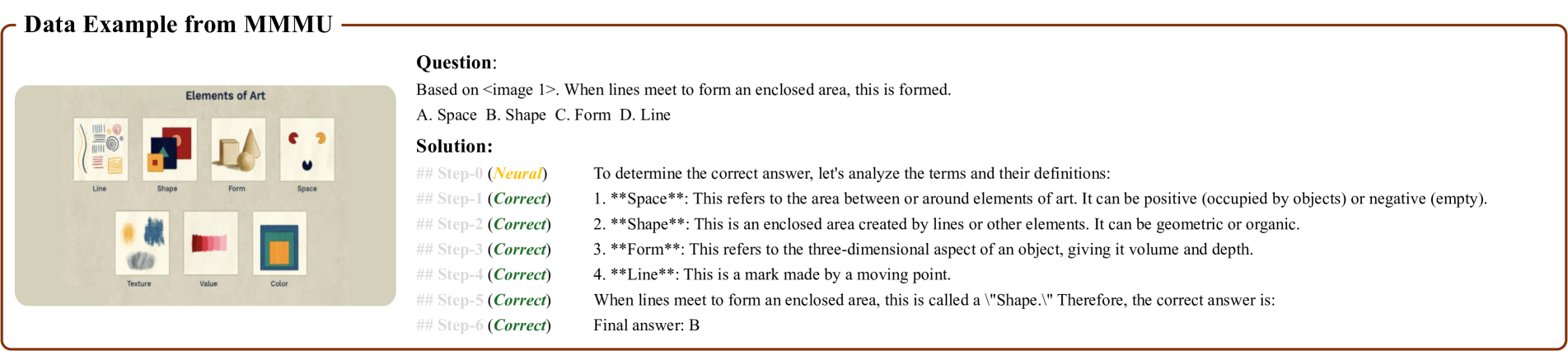
The image presents an educational diagram titled "Data Example from MMMU," focusing on the **Elements of Art**. It includes a question about geometric concepts and a step-by-step solution. The left side visually represents seven art elements (Line, Shape, Form, Space, Texture, Value, Color) with abstract examples, while the right side contains a multiple-choice question and its detailed solution.
---
### Components/Axes
- **Left Panel**:
- **Title**: "Elements of Art"
- **Visual Examples**:
1. **Line**: Abstract wavy and straight lines.
2. **Shape**: Geometric figures (triangle, square, circle).
3. **Form**: 3D objects (cube, sphere, cone).
4. **Space**: Negative/positive space interaction.
5. **Texture**: Patterns mimicking surfaces (e.g., fabric, stone).
6. **Value**: Gradient from light to dark.
7. **Color**: Primary colors (red, blue, yellow) with secondary hues.
- **Right Panel**:
- **Question**:
*"Based on <image 1>. When lines meet to form an enclosed area, this is formed."*
Options:
A. Space
B. Shape
C. Form
D. Line
- **Solution**:
Step-by-step breakdown of art element definitions:
1. **Space**: Area between/around elements (positive/negative).
2. **Shape**: Enclosed area created by lines (geometric/organic).
3. **Form**: 3D aspect of an object (volume/depth).
4. **Line**: Mark made by a moving point.
5. **Conclusion**: Enclosed area = "Shape" → Final answer: **B**.
---
### Detailed Analysis
- **Art Elements**:
- Each element is paired with a visual example (e.g., "Line" shows abstract strokes; "Color" uses primary/secondary hues).
- Definitions in the solution clarify distinctions (e.g., "Form" vs. "Shape" emphasizes 3D vs. 2D).
- **Question Logic**:
- The question tests recognition of geometric concepts.
- The solution methodically eliminates options by defining terms:
- **Space** (A) refers to spatial relationships, not enclosed areas.
- **Form** (C) implies 3D volume, not 2D boundaries.
- **Line** (D) is the tool, not the result.
---
### Key Observations
- **Correct Answer**: B (Shape) is explicitly justified by the definition of an enclosed area.
- **Visual-Textual Alignment**: The left panel’s "Shape" example (geometric figures) directly supports the textual explanation.
- **Step-by-Step Rigor**: The solution avoids ambiguity by defining all options before concluding.
---
### Interpretation
The diagram emphasizes foundational art theory, linking visual examples to abstract definitions. The question tests the ability to distinguish between spatial concepts (Space) and geometric constructs (Shape). By defining each term, the solution demonstrates critical reasoning:
- **Shape** is the only term describing a 2D enclosed area formed by lines.
- The diagram reinforces that art elements are interdependent (e.g., lines create shapes, which occupy space).
This structure aligns with pedagogical goals of clarifying abstract concepts through examples and definitions.