# Technical Document Extraction: Retrieval-Augmented Generation (RAG) Evolution Diagram
## Diagram Overview
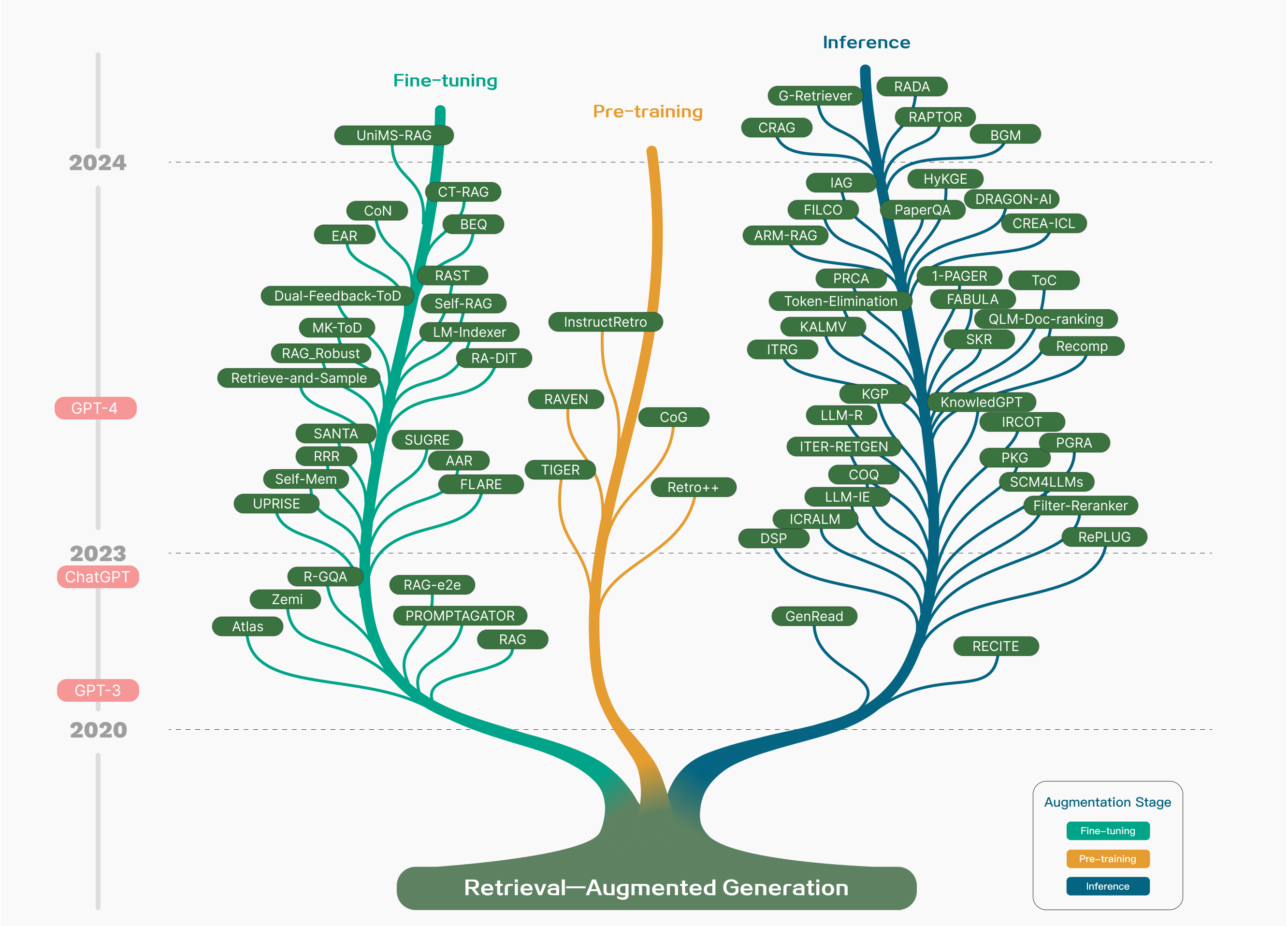
The image is a **tree diagram** illustrating the evolution of **Retrieval-Augmented Generation (RAG)** models across three stages: **Fine-tuning**, **Pre-training**, and **Inference**. The diagram spans four years (2020–2024) and categorizes models by their augmentation stage.
---
## Key Components
### 1. **Vertical Axis (Years)**
- **2020**: GPT-3
- **2023**: ChatGPT
- **2024**: GPT-4
### 2. **Horizontal Axis**
- **Title**: "Retrieval-Augmented Generation"
### 3. **Legend (Bottom Right)**
- **Fine-tuning**: Green
- **Pre-training**: Orange
- **Inference**: Blue
---
## Branch Analysis
### **A. Fine-tuning (Green Branch)**
- **Subcategories**:
- **UniMS-RAG**
- CT-RAG
- BEQ
- RAST
- Self-RAG
- **CoN**
- EAR
- Dual-Feedback-ToD
- MK-ToD
- **Retrieve-and-Sample**
- RAG_Robust
- SANTA
- RR
- Self-Mem
- UPRISER
- **RAG-e2e**
- PROMPTAGATOR
- **Atlas**
- Zemi
- R-GQA
### **B. Pre-training (Orange Branch)**
- **Subcategories**:
- **Raven**
- CoG
- **Tiger**
- Retro++
- **InstructRetro**
### **C. Inference (Blue Branch)**
- **Subcategories**:
- **G-Retriever**
- C-RAG
- **RAGA**
- RAPTOR
- BGM
- **HyKGE**
- DRAGON-AI
- CREA-ICL
- **Token-Eliminator**
- IAG
- FILCO
- ARM-RAG
- PRCA
- **1-PAGER**
- FABULA
- ToC
- **QLM-Doc-ranking**
- SKR
- Recomp
- **KnowledGPT**
- IR-COT
- PKG
- SCM4LLMs
- **Filter-Reranker**
- RePLUG
- **GenRead**
- RECI-TE
---
## Cross-Referenced Color Coding
- **Green (Fine-tuning)**: All subcategories under "Fine-tuning" are connected via green lines.
- **Orange (Pre-training)**: All subcategories under "Pre-training" are connected via orange lines.
- **Blue (Inference)**: All subcategories under "Inference" are connected via blue lines.
---
## Key Trends
1. **Temporal Progression**:
- Models evolve from **GPT-3 (2020)** to **GPT-4 (2024)**.
- New RAG variants emerge in each stage (e.g., UniMS-RAG in 2024).
2. **Stage Specialization**:
- **Fine-tuning** focuses on iterative improvements (e.g., Dual-Feedback-ToD, Self-RAG).
- **Pre-training** emphasizes foundational models (e.g., Raven, Tiger).
- **Inference** prioritizes deployment efficiency (e.g., RePLUG, GenRead).
3. **Model Complexity**:
- Subcategories branch into increasingly specialized variants (e.g., RAG_Robust → SANTA → Self-Mem).
---
## Diagram Flow
1. **Root**: "Retrieval-Augmented Generation" (central trunk).
2. **Branches**:
- **Green (Fine-tuning)**: Splits into subcategories like UniMS-RAG and Retrieve-and-Sample.
- **Orange (Pre-training)**: Splits into Raven, Tiger, and InstructRetro.
- **Blue (Inference)**: Splits into G-Retriever, RAGA, and KnowledGPT.
---
## Critical Notes
- **No Data Table**: The diagram uses branching structures instead of tabular data.
- **Text Embedding**: All model names (e.g., UniMS-RAG, RePLUG) are embedded directly in the branches.
- **Legend Accuracy**: Colors strictly align with the legend (green = Fine-tuning, orange = Pre-training, blue = Inference).
---
## Conclusion
This diagram maps the evolution of RAG models across three stages, highlighting specialization and temporal progression. The color-coded branches and year markers provide a clear visual representation of technical advancements from 2020 to 2024.