## Grid of Handwritten Digit Images
### Overview
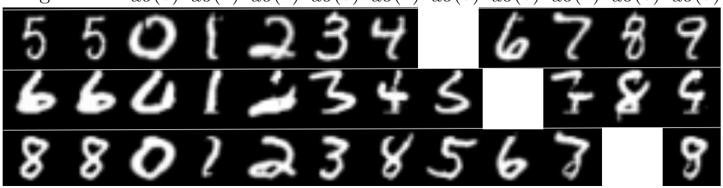
The image displays a grid of handwritten digits, presented as white strokes on a black background. The digits are arranged in three horizontal rows, each containing a sequence of individual digit samples. The image appears to be a visualization from a dataset (such as MNIST) or a machine learning context, showcasing variations in handwriting style for digits 0 through 9.
### Components/Axes
- **Layout**: The image is divided into three horizontal strips (rows). Each row contains a series of digit images placed side-by-side.
- **Grouping**: Within each row, the digits are split into two distinct groups separated by a noticeable gap (approximately one digit-width of empty space).
- **Digit Cells**: Each digit is contained within an implied rectangular cell. The digits are rendered in a pixelated, grayscale style typical of low-resolution digit datasets.
- **Labels/Text**: There are no explicit axis titles, legends, or numerical scales. The only textual content is the handwritten digits themselves.
### Detailed Analysis
**Row 1 (Top Strip):**
- **Left Group (7 digits)**: 5, 5, 0, 1, 2, 3, 4
- **Right Group (4 digits)**: 6, 7, 8, 9
- **Total Digits**: 11
- **Observations**: The first two digits are both '5' but exhibit different handwriting styles. The sequence progresses from 0 to 9, with '5' repeated and '6' through '9' placed in the right group.
**Row 2 (Middle Strip):**
- **Left Group (8 digits)**: 6, 6, 0, 1, 2, 3, 4, 5
- **Right Group (3 digits)**: 7, 8, 9
- **Total Digits**: 11
- **Observations**: The first two digits are both '6' with stylistic variation. The sequence includes all digits from 0 to 9, with '6' repeated and '7' through '9' in the right group.
**Row 3 (Bottom Strip):**
- **Left Group (10 digits)**: 8, 8, 0, 1, 2, 3, 8, 5, 6, 7
- **Right Group (1 digit)**: 8
- **Total Digits**: 11
- **Observations**: The first two digits are '8', and another '8' appears later in the left group. The sequence is less ordered, with digits 0, 1, 2, 3, 5, 6, 7, and multiple '8's. The right group contains a single '8'.
### Key Observations
1. **Intra-class Variation**: For digits that appear multiple times (e.g., '5' in Row 1, '6' in Row 2, '8' in Row 3), there are clear differences in handwriting style, stroke width, and shape.
2. **Grouping Pattern**: Each row consistently splits its digit sequence into a left group and a right group, with the gap position varying slightly. The right group generally contains the higher digits (6-9), but this is not strict (e.g., Row 3's right group has only '8').
3. **Digit Coverage**: All digits from 0 to 9 are present across the three rows, though not in a perfectly sequential order in each row.
4. **Visual Style**: The digits are low-resolution, anti-aliased, and appear to be normalized to a fixed size within their cells.
### Interpretation
This image likely serves as a qualitative demonstration of a handwritten digit dataset, emphasizing the natural variability in human writing. The grouping may represent different subsets, batches, or classes within the data. The repetition of certain digits (like '5', '6', '8') within a single row highlights the challenge for machine learning models to generalize across different writing styles for the same numeral. The lack of strict numerical order suggests the samples are randomly drawn or organized by some non-sequential criterion (e.g., writer ID, time of collection). For a technical document, this visualization underscores the importance of robust feature extraction and model training to handle such intra-class diversity in optical character recognition (OCR) or digit classification tasks.