\n
## Image: Handwritten Digit Samples
### Overview
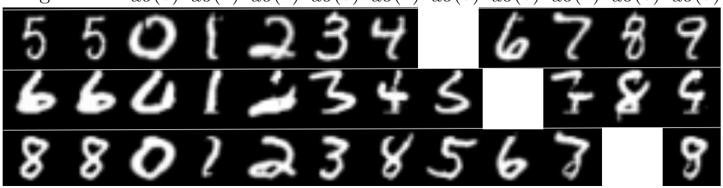
The image displays a grid of handwritten digits, likely used for training or testing a machine learning model for optical character recognition (OCR). The digits are presented in a 3x9 arrangement, with each cell containing a single digit. The background is black, and the digits are rendered in white.
### Components/Axes
There are no explicit axes or labels in the image. The arrangement suggests a simple grid structure. The digits themselves represent the data points.
### Detailed Analysis or Content Details
The image contains the following digits, arranged in a 3x9 grid (row by row):
* **Row 1:** 5, 5, 0, 1, 2, 3, 4, 6, 7, 8, 9
* **Row 2:** 6, 6, 0, 1, 2, 3, 4, 5, 7, 8, 9
* **Row 3:** 8, 8, 0, 1, 2, 3, 8, 5, 6, 7, 8
It's important to note that the handwriting style varies significantly between digits, and some digits are more clearly defined than others. Some digits appear multiple times (e.g., 0, 1, 2, 3, 5, 6, 8, 9).
### Key Observations
* The digit '0' appears three times.
* The digit '1' appears three times.
* The digit '2' appears three times.
* The digit '3' appears three times.
* The digit '5' appears twice.
* The digit '6' appears twice.
* The digit '8' appears three times.
* The digit '9' appears twice.
* The digit '4' appears twice.
* The digit '7' appears twice.
The variations in handwriting style suggest a diverse dataset, which is beneficial for training robust OCR models.
### Interpretation
The image represents a sample of handwritten digits, likely intended for use in a machine learning context. The purpose is to provide a dataset for training and evaluating algorithms that can recognize handwritten characters. The diversity in handwriting styles is a crucial aspect of this dataset, as it helps the model generalize to different writing styles and improve its accuracy. The presence of multiple instances of each digit ensures that the model has sufficient examples to learn from. The image itself doesn't provide any specific insights beyond the representation of these digits; its value lies in its potential use as training data. The image is a visual representation of data, but does not contain any data points beyond the digits themselves.