## Grid of Handwritten Digits
### Overview
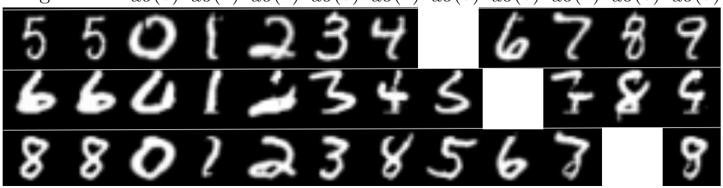
The image displays a 3x11 grid of handwritten digits (0-9) on a black background. Each cell contains a single digit rendered in white, with varying stroke thickness and style. The digits appear to be manually drawn, with some showing irregularities in form and alignment.
### Components/Axes
- **Grid Structure**: 3 rows × 11 columns
- **Content**: Handwritten digits (0-9) in white
- **Background**: Solid black
- **No explicit axes, legends, or labels** present in the image
### Detailed Analysis
**Row 1 (Top Row)**:
`5 5 0 1 2 3 4 6 7 8 9`
- Digits 0-9 appear once, except for two repetitions of "5" at the start.
- "0" is centered with a closed loop.
- "4" has a slightly open top stroke.
**Row 2 (Middle Row)**:
`6 6 0 1 2 3 4 5 7 8 9`
- Digits 0-9 appear once, except for two repetitions of "6" at the start.
- "6" has a thick lower loop.
- "5" has a curved top stroke.
**Row 3 (Bottom Row)**:
`8 8 0 1 2 3 8 5 6 7 8`
- Digits 0-9 appear once, except for three repetitions of "8" (positions 1, 2, 7, 11) and missing "4".
- "8" has a double-loop structure in some instances.
- "3" has a flat base.
### Key Observations
1. **Repetition Patterns**:
- First two digits in each row are repeated (e.g., "55", "66", "88").
- "8" appears four times in Row 3, the most frequent digit overall.
2. **Missing Digit**:
- "4" is absent in Row 3, breaking the 0-9 sequence.
3. **Stylistic Variations**:
- "0" and "6" show thicker strokes compared to other digits.
- "1" and "7" have inconsistent base alignment.
### Interpretation
This grid likely represents a test dataset for handwritten digit recognition systems (e.g., MNIST-like data). The repetitions and stylistic variations suggest an emphasis on robustness testing for algorithms. The missing "4" in Row 3 may indicate an intentional anomaly or data corruption. The consistent inclusion of all digits (except Row 3) implies a focus on comprehensive coverage for training/classification models. The irregularities in stroke thickness and alignment highlight challenges in real-world OCR systems dealing with human variability.