## Diagram: MemVerse Memory Framework
### Overview
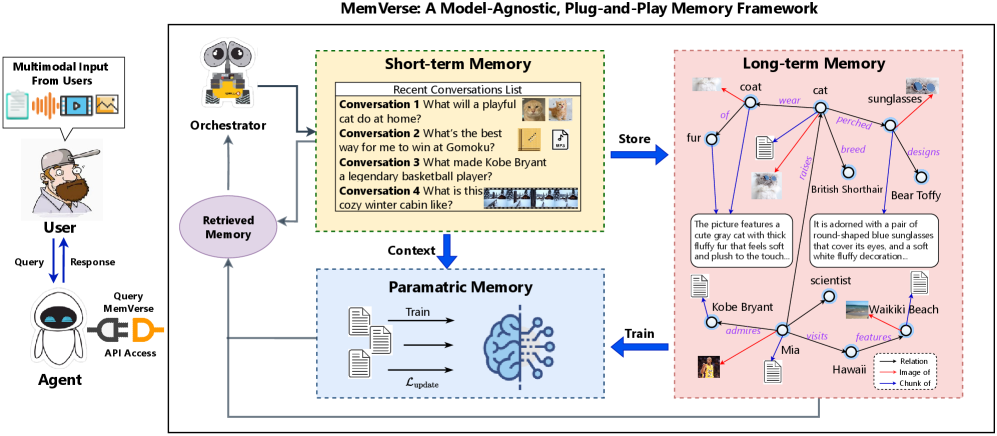
The image presents a diagram of the MemVerse memory framework, which is described as model-agnostic and plug-and-play. The diagram illustrates the flow of information between a user, an agent, and different types of memory (short-term, parametric, and long-term). It shows how multimodal inputs are processed and stored, and how context is used to train the parametric memory.
### Components/Axes
* **Title:** MemVerse: A Model-Agnostic, Plug-and-Play Memory Framework
* **User:** A cartoon depiction of a person labeled "User" who provides multimodal input (text, audio, video, image). The user sends a "Query" and receives a "Response."
* **Agent:** A cartoon depiction of a robot labeled "Agent" that accesses the MemVerse via "API Access" to process the user's query.
* **Orchestrator:** A cartoon depiction of a robot labeled "Orchestrator" that manages the flow of information between the user, agent, and memory modules.
* **Retrieved Memory:** An oval shape labeled "Retrieved Memory" that represents the memory retrieved by the orchestrator.
* **Short-term Memory:** A box with a dashed green border labeled "Short-term Memory." It contains a "Recent Conversations List" with four example conversations.
* Conversation 1: "What will a playful cat do at home?" (with an image of a cat)
* Conversation 2: "What's the best way for me to win at Gomoku?" (with an image of a document)
* Conversation 3: "What made Kobe Bryant a legendary basketball player?" (with an image of Kobe Bryant)
* Conversation 4: "What is this cozy winter cabin like?" (with an image of a winter cabin)
* **Context:** A downward arrow labeled "Context" that indicates the flow of information from short-term memory to parametric memory.
* **Parametric Memory:** A box with a dashed blue border labeled "Parametric Memory." It shows documents being used to "Train" a neural network. The update is labeled "L update".
* **Long-term Memory:** A box with a dashed red border labeled "Long-term Memory." It contains a knowledge graph with nodes representing concepts (e.g., coat, cat, sunglasses, fur, British Shorthair, Bear Toffy, Kobe Bryant, Waikiki Beach, Mia, Hawaii) and relations between them (e.g., "wear," "perched," "breed," "designs," "raises," "admires," "visits," "features").
* **Store:** An arrow labeled "Store" that indicates the flow of information from short-term memory to long-term memory.
* **Train:** An arrow labeled "Train" that indicates the flow of information from parametric memory to long-term memory.
* **Legend:** Located in the bottom-right corner of the "Long-term Memory" box.
* Relation: A solid black arrow.
* Image of: A dashed red arrow.
* Chunk of: A dotted blue arrow.
### Detailed Analysis or Content Details
* **User Interaction:** The user provides multimodal input, which is processed by the agent. The agent queries the MemVerse, and the orchestrator retrieves relevant information from memory.
* **Short-term Memory:** The short-term memory stores recent conversations, providing context for the agent's responses.
* **Parametric Memory:** The parametric memory is trained on the context from short-term memory, allowing it to learn patterns and relationships.
* **Long-term Memory:** The long-term memory stores a knowledge graph of concepts and relations, which is updated by both short-term and parametric memory.
* **Knowledge Graph Nodes and Relations:**
* coat -of-> fur
* cat -wear-> coat
* cat -perched-> sunglasses
* cat -breed-> British Shorthair
* sunglasses -designs-> Bear Toffy
* British Shorthair -raises-> The picture features a cute gray cat with thick fluffy fur that feels soft and plush to the touch...
* Bear Toffy -chunk of-> It is adorned with a pair of round-shaped blue sunglasses that cover its eyes, and a soft white fluffy decoration...
* Kobe Bryant -admires-> Mia
* scientist -chunk of-> Kobe Bryant
* Waikiki Beach -features-> Hawaii
* scientist -chunk of-> Waikiki Beach
* Mia -visits-> Hawaii
### Key Observations
* The MemVerse framework uses a combination of short-term, parametric, and long-term memory to process user queries.
* The short-term memory provides context, the parametric memory learns patterns, and the long-term memory stores a knowledge graph.
* The framework is designed to handle multimodal input, including text, audio, video, and images.
### Interpretation
The MemVerse framework is a sophisticated memory system that aims to provide a comprehensive and context-aware response to user queries. By integrating different types of memory, the framework can leverage both recent conversations and long-term knowledge to generate relevant and informative responses. The use of a knowledge graph in long-term memory allows the framework to represent complex relationships between concepts, while the parametric memory enables it to learn from new data and adapt to changing user needs. The diagram highlights the key components of the framework and how they interact to provide a seamless user experience.