## Diagram: MemVerse - A Model-Agnostic, Plug-and-Play Memory Framework
### Overview
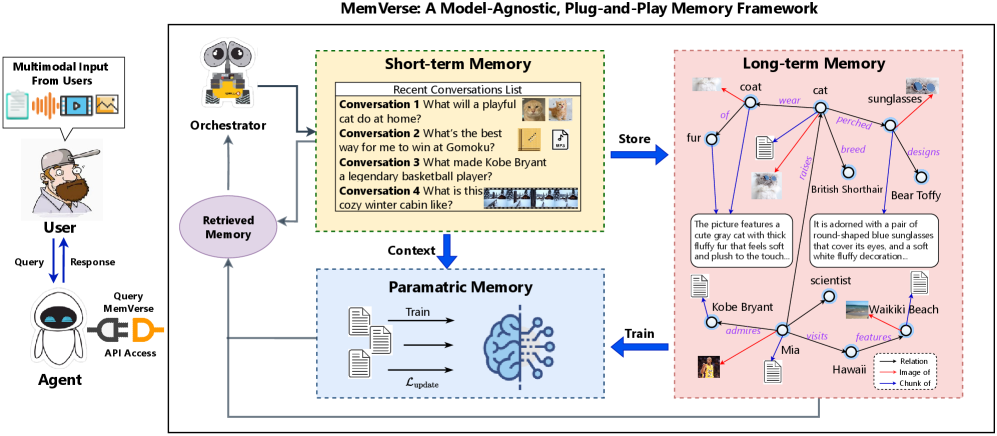
The image depicts a diagram illustrating the architecture of "MemVerse," a model-agnostic, plug-and-play memory framework. The diagram shows the interaction between a User, an Agent, and the MemVerse system, which is divided into Short-term Memory, Long-term Memory, and Parametric Memory. The diagram uses visual elements like icons, images, and a knowledge graph to represent the flow of information and the components of the system.
### Components/Axes
The diagram is divided into four main sections:
1. **Multimodal Input From Users:** Top-left corner, showing various input types (text, image, video, audio).
2. **MemVerse System:** The central and largest portion, divided into Short-term Memory (top-right), Long-term Memory (right), and Parametric Memory (bottom-center).
3. **User & Agent Interaction:** Left side, showing a User interacting with an Agent via Query and Response.
4. **Orchestrator:** Top-center, connecting the User and MemVerse.
The diagram also includes a legend in the bottom-right corner:
* **Relation:** Represented by a solid black line.
* **Image of:** Represented by a dashed black line.
* **Chunk of:** Represented by a dotted black line.
### Detailed Analysis or Content Details
**1. Multimodal Input From Users:**
* Icons representing various input modalities: text bubble, image, video camera, audio wave.
**2. Orchestrator:**
* An image of a robot (Eve from Wall-E) is used as the visual representation of the Orchestrator.
**3. User & Agent Interaction:**
* **User:** A stylized human figure.
* **Agent:** A robot icon.
* **Query:** A line with the label "Query" pointing from the Agent to MemVerse.
* **Response:** A line with the label "Response" pointing from MemVerse to the Agent.
* **API Access:** A small icon representing API access.
**4. Short-term Memory:**
* **Recent Conversations List:** A blue box containing four conversation snippets:
* Conversation 1: "What will a playful cat do at home?"
* Conversation 2: "What's the best way for me to win at Gomoku?"
* Conversation 3: "What made Kobe Bryant a legendary basketball player?"
* Conversation 4: "What is this cozy winter cabin like?"
* An image of a winter cabin.
* **Context:** A label indicating the context derived from the conversations and image.
* **Store:** A label indicating data is stored.
**5. Long-term Memory:**
* A knowledge graph representing relationships between concepts. Nodes include:
* cat
* coat
* sunglasses
* British Shorthair
* Bear Toffy
* fur
* wear
* breed
* designs
* perched
* Edges represent relationships like "wear," "fur," "breed," "designs," "perched."
* An image of a cat wearing sunglasses.
* Text description: "The picture features a cute gray cat with thick fluffy fur that feels soft and plush to the touch."
**6. Parametric Memory:**
* **Train:** A label indicating training data.
* An image of a brain with neural network connections.
* **L<sub>update</sub>:** A mathematical notation.
* Images of Kobe Bryant, Mia, Hawaii, Waikiki Beach, and a scientist.
* Text description: "It is adorned with a pair of round-shaped blue sunglasses that cover its eyes, and a soft white fluffy decoration."
* Relationships: Kobe Bryant "admires" Mia, Mia "visits" Hawaii, Hawaii "features" Waikiki Beach.
### Key Observations
* The system is designed to handle multimodal input.
* The Short-term Memory focuses on recent interactions, while the Long-term Memory stores more persistent knowledge.
* The Parametric Memory appears to be used for learning and updating the system's knowledge.
* The knowledge graph in Long-term Memory uses visual relationships to connect concepts.
* The diagram emphasizes the plug-and-play nature of the framework, suggesting modularity and flexibility.
### Interpretation
The diagram illustrates a sophisticated memory framework for AI agents. MemVerse aims to provide agents with a robust and flexible memory system capable of handling diverse input types and learning from interactions. The separation into Short-term, Long-term, and Parametric Memory allows for different types of knowledge storage and processing. The knowledge graph in Long-term Memory suggests a semantic understanding of concepts and their relationships. The use of images and text descriptions enhances the richness of the stored information. The Orchestrator acts as a central hub, managing the flow of information between the User, Agent, and the various memory components. The overall design suggests a system that can adapt and improve over time through learning and experience. The inclusion of specific examples (Kobe Bryant, Hawaii) suggests the system is capable of handling real-world knowledge and reasoning. The diagram is a high-level overview, and further details would be needed to understand the specific implementation and algorithms used within each component.