\n
## Diagram: Octree-GS Pipeline and Anchor Initialization
### Overview
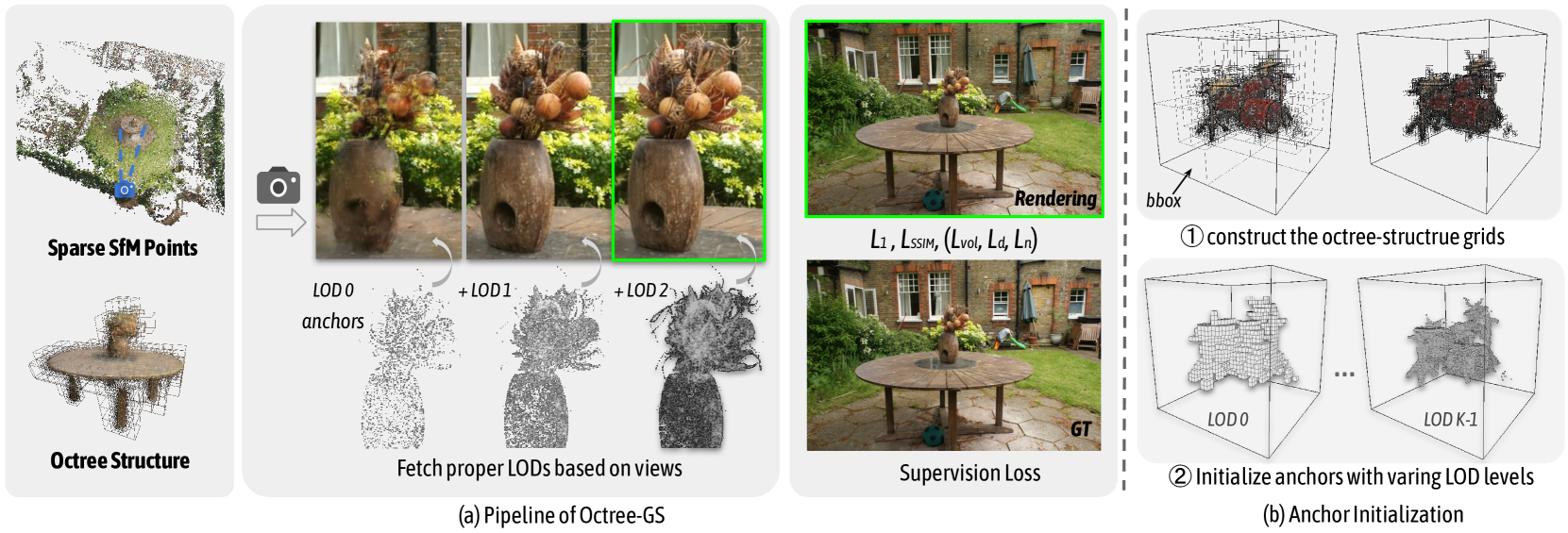
This diagram illustrates the pipeline of the Octree-GS method for generating and utilizing octree structures from sparse SfM points, along with the anchor initialization process. The diagram is divided into three main sections: the initial sparse point cloud and octree structure, the pipeline of Octree-GS, and the anchor initialization process.
### Components/Axes
The diagram consists of several labeled components:
* **Sparse SfM Points:** A point cloud representation of a scene.
* **Octree Structure:** A hierarchical tree-like data structure representing the scene.
* **Pipeline of Octree-GS:** A sequence of steps involving LOD (Level of Detail) fetching and supervision loss calculation.
* **Rendering:** The process of generating images from the 3D scene.
* **Supervision Loss:** A loss function used to guide the optimization process.
* **GT:** Ground Truth data.
* **bbox:** Bounding box.
* **L1, LSSIM (Lvol, Ld, Lt):** Loss function components.
* **Anchor Initialization:** A process for initializing anchors at varying LOD levels.
* **LOD0, LOD1, LOD2, LOD K-1:** Different levels of detail in the octree.
### Detailed Analysis or Content Details
**Section 1: Sparse SfM Points & Octree Structure (Left)**
* **Sparse SfM Points:** A dense cloud of points, colored in shades of green, representing a 3D reconstruction of a scene. A camera icon with a rotation indicator is positioned near the point cloud, suggesting viewpoint control.
* **Octree Structure:** A simplified, wireframe representation of the octree structure, showing a hierarchical decomposition of the scene.
**Section 2: Pipeline of Octree-GS (Center)**
This section shows a sequence of images demonstrating the pipeline:
1. **LOD 0 Anchors:** A sparse set of anchors at the lowest level of detail (LOD0).
2. **Fetch proper LODs based on views:** A series of progressively denser point clouds representing LOD1 and LOD2. The density of the point cloud increases from LOD0 to LOD2.
3. **Supervision Loss:** A rendered image of a table with chairs, overlaid with a grid representing the supervision loss. The text "Rendering" is positioned above the image. Below the image, the loss function components are listed: "L1, LSSIM (Lvol, Ld, Lt)". "GT" is also labeled at the bottom of the image.
**Section 3: Anchor Initialization (Right)**
This section illustrates the anchor initialization process:
1. **Construct the octree-structure grids:** A series of octree grids are shown, representing the hierarchical decomposition of the scene. The bounding box is labeled "bbox".
2. **Initialize anchors with varying LOD levels:** A sequence of anchor points at different LOD levels (LOD0 to LOD K-1) are shown. The complexity of the anchor points increases with the LOD level.
### Key Observations
* The pipeline progressively refines the level of detail (LOD) of the scene representation based on the viewpoint.
* The supervision loss is used to guide the optimization process, comparing the rendered image to the ground truth.
* Anchor initialization is performed at multiple LOD levels to provide a robust representation of the scene.
* The diagram visually demonstrates the hierarchical nature of the octree structure and its ability to represent scenes at varying levels of detail.
### Interpretation
The diagram illustrates a method for efficiently representing and rendering 3D scenes using octrees and level of detail (LOD) techniques. The pipeline starts with a sparse point cloud and progressively refines the representation based on the viewpoint, using a supervision loss to ensure accuracy. The anchor initialization process provides a robust representation of the scene at multiple LOD levels. This approach is likely designed to balance rendering quality and computational efficiency, allowing for real-time or near-real-time rendering of complex scenes. The use of a supervision loss suggests a learning-based approach, where the octree structure and LOD selection are optimized based on training data. The diagram highlights the key components and flow of the Octree-GS method, providing a clear understanding of its underlying principles.