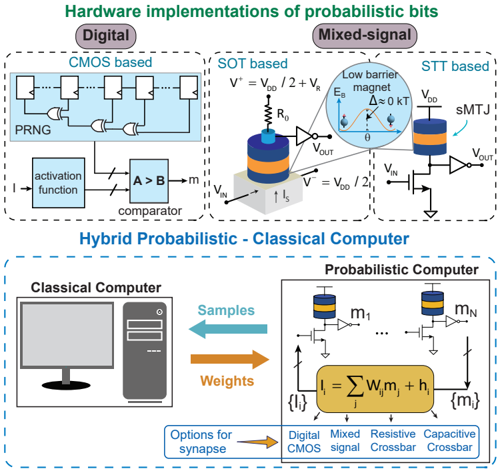
## Diagram: Hardware Implementations of Probabilistic Bits and Hybrid Probabilistic-Classical Computer System
### Overview
The image presents a comparative analysis of hardware implementations for probabilistic bits (P-bits) and a hybrid system integrating probabilistic and classical computing. It includes three distinct hardware architectures (CMOS-based, SOT-based, STT-based) and a conceptual hybrid system diagram.
### Components/Axes
#### Top Section: Hardware Implementations of Probabilistic Bits
1. **CMOS-based Implementation**
- **Components**:
- PRNG (Pseudo-Random Number Generator)
- Activation Function
- Comparator (A > B)
- Digital Signal Path (labeled "I" for input)
- **Key Labels**:
- "Digital" (top-left)
- "CMOS based" (center-left)
2. **SOT-based Implementation**
- **Components**:
- Voltage Source (V = V₀/2)
- Resistor (R)
- Low Barrier Magnet (Δ = 0 kT)
- Output Voltage (V_OUT)
- **Key Labels**:
- "SOT based" (center)
- "Mixed-signal" (top-right)
3. **STT-based Implementation**
- **Components**:
- Voltage Source (V₀)
- SMTJ (Spin-Transfer Torque Junction)
- Output Voltage (V_OUT)
- **Key Labels**:
- "STT based" (center-right)
#### Bottom Section: Hybrid Probabilistic-Classical Computer
1. **Classical Computer**
- **Components**:
- Computer Monitor
- Server/Workstation (labeled "Classical Computer")
- **Data Flow**:
- Arrows labeled "Samples" (blue) and "Weights" (orange) pointing to the probabilistic computer.
2. **Probabilistic Computer**
- **Components**:
- Magnetic Elements (m₁, m_N)
- Summation Block (ΣW_j m_j + h)
- Output (I = ΣW_j m_j + h)
- **Synapse Options**:
- Digital
- CMOS
- Mixed Signal
- Resistive Crossbar
- Capacitive Crossbar
### Detailed Analysis
- **CMOS-based**: Purely digital implementation using PRNG for randomness, activation function for processing, and comparator for decision-making.
- **SOT-based**: Mixed-signal analog/digital hybrid using spin-orbit torque (SOT) for probabilistic bit generation, with explicit voltage/resistance parameters (Δ = 0 kT).
- **STT-based**: Spin-transfer torque junction (SMTJ) for probabilistic bit manipulation, emphasizing magnetic domain switching.
- **Hybrid System**: Classical computer provides samples/weights to probabilistic computer, which processes via magnetic elements and summation logic. Synapse options suggest flexibility in interconnect technology.
### Key Observations
1. **Technology Spectrum**:
- CMOS (digital) vs. SOT/STT (analog/magnetic) implementations represent a continuum from digital to analog probabilistic computing.
2. **Hybrid Architecture**:
- Classical computer handles deterministic tasks (samples/weights), while probabilistic computer manages stochastic computations (magnetic elements, summation).
3. **Synapse Flexibility**:
- Multiple crossbar technologies (resistive/capacitive) indicate adaptability in probabilistic computing hardware.
### Interpretation
The diagram illustrates a transition from traditional digital computing (CMOS) to emerging analog/magnetic technologies (SOT/STT) for probabilistic computing. The hybrid system suggests a future where classical and probabilistic computers collaborate, with the probabilistic unit handling uncertainty-driven tasks (e.g., optimization, sampling) while the classical system manages structured data. The explicit labeling of synapse options (resistive/capacitive crossbars) highlights ongoing research into energy-efficient interconnects for such systems. Notably, the absence of numerical performance metrics (e.g., speed, power consumption) leaves the relative efficiency of each implementation open to interpretation, emphasizing conceptual rather than quantitative comparison.