## Diagram: Neural Network Architecture Block Diagram
### Overview
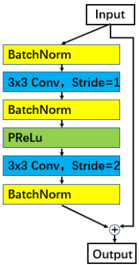
The image depicts a simplified block diagram of a neural network architecture, illustrating the sequence of layers and operations applied to an input signal. The diagram uses color-coded blocks to represent different operations, with arrows indicating data flow.
### Components/Axes
- **Input**: Labeled "Input" at the top-left, feeding into the first layer.
- **Layers**:
1. **BatchNorm** (yellow block): Batch normalization operation.
2. **3x3 Conv, Stride=1** (blue block): 3x3 convolutional layer with stride 1.
3. **BatchNorm** (yellow block): Second batch normalization.
4. **PReLu** (green block): Parametric Rectified Linear Unit activation function.
5. **3x3 Conv, Stride=2** (blue block): 3x3 convolutional layer with stride 2 (downsampling).
6. **BatchNorm** (yellow block): Third batch normalization.
- **Output**: Labeled "Output" at the bottom-right, receiving summed input from the final BatchNorm layer.
- **Arrows**: Black arrows indicate data flow direction. A "+" symbol at the output suggests element-wise summation (likely residual connection).
### Detailed Analysis
- **Color Coding**:
- Yellow: BatchNorm layers (3 instances).
- Blue: Convolutional layers (2 instances).
- Green: PReLu activation (1 instance).
- **Stride Values**:
- First Conv layer: Stride=1 (no downsampling).
- Second Conv layer: Stride=2 (halves spatial dimensions).
- **Residual Connection**: The "+" symbol at the output implies a skip connection, common in ResNet-style architectures.
### Key Observations
1. **Downsampling**: The second Conv layer (Stride=2) reduces spatial resolution, typical for feature extraction in deeper networks.
2. **Normalization**: BatchNorm layers are interspersed between Conv and activation layers, stabilizing training.
3. **Activation**: PReLu (green) introduces non-linearity after the second BatchNorm.
### Interpretation
This architecture likely represents a **feature extraction block** for tasks like image classification or object detection. The residual connection (output summation) suggests it may be part of a ResNet-inspired design, enabling deeper networks by mitigating vanishing gradients. The use of BatchNorm and PReLu indicates an emphasis on training stability and non-linear feature learning. No numerical data (e.g., weights, dimensions) is provided, so the diagram focuses on structural relationships rather than quantitative analysis.