## Diagram: Data Flow Architecture with Resource Allocation
### Overview
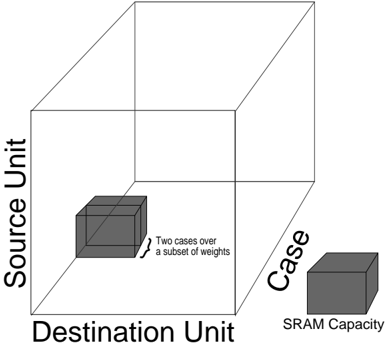
The diagram illustrates a data processing architecture involving two primary units (Source Unit and Destination Unit) and an external resource labeled "Case" with associated "SRAM Capacity." A smaller box within the Source Unit contains text indicating "Two cases over a subset of weights," suggesting resource allocation or processing prioritization.
### Components/Axes
- **Source Unit**: A large rectangular box labeled on the left side, containing a smaller nested box.
- **Destination Unit**: An empty rectangular box labeled on the right side, positioned opposite the Source Unit.
- **Case**: A standalone box outside the Source Unit, labeled "Case" with "SRAM Capacity" written below it.
- **Textual Elements**:
- "Two cases over a subset of weights" (inside the Source Unit's nested box).
- "SRAM Capacity" (below the external Case box).
### Detailed Analysis
- **Source Unit**: Contains a nested box with text specifying "Two cases over a subset of weights." This implies the Source Unit processes or manages two instances ("cases") distributed across a specific selection of weights, possibly indicating prioritization or resource partitioning.
- **Destination Unit**: Empty, suggesting it receives processed data or results from the Source Unit but does not perform active processing.
- **Case**: Positioned externally, labeled with "SRAM Capacity," which may represent additional storage or computational resources allocated to handle specific tasks or overflow.
### Key Observations
1. The Source Unit processes data involving "two cases" over a subset of weights, while the Destination Unit remains unoccupied, possibly awaiting output.
2. The external "Case" with SRAM Capacity is disconnected from the main flow, suggesting it serves as auxiliary storage or a specialized processing unit.
3. No numerical values or quantitative data are provided, limiting trend analysis.
### Interpretation
The diagram likely represents a system where the Source Unit handles weighted data processing (e.g., machine learning model inference or resource allocation), with prioritization of two specific cases. The Destination Unit acts as a passive receiver, while the external "Case" with SRAM Capacity may store intermediate results or manage memory constraints. The absence of numerical data prevents quantitative analysis but emphasizes architectural relationships: the Source Unit’s nested processing, the Destination Unit’s role as an endpoint, and the external Case’s auxiliary function. The phrase "subset of weights" hints at optimization strategies, such as focusing computational resources on critical data subsets.