## Logic Puzzle: Syllogistic Deduction
### Overview
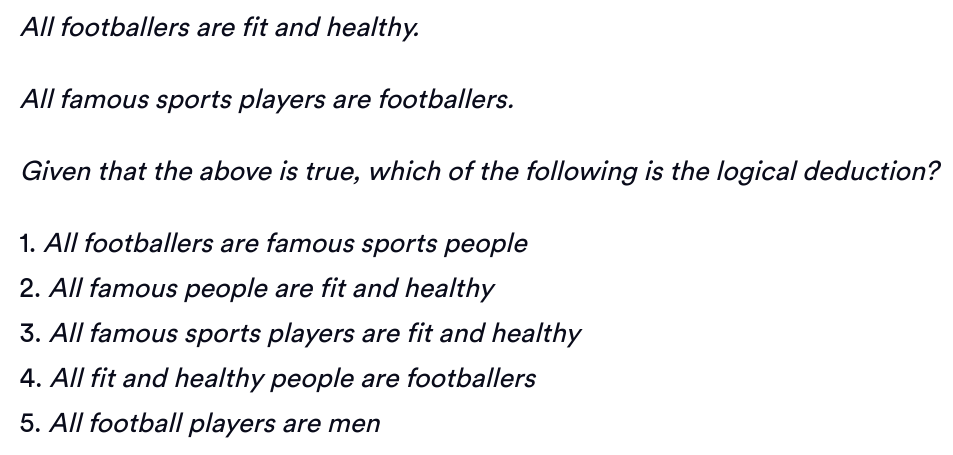
The image contains a text-based logic puzzle (a syllogism). It presents two premises and asks the reader to identify the correct logical deduction from a list of five provided options.
### Components
The content is structured as follows:
* **Premise 1:** "All footballers are fit and healthy."
* **Premise 2:** "All famous sports players are footballers."
* **Question:** "Given that the above is true, which of the following is the logical deduction?"
* **Options:** A list of five potential conclusions.
### Detailed Analysis
The text in the image is transcribed below:
"All footballers are fit and healthy."
"All famous sports players are footballers."
"Given that the above is true, which of the following is the logical deduction?"
"1. All footballers are famous sports people"
"2. All famous people are fit and healthy"
"3. All famous sports players are fit and healthy"
"4. All fit and healthy people are footballers"
"5. All football players are men"
### Key Observations
* **Logical Structure:** The puzzle uses the transitive property of sets.
* Let **F** = Footballers
* Let **H** = Fit and healthy people
* Let **S** = Famous sports players
* **Premise 1:** All F are H ($F \subseteq H$)
* **Premise 2:** All S are F ($S \subseteq F$)
* **Chain:** Since all S are F, and all F are H, it follows that all S are H.
### Interpretation
The correct logical deduction is **Option 3: "All famous sports players are fit and healthy."**
**Reasoning:**
* **Option 1** is incorrect because it assumes the converse of Premise 2 (that all footballers are famous sports players), which is not supported by the premises.
* **Option 2** is incorrect because "famous people" is a category not introduced in the premises; we only know about "famous sports players."
* **Option 3** is correct because it follows the transitive property: If $S \subseteq F$ and $F \subseteq H$, then $S \subseteq H$.
* **Option 4** is incorrect because it assumes the converse of Premise 1 (that all fit and healthy people are footballers), which is a logical fallacy.
* **Option 5** is incorrect because the gender of football players is not mentioned in the premises.